Section 13 — Modern slavery
13.1 Introduction
Modern slavery is all around us, often hidden in plain sight. People can be forced into situations of slavery, such as when making our clothes, serving our food, picking our crops, working in factories, or working in houses as cooks, cleaners or nannies. Individuals subjected to modern slavery are in situations of exploitation they cannot refuse or leave because of factors such as violence or threats, inescapable debt, or having their passport taken away and threatened with deportation. Many people end up in these situations while trying to escape poverty or insecurity, improve their lives and support their families.1
In Australia, modern slavery is an umbrella term used to describe a range of extreme exploitative practices including:
-
trafficking in persons
-
slavery, and
-
slavery-like practices, including forced labour, forced marriage servitude, debt bondage and deceptive recruiting for labour or services.
Australia is not immune from modern slavery. It can occur in both public or private sectors, including industries such as agriculture, construction, domestic work, sex work, cleaning, hospitality, and food services.2
The most common forms of modern slavery reported to the Australian Federal Police (AFP) include forced marriage (including child marriage), and trafficking (including entry, exit and child trafficking).3 As the 12th largest economy in the world, Australia is also exposed to the risk of modern slavery through the products it imports. Australia is estimated to import US$17.4 billion products at-risk of being made using forced labour annually.4
Modern slavery crimes persist due to a range of root causes and drivers such as: poverty; underemployment and unemployment; displacement due to conflict or natural disasters; discrimination and marginalisation, including gender inequality; weak rule of law; lack of education, opportunities and access to resources; and poor workplace conditions.5
The purpose of this resource is to:
-
highlight modern slavery issues, including identification of vulnerable groups and the types of cases that are likely to arise in NSW courts
-
provide guidance about how judicial officers may take account of this information in court — from the start to the conclusion of court proceedings. This guidance is not intended to be prescriptive.
13.2 Modern slavery — prevalence and vulnerable groups
13.2.1 Prevalence of modern slavery in Australia
-
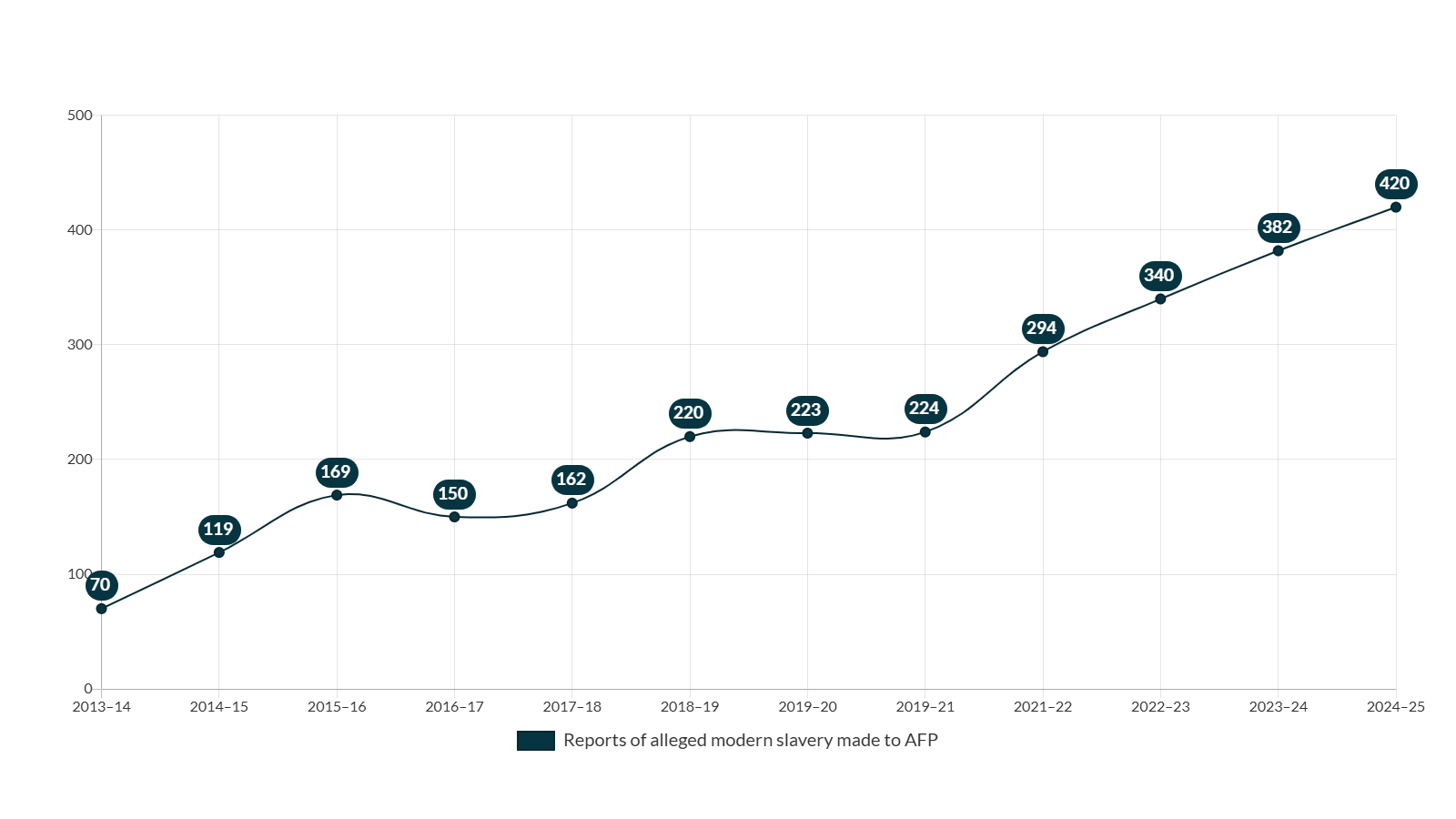
Modern slavery is underreported globally and domestically. In the 2024–2025 financial year, the Australian Federal Police (AFP) received 420 reports of modern slavery. This represents an increase of 10% on the previous financial year, reflective of a consistent year-on-year upward trend.6 See Figure 2 below for a chart representing reports of alleged modern slavery made to the AFP, 2013–2014 to 2024–2025.
-
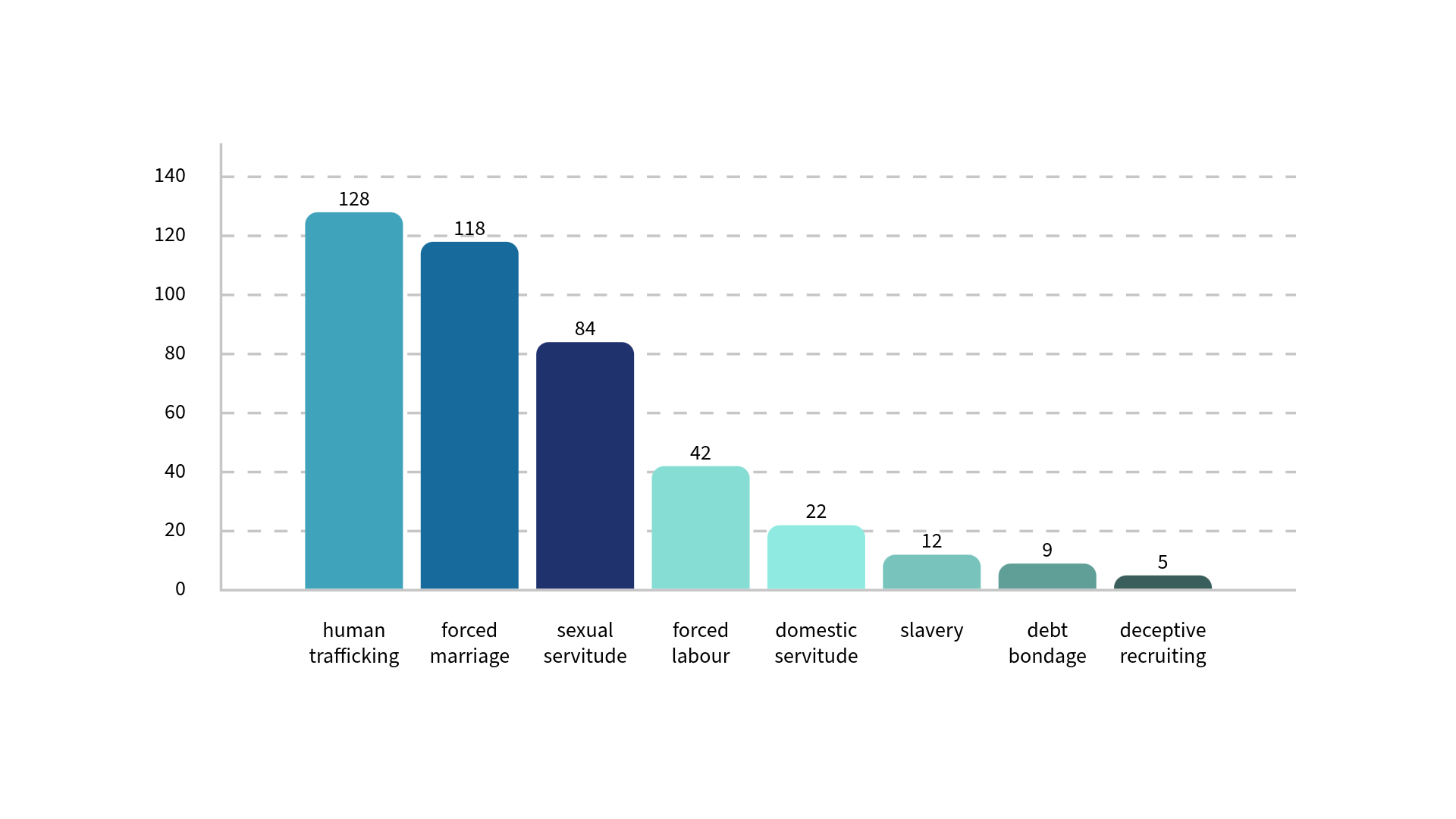
Modern slavery offences referred to the AFP in 2024–2025 were: trafficking in persons — inclusive of exit trafficking, child trafficking and domestic trafficking (128 reports); forced marriage (118 reports); sexual servitude (84 reports); forced labour (42 reports); domestic servitude (22 reports); slavery (12 reports); debt bondage (9 reports); and deceptive recruitment (5 reports).7 See Figure 3 below.
-
Due to the hidden nature of these crimes, it is estimated that for every victim-survivor detected by authorities in Australia, four remain undetected. This means that 80% of victims do not get the support they need and remain in slavery. The cases identified by authorities are likely to be a small proportion of the scale of trafficking and slavery in Australia.8
-
In contrast to formal reports, the 2023 Global Slavery Index estimates that on any given day in 2021, there were 41,000 individuals living in modern slavery in Australia. This equates to 1.6 people in modern slavery for every 1,000 people in the country.9 Of those, 40% are estimated to be in NSW.10
-
Women and girls are disproportionately vulnerable to modern slavery, accounting for approximately 71% of all victim-survivors worldwide.11
Concurrent crises like the COVID-19 pandemic, climate change and armed conflict are contributing to poverty, unemployment, lack of education, unsafe migration pathways, gender inequality and gender-based violence and increasing the risk of modern slavery in Australia and globally.15
13.2.2 Prevalence of modern slavery in NSW
New South Wales Anti-slavery Commissioner, Dr James Cockayne, states:16
Modern slavery remains dangerously undetected and unexposed in New South Wales, creating real risks of harm to the State’s reputation, economy and public health.
-
Historically, most survivors of human trafficking and slavery have been identified in the two most populous States of NSW and Victoria.17 Between 2009–2017, 98 victims of human trafficking living in NSW were identified. However, due to underreporting the actual numbers of people in modern slavery living in NSW may be much higher. Since 2009, authorities in NSW have identified 42% of people experiencing modern slavery have been subjected to various forms of exploitation, 43% have been exploited in the sex work industry, and 15% subject to forced marriage.18
-
The Office of the NSW Anti-slavery Commissioner states, according to the best survey-based estimate available, there are 16,400 people in the State who are victim-survivors of modern slavery.19 Of those, an estimated 80–98% of victim-survivors remain unidentified.20
-
Those modern slavery cases are estimated to ultimately cost NSW significant sums of money in terms of three factors:
-
in anticipation (expenditure on protective and preventative measures)
-
consequentially, including physical and emotional harms, lost time and output, health and victim services
-
in response, including police costs and costs to the criminal justice system.21
-
13.2.3 Vulnerable groups
Factors that make people vulnerable to modern slavery include governance issues, lack of basic needs, inequality, disenfranchisement, and the effects of conflict.22 Consequently, those at greater risk of modern slavery in Australia are those who are more affected by these factors, such as women, children, refugees and asylum seekers, migrants, backpackers, international students and those in occupations with low visibility or legal protection, as well as homeless youth, those living in segregated disability accommodation and those living with drug and alcohol abuse, to name a few.23 Australia is also a known destination country for victims of human trafficking and slavery, primarily from South Asia, the Middle East, and more recently, the Pacific Region.24
Forced marriage has historically been the most frequent report to the AFP, although trafficking in persons was the most common in the 2023–2024 financial year.25 Forced marriage can occur within NSW, as well as individuals trafficked out of NSW to a foreign country for a marriage to which they did not consent.26 While most reported victims are young women and girls, men and boys can also be victim-survivors of forced marriage. Those who experience forced marriage often come from households with strong traditional and cultural beliefs, where there is intense pressure to conform, leading to limited personal autonomy.27
Migrant workers are particularly at risk of modern slavery and are sometimes subjected to poor working conditions such as underpayment or non-payment of wages, and fraudulent contracting through third-party labour hire arrangements.28 This includes those working on short-term projects such as construction or seasonal work, as historically there have been few resources dedicated to monitoring, training and the management of human rights issues and workers’ rights.29
Backpackers, international students and asylum seekers in Australia are also particularly vulnerable as they may lack of awareness of Australian workplace laws and legal protections, and may also be in rural, regional and remote locations with limited access to support.30 Jobs that have lower barriers to entry such as cleaning, security, catering, transport and maintenance may be more accessible to migrants, and those from low socio-economic or culturally and linguistically diverse backgrounds.31
The Department of Home Affairs estimates about 70,000 people live in Australia unlawfully, many arriving on student or visitor visas. Undocumented workers, sought by employers to avoid compliance with Australian labour law, are among the most vulnerable cohort in Australia due to the fear of arrest or deportation or unfavourable outcomes as a non-citizen if they were to seek assistance from authorities.32
Some businesses operating in Australia have been exposed as exploiting vulnerable workers including foreign students and migrants, sometimes systemically, either through their own operations or their supply chains.33
The Australian Government’s Targeted review (Findings Report)34 has also identified people with disabilities as facing unique vulnerabilities that increase the risk of modern slavery. These vulnerabilities include dependency on care givers, barriers to getting help and a lack of awareness of the right to refuse unwanted touch and exploitive labour.35 See Equality Before the Law Bench Book, “Section 5 — People with disabilities” for more information on this topic.
Vulnerable and marginalised populations face additional difficulties to reporting their experience of harm: language, level of education and literacy, visa insecurity and disability may all contribute.36
13.3 Australia’s regulatory response to modern slavery
13.3.1 Overview
Australia’s legislative response to modern slavery includes the respective Commonwealth and NSW Modern Slavery Acts37 along with offences created in State and Territory criminal legislation. In NSW, the response incorporates NSW and Commonwealth legislation regulating offences as well as a transparency framework directed to due diligence in procurement processes and reporting obligations of certain public organisations (NSW) and public and private organisations (Commonwealth). The transparency framework is provided by the respective NSW and Commonwealth Modern Slavery Acts and is discussed further at 13.5.
The relevant offence provisions are found in the Commonwealth Criminal Code Act 1995 (Criminal Code), Div 270 (“Slavery and slavery-like offences”) and 271 (“Trafficking in persons”) and the Crimes Act 1900 (NSW) along with several other key instruments addressing human trafficking and slavery. A summary of these offences is set out in Table 1 below.
Note that modern slavery offences (slavery, slavery-like offences and offences relating to trafficking in persons and organ trafficking) pre-date enactment of both the Commonwealth and NSW Modern Slavery Acts.
13.3.1.1 Table 1 — Modern slavery offences
Table 1 provides a summary of Commonwealth and NSW modern slavery offences as defined in s 5(1) and set out in Sch 2 to the Modern Slavery Act 2018 (NSW) (hereafter MSA (NSW)).
Also included in Table 1 (shaded in grey) are:
-
offences for harbouring a victim criminalised in ss 271.7F and 271.7G of the Criminal Code. While not included as a modern slavery offence in Sch 2 of the MSA (NSW), these offences are contained in the Criminal Code under Div 271 — Trafficking in persons. See further 13.4.10.
-
Migration Act 1958 (Cth) aggravated offences: ss 245AD(1), (2), 245AEB(1), (2). The Migration Act provides offences for allowing an unlawful or lawful non-citizen to work in breach of work-related visa conditions. The offences are escalated to aggravated offences if the worker is being exploited and the person knows of, or is reckless to, that circumstance (Category B offences).38
| Crimes Act 1900 (NSW) | |||
|---|---|---|---|
| Section | Offence | Maximum penalty | Extended jurisdiction39 |
|
80D(1) |
Causing sexual servitude See 13.4.3 |
15 years |
MSA (NSW), s 4 |
|
80D(2) |
Causing sexual servitude in circumstances of aggravation (s 80C)40 See 13.4.3 |
20 years |
MSA (NSW), s 4 |
|
80E(1) |
Conduct of business involving sexual servitude See 13.4.3 |
15 years |
MSA (NSW), s 4 |
|
80E(2) |
Conduct of business involving sexual servitude in circumstances of aggravation (s 80C)41 See 13.4.3 |
19 years |
MSA (NSW), s 4 |
|
91G(1) and (2) |
Children not to be used for production of child abuse material See 13.4.7 |
14 years (where victim is under 14) 10 years (where victim is 14 or above) |
MSA (NSW), s 4 |
|
91G(3) |
Children not to be used for production of child abuse material in circumstances of aggravation42 See 13.4.7 |
20 years |
MSA (NSW), s 4 |
|
91H |
Production, dissemination or possession of child abuse material See 13.4.7 |
10 years |
MSA (NSW), s 4 |
|
91HAA |
Administering a digital platform used to deal with child abuse material See 13.4.7 |
14 years |
MSA (NSW), s 4 |
|
93AB |
Slavery, servitude and child forced labour See 13.4.3 |
25 years |
MSA (NSW), s 4 |
|
93AC |
Child forced marriage See 13.4.5 |
9 years |
MSA (NSW), s 4 |
| Human Tissue Act 1983 (NSW) | |||
|---|---|---|---|
| Section | Offence | Maximum penalty | Extended jurisdiction39 |
|
32 (but only in relation to tissue that is an organ) |
Trading in tissue prohibited See 13.4.9 |
40 penalty units43 or 6 months or both |
|
| Criminal Code Act 1995 (Cth) | |||
|---|---|---|---|
| Section | Offence | Maximum penalty | Extended jurisdiction39 |
|
270.3 |
Slavery offences See 13.4.2 |
25 years (s 270.3(1) slave trading) 17 years (s 270.3(2) commercial transaction involving a slave) |
Category D (ss 15.4, 270.3A) |
|
270.5 |
Servitude offences See 13.4.3 |
15 years |
Category B (ss 15.2, 270.9) |
|
270.5 |
Aggravated servitude offences (if conditions met under s 270.8)44 See 13.4.3 |
20 years |
Category B (ss 15.2, 270.9) |
|
270.6A |
Forced labour offences See 13.4.3 |
9 years |
Category B (ss 15.2, 270.9) |
|
270.6A |
Aggravated forced labour offences (if conditions met under s 270.8)45 See 13.4.3 |
12 years |
Category B (ss 15.2, 270.9) |
|
270.7 |
Deceptive recruiting for labour or services See 13.4.4 |
7 years |
Category B (ss 15.2, 270.9) |
|
270.7 |
Aggravated deceptive recruiting for labour or services (if conditions met under s 270.8)46 See 13.4.4 |
9 years |
Category B (ss 15.2, 270.9) |
|
270.7B |
Forced marriage offences See 13.4.5 |
7 years |
Category B (s 270.9) |
|
270.7B |
Aggravated forced marriage offences (if conditions met under s 270.8)47 See 13.4.5 |
9 years |
Category B (s 270.9) |
|
270.7C |
Offence of debt bondage See 13.4.6 |
4 years |
Category B (s 270.9) |
|
270.7C |
Aggravated offence of debt bondage (if conditions met under s 270.8)48 See 13.4.6 |
7 years |
Category B (s 270.9) |
|
271.2 |
Offence of trafficking in persons See 13.4.8 |
12 years |
Category B (s 271.10) |
|
271.3 |
Trafficking in persons — aggravated offence See 13.4.8 |
20 years |
Category B (s 271.10) |
|
271.4 |
Offence of trafficking in children See 13.4.8 |
25 years |
Category B (s 271.10) |
|
271.5 |
Offence of domestic trafficking in persons See 13.4.8 |
12 years |
s 271.11 requirements |
|
271.6 |
Domestic trafficking in persons — aggravated offence See 13.4.8 |
20 years |
s 271.11 requirements |
|
271.7 |
Offence of domestic trafficking in children See 13.4.8 |
25 years |
s 271.11 requirements |
|
271.7B |
Offence of organ trafficking — entry into and exit from Australia See 13.4.9 |
12 years |
Category B (s 271.10) |
|
271.7C |
Organ trafficking — aggravated offence See 13.4.9 |
25 years (aggravated offence — victim under 18) 20 years (aggravated offence) |
Category B (s 271.10) |
|
271.7D |
Offence of domestic organ trafficking See 13.4.9 |
12 years |
s 271.11 requirements |
|
271.7E |
Domestic organ trafficking — aggravated offence See 13.4.9 |
25 years (aggravated offence — victim under 18) 20 years (aggravated offence) |
s 271.11 requirements |
|
271.7F49 |
Harbouring a victim See 13.4.10 |
4 years |
Category B (s 271.10) |
|
271.7G |
Harbouring a victim — aggravated offence See 13.4.10 |
7 years (aggravated offence — victim under 18) |
Category B (s 271.10) |
| Migration Act 1958 (Cth) | |||
|---|---|---|---|
| Section | Offence | Maximum penalty | Extended jurisdiction39 |
|
245AD(1) |
Allowing an unlawful non-citizen to work in breach of a work-related condition |
5 years or 900 penalty units, or both (aggravated offence) |
Category B (s 271.10) |
|
245AD(2) |
Allowing a lawful non-citizen to work in breach of a work-related condition |
5 years or 900 penalty units, or both (aggravated offence) |
Category B (s 271.10) |
|
245AEB(1) |
Referring an unlawful non-citizen for work in breach of a work-related condition |
5 years or 900 penalty units, or both (aggravated offence) |
Category B (s 271.10) |
|
245AEB(2) |
Referring a lawful non-citizen for work in breach of a work-related condition |
5 years or 900 penalty units, or both (aggravated offence) |
Category B (s 271.10) |
The following provisions also apply as follows:50
-
Crimes Act 1914 (Cth)
-
provides protections for people in modern slavery when giving evidence and allows a court to order that offenders make reparations to victims: Pt IAD.
-
-
Migration Act 1958 (Cth)
-
creates offences relating to sham or contrived marriages: ss 237–245.
-
-
Fair Work Act 2009 (Cth)
-
empowers the Fair Work Ombudsman to enforce compliance with the Fair Work Act: Pt 5.2.
-
-
Marriage Act 1961 (Cth)
-
creates offences for marrying a person or solemnising or going through a ceremony of marriage with a person who is not of marriageable age: ss 95, 100, 101, 103.
-
-
Proceeds of Crime Act 2002 (Cth), Confiscation of Proceeds of Crime Act 1989 (NSW) and Criminal Assets Recovery Act 1990 (NSW)51
-
provides schemes for tracing, restraining and confiscating the proceeds of crime, including for trafficking and slavery.
-
-
Victims Rights and Support Act 2013 (NSW)
-
creates entitlements for a primary victim of an act of violence or act of modern slavery to various forms of support.
-
13.3.2 Key concepts and definitions
13.3.2.1 Defining slavery
Australia’s legal and policy frameworks give effect to its international treaty obligations to address human trafficking and slavery. Division 270 Criminal Code criminalises offences relating to slavery, which is defined in accordance with the 1926 Slavery Convention. Division 271 Criminal Code contains specific offences for trafficking in persons fulfilling Australia’s obligations under the Protocol to Prevent, Suppress and Punish Trafficking in Persons, Especially Women and Children supplementing the United Nations Convention Against Transnational Organized Crime.52
The development of the “Bellagio-Harvard guidelines on the legal parameters of slavery”,53 adopted on 3 March 2012,54 provided legal clarity with regard to the interpretation of the definition of slavery in international law. The guidelines state that the starting point for understanding that definition is Art 1(1) of the 1926 Slavery Convention which reads:
Slavery is the status or condition of a person over whom any or all of the powers attaching to the right of ownership are exercised.
In 2008, the High Court of Australia considered underpinning research to the guidelines as a basis to establish the legal applicability of the 1926 definition of slavery to contemporary situations (The Queen v Tang (2008) 237 CLR 1, discussed further at 13.3.2.2).55
Relevant international instruments that the Australian Government has ratified as set out in s 7 Modern Slavery Act 2018 (Cth) (hereafter MSA (Cth)) include:56
- (a)
the International Convention to Suppress the Slave Trade and Slavery, done at Geneva on 25 September 1926 ([1927] ATS 11);
- (b)
the ILO Convention (No 29) concerning Forced or Compulsory Labour, done at Geneva on 28 June 1930 ([1933] ATS 21);
- (c)
the Supplementary Convention on the Abolition of Slavery, the Slave Trade, and Institutions and Practices similar to Slavery, done at Geneva on 7 September 1956 ([1958] ATS 3);
- (d)
the International Covenant on Civil and Political Rights, done at New York on 16 December 1966 ([1980] ATS 23);
- (e)
the Convention on the Elimination of All Forms of Discrimination Against Women, done at New York on 18 December 1979 ([1983] ATS 9);
- (f)
the Convention on the Rights of the Child, done at New York on 20 November 1989 ([1991] ATS 4);
- (g)
the Protocol to Prevent, Suppress and Punish Trafficking in Persons, Especially Women and Children, supplementing the United Nations Convention against Transnational Organized Crime, done at New York on 15 November 2000 ([2005] ATS 27);
- (h)
the Optional Protocol to the Convention on the Rights of the Child on the Sale of Children, Child Prostitution and Child Pornography, done at New York on 25 May 2000 ([2007] ATS 6);
- (i)
the ILO Convention (No 182) concerning the Prohibition and Immediate Action for the Elimination of the Worst Forms of Child Labour, done at Geneva on 17 June 1999 ([2007] ATS 38).
Additionally, Australia formally ratified the ILO Minimum Age Convention, 1973 (No 138) in June 2023, declaring 15 as the minimum age for admission to employment or work in any occupation as this is the youngest age at which a child ceases to be of compulsory school age.
13.3.2.1.1 “Modern slavery”, “slavery”; “slavery-like offences”, human trafficking offences, organ trafficking
“Modern slavery” is defined in s 4 MSA (Cth) as conduct which would constitute:
- (a)
an offence under Division 270 [Slavery and slavery-like offences] or Division 271 [trafficking in persons] of the Criminal Code; or
- (b)
an offence under either of those Divisions if the conduct took place in Australia; or
- (c)
trafficking in persons, as defined in Article 3 of the Protocol to Prevent, Suppress and Punish Trafficking in Persons, Especially Women and Children, supplementing the United Nations Convention against Transnational Organized Crime, done at New York on 15 November 2000 ([2005] ATS 27); or
- (d)
the worst forms of child labour, as defined in Article 3 of the ILO Convention (No 182) concerning the Prohibition and Immediate Action for the Elimination of the Worst Forms of Child Labour, done at Geneva on 17 June 1999 ([2007] ATS 38).
“Slavery” and “slavery-like offences” in the Criminal Code are contained in Div 270.
“Slavery” is defined in s 270.1 Criminal Code as “the condition of a person over whom any or all of the powers attaching to the right of ownership are exercised, including where such a condition results from a debt or contract made by the person”.57
A “slavery-like offence” means an offence against any of the following provisions:58
- (a)
s 270.5 servitude offences;
- (b)
s 270.6A forced labour offences;
- (c)
s 270.7 deceptive recruiting for labour or services;
- (d)
s 270.7B forced marriage offences;
- (e)
s 270.7C debt bondage.
Slavery and slavery-like offences under the Criminal Code have extended geographical jurisdiction: see further 13.3.3.3.
Trafficking in persons and organ trafficking offences in the Criminal Code in Div 271 include:
-
s 271.2 offence of trafficking in persons and s 271.3 aggravated offence
-
s 271.4 offence of trafficking in children
-
s 271.5 offence of domestic trafficking in persons and s 271.6 aggravated offence
-
s 271.7 offence of domestic trafficking in children
-
s 271.7A removal of organs
-
s 271.7B offence of organ trafficking and s 271.7C aggravated offence
-
s 271.7D offence of domestic organ trafficking and s 271.7E aggravated offence
-
s 271.7F offence of harbouring a victim and s 271.7G aggravated offence.
13.3.2.2 Indicators of slavery
The legislation does not define “the powers attaching to the right of ownership” in the definition of slavery in s 270.1, however, Australian case law has provided guidance on the factors courts need to take into account to determine whether the condition of slavery exists. In The Queen v Tang,59 Gleeson CJ noted the definition was clearly based on the definition in Art 1 of the 1926 Slavery Convention, and while not identical, was reasonably capable of being considered appropriate and adapted to give effect to Australia’s obligations under that Convention and was not limited to chattel slavery.60 Whether behaviours constitute an exercise of “a power attaching to ownership” is a matter of degree.61
In The Queen v Tang, the High Court of Australia made clear that the terms “ownership” and “powers attaching to the right of ownership” are not technical legal terms but should be given their ordinary meanings in the context, and that the primary feature of that context is that the subject of the exercise of those powers is a human being.62 To constitute “ownership”, one must have dominion over another.63
Chief Justice Gleeson identified the following factors as indicative of slavery:64
The “indicia” are not capable of constituting slavery on their own, as distinct from being one of the range of circumstances which are relevant to determining the physical element of the offences under s 270.3(1)(a) Criminal Code (possesses a slave or exercises over a slave powers attaching to the right ownership).69 Furthermore, it is possible for more than one offence of slavery or slavery-like offences and debt bondage to arise out of the same circumstances and the offence provisions in the Code are not mutually exclusive.70
Chief Justice Gleeson was also careful to specify that harsh and exploitative working conditions will not of themselves amount to slavery.71 His Honour said that the capacity to deal with a person as an object of sale and purchase “may be a powerful indication that a case falls on one side of the line [between harsh employment and slavery]”.72 Another factor could be “the exercise of powers of control over movement which extend well beyond powers exercised even in the most exploitative of employment circumstances, and absence or extreme inadequacy of payment for services”.73
The International Labour Organization (ILO) and United Nations Office on Drugs and Crime (UNODC) publications on indicators of forced labour and trafficking in persons may also assist.74
13.3.2.3 Definition of modern slavery in NSW legislation
“Modern slavery” in MSA (NSW) includes:78
- (a)
any conduct constituting a modern slavery offence,
- (b)
any conduct involving the use of any form of slavery, servitude or forced labour to exploit children or other persons taking place in the supply chains of organisations.
A “modern slavery offence” means the following:79
- (a)
an offence described in Sch 2,
- (b)
an offence of attempting, or of incitement, to commit an offence described in Sch 2,
- (c)
conduct engaged in elsewhere than in New South Wales that, if it occurred in New South Wales, would constitute a modern slavery offence under paragraph (a) or (b).
Schedule 2 offences include:80
-
sexual servitude offences
-
Crimes Act 1900 (NSW), ss 80D, 80E
-
-
child abuse material offences and aggravated form of offences
-
Crimes Act, ss 91G(1), (2) and (3), 91H, 91HAA
-
-
slavery and slavery-like offences
-
Crimes Act, ss 93AA–93AC (slavery, servitude, child forced labour and child forced marriage) and Criminal Code, ss 270.3, 270.5
-
-
trading in human tissue
-
Human Tissue Act 1983 (NSW), s 32
-
-
forced labour and deceptive recruiting offences
-
Criminal Code, ss 270.6A, 270.7
-
-
forced marriage offences
-
Criminal Code, s 270.7B
-
-
debt bondage offences
-
Criminal Code, s 270.7C
-
-
human trafficking including child trafficking offences
-
Criminal Code, ss 271.3–271.7
-
-
organ trafficking offences
-
Criminal Code, s 271.7E.
-
Slavery is not defined in the Crimes Act (NSW), Pt 3 Div 17 (Slavery and slavery-like offences).
See Table 1 at 13.3.1 for the list of offences (in Crimes Act, Human Tissue Act 1983 and Criminal Code) defined as a “modern slavery” offence in the MSA (NSW).
13.3.2.4 Exploitation, coercion, deception, threats
Modern slavery describes situations where offenders use coercion, deception or threats to exploit victims and undermine their freedom. It is a term used to describe serious exploitation and it does not include practices like substandard working conditions or underpayment of workers.81
Note that absolute liability applies to ss 271.2(1)(c), (1A)(c) and s 271.5(1)(c) (offences of trafficking in persons) Criminal Code which require the use of coercion, threats or deception, meaning there is no proof of fault required and the defence of mistake of fact under s 9.2 Criminal Code is unavailable.82
“Exploitation” is defined in s 271.1A as occurring if one person’s conduct causes the victim to enter into slavery or a condition similar to slavery, servitude, forced labour, forced marriage, or debt bondage: Criminal Code, s 271.1A. This is an exhaustive definition.83 This definition captures aggravated offence provisions in the Migration Act 1958 at ss 245AD(1), (2) and 245AEB(1), (2) where the offences occur in circumstances where the victim is knowingly or recklessly exploited by an offender or another person.84
“Coercion”, “deceive” and “threat” are each defined in Div 270 Criminal Code and Pt 3, Div 17 Crimes Act 1900 (NSW) (slavery and slavery-like offences).85
“Coercion” includes coercion by any of the following (Criminal Code, s 270.1A; Crimes Act, s 93AA):
- (a)
force,
- (b)
duress,
- (c)
detention,
- (d)
psychological oppression,
- (e)
abuse of power,
- (f)
taking advantage of a person’s vulnerability.
This definition is non-exhaustive and captures both physical and non-physical means of coercion.86
In R v Pulini, the Queensland Court of Appeal considered the meaning of “coercion” in the Criminal Code. Justice Morrison stated that the relevant conduct of “taking advantage of a person’s vulnerability” included both situational vulnerabilities (her unlawful status, continued deception and absence of a visa) and personal vulnerabilities (her fears of the authorities and the offenders, poor financial resources and personal vulnerability).87
“Deceive” means to mislead as to fact (including the intention of any person) or as to law, by words or other conduct: Criminal Code, ss 270.1A, 271.1; Crimes Act 1900, s 93AA. There is no explicit provision to make a deceptive omission an element of offences in Div 270 and 271 Criminal Code.88
“Threat” is defined in the Criminal Code (s 270.1A) as:
- (a)
a threat of coercion [as defined above]; or
- (b)
a threat to cause a person’s deportation or removal from Australia; or
- (c)
a threat of any other detrimental action, unless there are reasonable grounds for the threat of that action.
The definition incudes a threat made by any conduct, whether express or implied and whether conditional or unconditional.
The definition of “threat” in s 93AA Crimes Act 1900 mirrors the definition in the Criminal Code, but refers to “a threat of force” rather than “a threat of coercion”:
“threat” means—
- (a)
a threat of force, or
- (b)
a threat to cause a person’s deportation, or
- (c)
a threat of any other detrimental action, unless there are reasonable grounds for the threat of that action in connection with provision of labour or services by the person.
These terms are often grouped together when forming an element of an offence in Div 270 and 271,89 and are intended to capture a broad range of circumstances, including where the coercion, threat or deception is subtle.90 The coercion, threat or deception can be in regard to another person and does not need to occur against the victim themselves.91
Servitude is one such offence in which the use of “coercion, threat or deception” is an element of the offence. In R v Netthip,92 decided under the previous sexual servitude offence (former s 270.6), the offender exercised control through an arrangement akin to debt bondage. “Threat” in this case was ascertained to have arisen from the presence of the debt and not physical constraint.
The definition of “intimidation” in the Crimes (Domestic and Personal Violence) Act 2007 (NSW), s I7(1)(d) and (e) includes conduct amounting to “coercion or deception of, or a threat to” a person to enter into a forced marriage. The meaning of “personal violence offence” in s 4 Crimes (Domestic and Personal Violence) Act includes forced marriage and child forced marriage offences found in the Criminal Code (s 270.7B).93
13.3.2.5 Crimes that may overlap with modern slavery
There are a number of practices that do not constitute modern slavery as such but may be exploited in a way that results in modern slavery practices.94 Practices that may overlap with trafficking in persons and slavery or slavery-like offences are:
People smuggling, while distinct from human trafficking, can lead to victims being trafficked during or after smuggling.102
Wage theft is a criminal offence at a Commonwealth level from 1 January 2025 and applies to employers who intentionally engage in conduct that results in an underpayment to employees.103
13.3.2.6 Victim consent
The issue of victim consent is specifically addressed in mirror provisions of the Criminal Code (ss 270.11, 271.11B) which provide:
it is not a defence in a proceeding for an offence against [Div 270 and 271] that a person against whom the offence is alleged to have been committed consented to, or acquiesced in, conduct constituting any element of the offence.
The concluding words of the definition of slavery in s 270.1 Criminal Code, which state that “slavery is the condition of a person over whom any or all of the powers attaching to the right of ownership are exercised, including where such a condition results from a debt or contract made by the person” [emphasis added], also show that the existence of a contract or a debt between an alleged offender and a complainant is not inconsistent with the commission of an offence.
Consent of a victim-survivor, for example, to one or more aspects of the trafficking process, such as a willingness to travel to Australia, does not reduce their vulnerability or diminish the exploitation they may face after arrival in Australia, ie having travel documents taken away from them, being kept against their will, being forced to pay off large debts, or being physically abused.104
13.3.2.7 Modern slavery and the non-punishment principle
Victim-survivors of modern slavery may be forced to commit unlawful activities in the course of, or as a consequence of, their exploitation. Some examples include involvement in drug production or trafficking, online scams, possession or the use of fraudulent documents or entering Australia in a manner that does not comply with immigration laws. This raises serious questions about the discretion of the court to apply the internationally recognised non-punishment principle, which can be generally stated as:110
Trafficked persons should not be subject to arrest, charge, detention, prosecution, or be penalized or otherwise punished for illegal conduct that they committed as a direct consequence of being trafficked.
The non-punishment principle can be sourced to negotiations of the United Nations Trafficking in Persons Protocol in 2000.111 While the principle is not explicitly contained in the Trafficking Protocol112 nor the United Nations Convention against Transnational Organized Crime (UNTOC), it is increasingly understood as a core component of human rights-based victim protection and assistance, including in the Recommended principles and guidelines on human rights and human trafficking of the Office of the United Nations High Commissioner for Human Rights.113
The principle does not provide blanket immunity, but aims to protect a victim-survivor when they had no choice but to commit an unlawful act because of their situation, the reality being that the person had no autonomy.114 The principle is based on the understanding that the victim-survivor’s responsibility for unlawful acts is to be framed in the context of coercion or other forms of control, drawing on the criminal defence principles of duress and necessity. Moreover, punishing trafficked persons serves none of the “purposes” of punishment including retribution, deterrence, incapacitation.115 Further rationale for the principle include ensuring victim-survivors are not punished for the conduct of traffickers and encouraging victim-survivors to report crimes committed against them and participate as witnesses in trials against traffickers without fear of being censured themselves.116
Presently, there is no non-punishment provision for criminal offending in Australia’s domestic legal framework.117 In 2017, the Joint Standing Committee on Foreign Affairs, Defence and Trade recommended:118
[T]hat the Australian Government introduce defences for victims of modern slavery offences who are compelled to commit a crime due to exploitation, similar to but improving on section 45 of the UK Modern Slavery Act 2015 and drawing from international best practice. This should include a pathway for appeal and/or expungement of criminal convictions for victims of modern slavery who have legitimate defences.
The Committee recommended that specific guidance (including sentencing guidance) be developed to support the introduction of these defences, which takes into account the impact of modern slavery, exploitation, coercion and vulnerability on victims.
The Commonwealth National action plan to combat modern slavery 2020–25 further made it a strategic priority to “undertake a targeted review of support and legislative protections, defences and remedies available to modern slavery victims and survivors, particularly women and children, taking into account existing reviews and inquiries”.119 However, specific legislative protections or defences available to victim-survivors of modern slavery or trafficking in Australia are yet to be implemented, and protection is limited to prosecutorial discretion or general criminal defences which are often not fit for purpose, and fail to reflect the nuances and realities of the cycles of abuse that trafficked persons often find themselves in.120
Statutory defences under the Criminal Code that may be available to victim-survivors of modern slavery and trafficking under certain circumstances, include:121
-
the general defence of duress under s 10.2
-
the defence of sudden or extraordinary emergency under s 10.3(1) (based on the common law defence of necessity)122 may provide some protection if emergency is broadly defined so that a person is not criminally responsible for conduct constituting an offence if such conduct is committed in response to circumstances of sudden or extraordinary emergency
-
self-defence under s 10.4, which provides that a person is not criminally responsible for an offence if he or she carries out the conduct constituting the offence in self-defence and the conduct is a reasonable response in the circumstances (as provided in s 10.4(2)) as he or she perceives them
-
the defence of innocent agency under s 11.3 provides for conviction of an offender who uses another as their instrument to commit an offence.123
In NSW, the common law defences of duress and necessity124 may also be available in certain circumstances, however these are untested in the context of trafficking as non-punishment is not embedded as an approach to human trafficking in criminal law.125
The courts have stated that the non-punishment principle does not extend to protecting trafficked persons who later become trafficking offenders. In Ho v R,126 prior victimisation was not treated as a mitigating factor in sentencing as the court said the fact the offender was once a contracted slave had “both positive and negative aspects from her perspective”.127
In Re Boo,128 counsel for the accused in a bail application submitted the applicant was a victim of modern slavery, but the judge described the submission as not persuasive due to a lack of significant evidence.
13.3.3 Commonwealth legislation overview
This section discusses the Commonwealth modern slavery offences. For a discussion on the reporting obligations of Australian corporations and entities under the MSA (Cth) see 13.5. Note that the Commonwealth Modern Slavery Act 2018 (commenced on assent on 10 December 2018, substantial commencement on 1 January 2019) does not contain offences unlike the NSW Modern Slavery Act 2018 (commenced 1 January 2022). The Commonwealth offences are contained in various statutes outlined below.
13.3.3.1 Background to Commonwealth modern slavery offences and Modern Slavery Act
Offences relating to slavery, sexual servitude and deceptive recruiting for sexual services were inserted into Div 270 Criminal Code in 1999 by the Criminal Code Amendment (Slavery and Sexual Servitude) Act 1999 (Cth)129 following the Australian Law Reform Committee’s report on Criminal admiralty jurisdiction and prize in which it was recommended that the 19th century Imperial Acts be replaced with modern and concise Australian statutory offences.130
The Criminal Code Amendment (Trafficking in Persons Offences) Act 2005 (Cth)131 inserted offences into Div 271 of the Criminal Code in 2005 criminalising trafficking in persons, trafficking in children and debt bondage activities, fulfilling Australia’s legislative obligations under the Trafficking Protocol.132
Significant law reform regarding slavery and trafficking in persons offences occurred in 2013 when the Criminal Code was amended by the Crimes Legislation Amendment (Slavery, Slavery-like Conditions and People Trafficking) Act 2013,133 including:
-
inserting offences of forced labour, forced marriage, organ trafficking and harbouring a victim
-
ensuring the slavery offence applies to conduct which renders a person a slave, as well as conduct involving a person who is already a slave
-
extending the application of existing offences of deceptive recruiting and sexual servitude to non-sexual servitude and all forms of deceptive recruiting
-
increasing penalties for debt bondage offences
-
broadening the definition of exploitation to include all slavery-like practices, and
-
amending existing definitions to provide that the broadest range of exploitative conduct is criminalised.
The Amending Act also amended the Crimes Act 1914 (Cth) to increase the availability of reparation orders to individual victims of Commonwealth offences.
The Crimes Legislation Amendment (International Crime Cooperation and Other Measures) Act 2018 (Cth)134 further amended Pt IAD of the Crimes Act to clarify that the protections afforded to vulnerable witnesses and complainants apply to future criminal proceedings, regardless of when the alleged offence occurred, and to expand the definition of “debt bondage” in the Criminal Code to include the condition of a person whose personal services are pledged by another person, as security for the other person’s debt.
Two national inquiries into modern slavery and human trafficking led to the enactment of the Commonwealth Modern Slavery Act 2018 commencing on assent on 10 December 2018 (substantially commencing 1 January 2019).135 This Act established national modern slavery reporting requirements applying to large businesses and other entities in the Australian market with annual consolidated revenue of at least A$100 million.
13.3.3.2 Hierarchy of Commonwealth offences
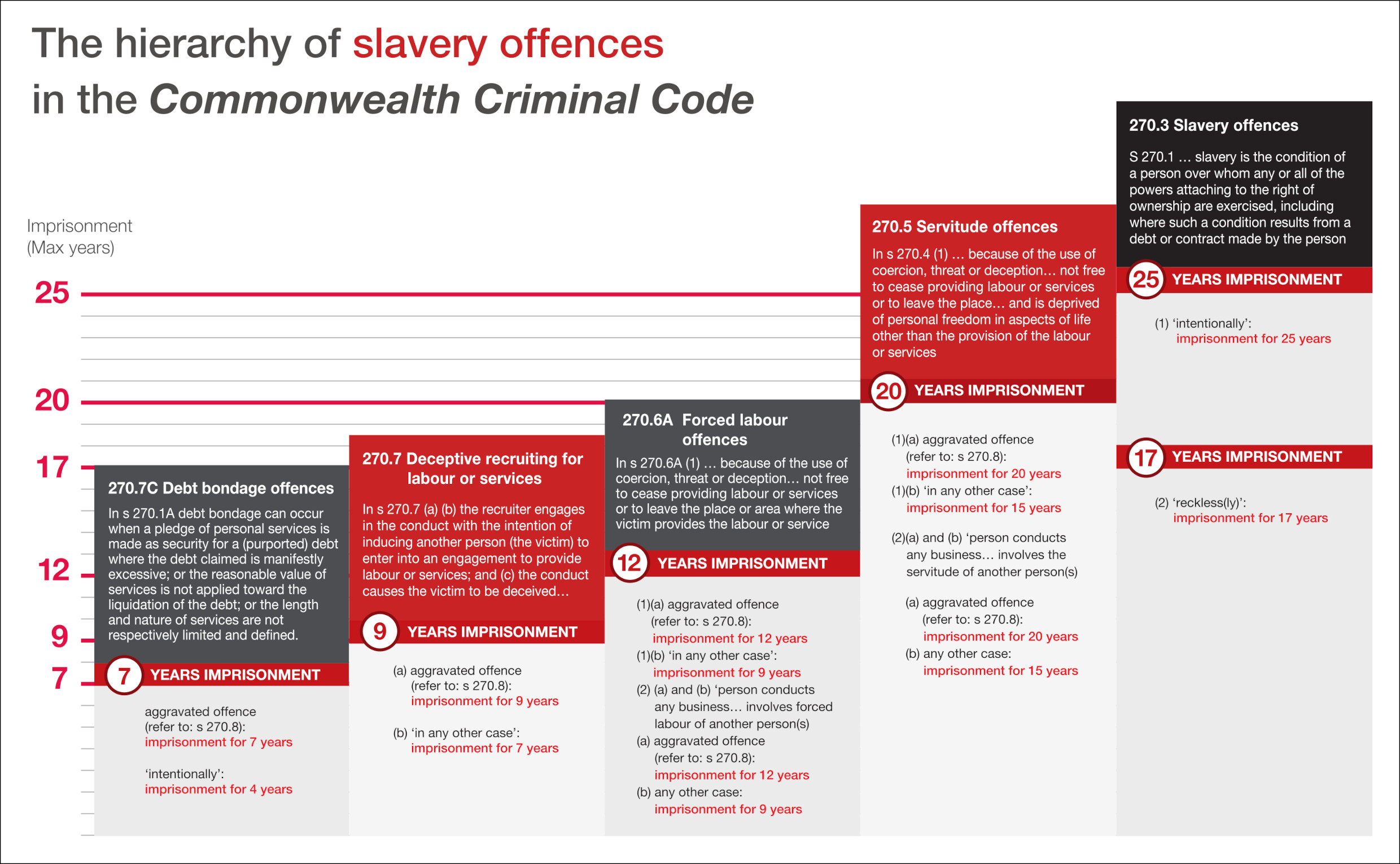
Modern slavery offences in Div 270 Criminal Code range in seriousness with respect to the length of prison terms to be served, from debt bondage and deceptive recruiting through forced labour to servitude and slavery which attract the most severe penalties. These offences may be characterised as a “hierarchy” as illustrated in Figure 3 below.136
|
Figure 4. Hierarchy of Commonwealth slavery offences
 |
13.3.3.3 Migration Act 1958 aggravated offences
There is overlap between some modern slavery offences and the Migration Act 1958 (Cth) which makes it an offence to knowingly or recklessly employ or refer for work a person who does not have a valid visa or is working in breach of visa conditions: ss 245AC, 245AE.
These offences are escalated to aggravated offences if the worker is being exploited and the offender knows of, or is reckless to, that circumstance: ss 245AD(1) and (2), 245AEB(1) and (2). Under the Migration Act, exploitation occurs if a person causes another person to enter into slavery, or a condition similar to slavery, servitude, forced labour, forced marriage, or debt bondage.137 The offences have a maximum penalty of 5 years imprisonment: s 245AH; Criminal Code, ss 271.1 and 271.1A.
Differences in the elements between modern slavery offences and these aggravated Migration Act offences mean that a person may be convicted of both offences.138 In Natahkum v The Queen139 the offender appealed against sentences for offences contrary to both s 245AC of the Migration Act and s 270.1 Criminal Code (intentionally possessing a slave). The Australian Capital Territory Court of Appeal confirmed that in sentencing for multiple offences, there is a need to ensure that the offender is not doubly punished for a factual circumstance that is an element of two or more offences:140
[T]here are no common elements between the slavery offence and the unaggravated form of the immigration offences, but the fact that a person has been kept in slavery may aggravate the immigration offences. For that reason, avoiding double punishment in this case did require the sentencing judge, having sentenced for the offence of possessing a slave, to ensure that the sentences for the aggravated immigration offences recognised the duplication between the circumstances of aggravation provided by the exploitation of SK by possessing her as a slave and the slavery offence itself.
13.3.3.4 Extended geographical jurisdictional requirements
Given the global nature of modern slavery offences, territorial jurisdiction may become relevant in certain cases, as these offences can occur outside Australia.
13.3.3.4.1 Slavery-like offences and trafficking in persons offences (other than domestic trafficking in persons or organs) — Category B
Part 2.7 Criminal Code concerns the geographical application of offences in the Criminal Code and provides for four categories of extended geographic jurisdiction. All slavery-like offences and human trafficking offences other than domestic trafficking in persons or organs under the Criminal Code attract Category B extraterritorial jurisdiction, which applies to: Australian citizens, residents, and bodies corporate; conduct that occurs in Australia; and overseas conduct the effect of which occurs in Australia: s 270.9.
Under Category B jurisdiction, a person commits the offence if:141
-
The offence is conducted wholly or partly in Australia, or, completely or partly on board an Australian aircraft or ship; or
-
The conduct constituting the offence occurred outside of Australia but the result of the conduct occurred wholly or partly in Australia, or, completely or partly in on board an Australian Aircraft or ship; or
-
The conduct constituting the offence occurred outside of Australia but the person who committed the offence is an Australian citizen, or, the body corporate which committed the offence is incorporated by or under a law of the Commonwealth or of a State or Territory; or
-
All of the following conditions are satisfied:
-
the alleged offence is an ancillary offence (an offence related to a primary offence);
-
the conduct constituting the alleged offence occurs wholly outside Australia;
-
the conduct constituting the primary offence to which the ancillary offence relates, or a result of that conduct, occurs, or is intended by the person to occur, wholly or partly in Australia or wholly or partly on board an Australian aircraft or an Australian ship.
-
A primary offence means an offence against a law of the Commonwealth, other than an ancillary offence. An ancillary offence is an offence against ss 11.1 (Attempt), 11.4 (Incitement), 11.5 (Conspiracy) or an offence against a law of the Commonwealth, to the extent to which the offence arises out of the operation of ss 11.2, 11.2A or 11.3.142
A “local law defence” applies to Category B which provides that where a primary or ancillary offence is committed outside Australia, and the person is not an Australian citizen, resident, or body corporate, and there is not a corresponding local law prohibiting the same conduct in the country or part of the country where the conduct occurs, no offence is committed: ss 15.2–15.4. A defendant bears an evidential burden in relation to these matters: s 15.2(3), (5).143
The defence in s 15.2(2) may be available if jurisdiction is to be exercised on the basis of residence, but not if jurisdiction is to be exercised on the basis of nationality.144
Under s 15.2(2), a defence for a primary offence applies if:
- (a)
the conduct constituting the alleged offence occurs wholly in a foreign country, but not on board an Australian aircraft or an Australian ship; and
- (b)
the person is neither:
- (i)
an Australian citizen; nor
- (ii)
a body corporate incorporated by or under a law of the Commonwealth or of a State or Territory; and
- (c)
there is not in force in:
- (i)
the foreign country where the conduct constituting the alleged offence occurs; or
- (ii)
the part of the foreign country where the conduct constituting the alleged offence occurs;
a law of that foreign country, or a law of that part of that foreign country, that creates an offence that corresponds to the first-mentioned offence.
Under s 15.2(4), a defence for an ancillary offence applies if:
- (a)
the alleged offence is an ancillary offence; and
- (b)
the conduct constituting the alleged offence occurs wholly in a foreign country, but not on board an Australian aircraft or an Australian ship; and
- (c)
the conduct constituting the primary offence to which the ancillary offence relates, or a result of that conduct, occurs, or is intended by the person to occur, wholly in a foreign country, but not on board an Australian aircraft or an Australian ship; and
- (d)
the person is neither:
- (i)
an Australian citizen; nor
- (ii)
a body corporate incorporated by or under a law of the Commonwealth or of a State or Territory; and
- (e)
there is not in force in:
- (i)
the foreign country where the conduct constituting the primary offence to which the ancillary offence relates, or a result of that conduct, occurs, or is intended by the person to occur; or
- (ii)
the part of the foreign country where the conduct constituting the primary offence to which the ancillary offence relates, or a result of that conduct, occurs, or is intended by the person to occur;
a law of that foreign country, or a law of that part of that foreign country, that creates an offence that corresponds to the primary offence.
13.3.3.4.2 Domestic trafficking in persons or organs — s 271.11 jurisdictional requirements
Domestic trafficking of persons offences and domestic organ trafficking offences attract s 271.11 jurisdictional requirements.
Where s 271.11 applies, a person commits an offence only if one or more of the following apply:
- (a)
the conduct constituting the offence occurs to any extent outside Australia;
- (b)
the conduct constituting the offence involves transportation across State borders, either for reward or in connection with a commercial arrangement;
- (c)
the conduct constituting the offence occurs within a Territory or involves transportation to or from a Territory;
- (d)
the conduct constituting the offence is engaged in by, or on behalf of, a constitutional corporation, or in circumstances where the victims of the trafficking conduct were intended to be employed by a constitutional corporation;
- (e)
some of the conduct constituting the offence is engaged in by communication using a postal, telegraphic or telephonic service within the meaning of paragraph 51(v) of the Constitution;
- (f)
the victim of the conduct constituting the offence is an alien.
13.3.3.4.3 Slavery offences — Category D
Slavery proper (s 270.3) is an offence with unlimited (Category D) jurisdiction: s 15.4. Any person can be prosecuted for slavery in an Australian court whether or not they are an Australian citizen or body corporate, and whether or not the conduct or a result of the conduct constituting the alleged offence occurred in Australia. There are no defences or exemptions to its application for Category D extended geographical jurisdiction offences.
Proceedings for an offence against s 270.3 where the conduct constituting the alleged offence occurs wholly outside of Australia must not take place except with the consent in writing of the Attorney-General: s 270.3B(1). Even if consent in accordance with s 270.3B(1) is not given:
- (a)
a person may be arrested for the offence, and a warrant for the arrest of a person for the offence may be issued and executed [s 270.3B(2)(a)]; and
- (b)
a person may be charged with the offence [s 270.3B(2)(b)]; and
- (c)
a person so charged may be remanded in custody or on bail [s 270.3B(2)(c)].
No further step in proceedings referred to in s 270.3B(1) is to be taken until such a consent has been given: s 270.3B(2). Section 270.3B(2) does not prevent the discharge of the accused if proceedings are not continued within a reasonable time.
See Table 1 at 13.3.1 for a summary of Commonwealth and NSW modern slavery offences as defined in s 5(1) and set out in Sch 2 to the MSA (NSW) and their corresponding jurisdictional requirements.
13.3.4 Background to the NSW Modern Slavery Act 2018
New South Wales established the first State regime in Australia to address modern slavery with the commencement of the MSA (NSW) on 1 January 2022. The MSA (NSW) created new due diligence and reporting obligations for certain public entities in NSW and provides for the appointment and functions of an Anti-slavery Commissioner. It also introduced offences of slavery, servitude and child forced labour, child forced marriage, and production of child abuse materials into the Crimes Act 1900 (NSW).
The objects of the MSA (NSW) as set out in s 3 are:
- (a)
to combat modern slavery,
- (b)
to provide assistance and support for victims of modern slavery,
- (c)
to provide for an Anti-slavery Commissioner,
- (d)
to provide for detection and exposure of modern slavery that may have occurred or be occurring or that is likely to occur,
- (e)
to raise community awareness of, and provide for education and training about, modern slavery,
- (f)
to encourage collaborative action to combat modern slavery,
- (g)
to provide for the assessment of the effectiveness and appropriateness of laws prohibiting modern slavery and to improve the implementation and enforcement of such laws,
- (h)
to provide for mandatory reporting of risks of modern slavery occurring in the supply chains of government agencies,
- (i)
to make forced marriage of a child and certain slavery and slavery-like conduct offences in NSW [see Crimes Act 1900, s 93AC (child forced marriage) and Crimes Act 1900, s 93AB (slavery, servitude and child forced labour)],
- (j)
to further penalise involvement in cybersex trafficking by making it an offence to administer a digital platform for the purpose of child sexual abuse material or encourage another person to use a digital platform to deal with child abuse material, [see Crimes Act 1900, ss 91G, 91HAA, 91HAB and 91HAC],
- (k)
to provide for education, training and guidance about identifying and addressing modern slavery taking place within supply chains of organisations.
The genesis of the MSA (NSW) was the 2017 report of the Select Committee on Human Trafficking in NSW.145 The report made a number of recommendations aimed at combating human trafficking and modern slavery.146 The NSW Bill, developed by a cross-party working group on modern slavery, was informed by the two national inquiries as well as the NSW Select Committee report.147
Parliament assented to the Act on 27 June 2018, making NSW the first State or Territory in Australia to introduce standalone legislation to address modern slavery. The Act, however, did not come into force until more than three years later on 1 January 2022, as the NSW State Government deferred commencement of the NSW Act to avoid inconsistencies with the federal Act, to allow stakeholders an opportunity to interpret the legislation, and to provide enough time to establish the Anti-slavery Commissioner in NSW.148
Prior to its commencement, the MSA (NSW) was amended in response to recommendations of the Legislative Council Standing Committee on Social Issues in March 2020.149 Miscellaneous amendments were made to the uncommenced 2018 Act by the Modern Slavery Amendment Act 2021.150
The MSA (NSW) in its original form, introduced a reporting obligation on a “commercial organisation”, defined as having a total turnover of not less than $50 million a year. The Amendment Act repealed provisions making it mandatory for commercial organisations to prepare and make public a modern slavery statement and penalties for failing to do so (previous s 24(2), (6) (transparency of supply chain). Commercial organisations do not, as a general rule, have to report under the NSW legislation and there are no longer financial penalties for failing to comply with the reporting requirements.151 The MSA (NSW) previously included fines of up to $1,100,000 for failing to publish a statement or providing false or misleading information while the Commonwealth Act does not include financial penalties.
These changes were designed to remove the regulatory burden on the NSW private sector under two inconsistent schemes and harmonise the reporting regime under the schemes, by removing the reporting requirement for businesses earning $50–100 million.152
Significantly, the Amendment Act has also removed the ability of courts to make “modern slavery risk orders” (previous s 29). These post-conviction orders would have prevented individuals convicted of offences under the MSA (NSW) from engaging in conduct which might result in further slavery. Modern slavery risk orders were largely criticised for fitting poorly alongside pre-existing NSW laws.153
The Amendment Act additionally amended the Victims’ Rights and Support Act 2013 (NSW) to make various references to “victims of modern slavery”. This allows for the provision of recognition payments and counselling to victims of modern slavery where the offending acts occurred in NSW. Notably, the implementation arrangements narrow who can receive such payments, because they must demonstrate that they have, while suffering modern slavery, been a victim of “an act of violence”. While this would include both physical violence, such as assault, and sexual violence, it means that victims of debt bondage or deceptive recruiting, for example, cannot, absent acts of violence, access the support available under the scheme.
The key to the operation of the NSW modern slavery scheme is the establishment of the independent office of the NSW Anti-slavery Commissioner whose functions include advocating for and promoting action to combat modern slavery, identifying and providing assistance and support for victims of modern slavery, and giving support to and oversight of NSW public procurement efforts to remove products of modern slavery from supply-chains.154
In June 2023, the Office of the NSW Anti-slavery Commissioner released the Commissioner’s Strategic Plan 2023–2026155 which outlines the key priorities for the Commissioner’s work with a focus on developing awareness, due diligence and giving voice to those with lived modern slavery experience.
13.4 Modern slavery offences
13.4.1 Overview
This section discusses the offences recognised as modern slavery offences under Sch 2 MSA (NSW) (see Table 1 at 13.3.1). Schedule 2 MSA (NSW) includes offences against ss 80D, 80E, 91G(1), (2) and (3), 91H, 91HAA, 93AA–93AC Crimes Act 1900 (NSW), s 32 Human Tissue Act 1983 (NSW), and Div 270 and 271 Commonwealth Criminal Code.156
13.4.2 Slavery offences
| Criminal Code (Cth) | Maximum penalty |
| s 270.3 | 25 years (s 270.3(1) slave trading) |
| 17 years (s 270.3(2) commercial transaction involving a slave) | |
| s 270.6A | 9 years; 12 years (aggravated offence) |
| Crimes Act 1900 (NSW) | Maximum penalty |
| s 93AB | 25 years |
13.4.2.1 Commonwealth (Criminal Code)
“Slavery” describes the most serious offence in a continuum of exploitative conduct and is therefore distinguished from “slavery-like practices” of servitude, forced labour, deceptive recruiting, forced marriage and debt bondage in the Criminal Code.157 See 13.3.3.2.
Slavery occurs when a person exercises the rights of ownership over another person. This includes the power to make the victim an object of purchase or to use their labour or services in a substantially unrestricted manner.158
“Slavery” is defined in s 270.1 Criminal Code as the condition of a person over whom any or all of the powers attaching to the right of ownership are exercised, including where such a condition results from a debt or contract made by the person. See 13.3.2.
Pursuant to s 270.3(1), a person commits an offence of slavery, whether within or outside Australia, who intentionally:
- (a)
reduces a person to slavery; or
- (b)
possesses a slave or exercises over a slave any of the other powers attaching to the right of ownership; or
- (c)
engages in slave trading; or
- (d)
enters into any commercial transaction involving a slave; or
- (e)
exercises control or direction over or provides finance for any act of slave trading or any commercial transaction involving a slave.
When determining the relevant intention, in The Queen v Tang the High Court held, in relation to a prosecution under s 270.3(1)(a), it is not necessary for the prosecution to prove that the accused knew or believed that the nature of the powers the accused was exercising over the complainant were powers attaching to the right of ownership or the accused was dealing with the complainant as mere property.159
The maximum penalty for committing this offence is 25 years imprisonment: s 270.3(1). Where a person is reckless as to whether a commercial transaction or act involves a slave, slavery, slave trading or the reduction of a person to slavery, the maximum penalty of 17 years imprisonment applies: s 270.3(2).
Slavery offences are subject to Category D extended geographical jurisdiction requirements: see 13.3.3.3.
The offence applies whether or not the conduct constituting the alleged offence occurs in Australia; and whether or not a result of the conduct constituting the alleged offence occurs in Australia: ss 15.4, 270.3A.
13.4.2.2 Defences for slavery and slavery-like offences under the Criminal Code
Under the Criminal Code, a person who engages in any conduct with the intention of securing the release of a person from slavery does not commit an offence against the slavery and slavery-like offences in Div 270: s 270.3(4).160 The burden of establishing this defence rests with the accused: s 270.5.
It is not a defence in a proceeding for an offence against Div 270 that a person against whom the offence is alleged to have been committed consented to, or acquiesced in, conduct constituting any element of the offence: s 270.11; The Queen v Tang.161
The principle of double jeopardy also applies. If a person has been convicted or acquitted in a country outside Australia of an offence against the law of that country in respect of any conduct, the person cannot be convicted of an offence against Div 270 in respect of that conduct: s 270.13.
13.4.2.3 New South Wales (Crimes Act 1900)
In NSW, slavery (and servitude and child forced labour (discussed below)) are all criminalised under s 93AB Crimes Act 1900 with a maximum penalty of imprisonment of 25 years. This contrasts with the Criminal Code which defines these offences separately. The prohibited actions must occur in NSW.
A person is guilty of an offence under s 93AB if, in NSW:
- (a)
the person holds another person in slavery or servitude and the circumstances are such that the person knows or ought to know that the person is held in slavery or servitude, or
- (b)
the person requires a child to perform forced or compulsory labour and the circumstances are such that the person knows or ought to know that the child is being required to perform forced or compulsory labour. [See 13.4.3.5 below].
Both “servitude” and “slavery” have the meanings they have in the corresponding sections of the Criminal Code: see Crimes Act 1900, s 93AB(6); Criminal Code, ss 270.1, 270.4.
In determining whether a person is being held in slavery or servitude or a child is required to perform forced compulsory labour, regard may be had to all the circumstances162 which can include:
- (a)
any of the person’s personal circumstances (such as the person being a child, the person’s family relationships, and any mental or physical illness) which may make the person more vulnerable than other persons,
- (b)
any work or services provided by the person, including work or services provided in circumstances which constitute exploitation,
- (c)
the coercion, threat or deception involved,
- (d)
without limiting para (c), whether the person has been coerced, threatened or deceived into doing anything which involves the supply or sale of the person’s tissue (within the meaning of the Human Tissue Act 1983).
“Coercion” and “deceive” are defined in s 93AA and mirror the definitions of the Criminal Code. “Threat” also mirrors the definition in the Criminal Code but refers to “a threat of force” rather than “a threat of coercion”: s 93AA. See 13.3.2.
The consent of a person (whether an adult or a child) to any of the acts alleged to constitute holding the person in slavery or servitude, or requiring the child to perform forced or compulsory labour, does not preclude a determination that the person is being held in slavery or servitude, or the child is required to perform forced or compulsory labour: s 93AB(5).
13.4.3 Servitude (including sexual servitude) and forced labour
| Criminal Code (Cth) | Maximum penalty |
| s 270.5 | 15 years; 20 years (aggravated offence) |
| s 270.6A | 9 years; 12 years (aggravated offence) |
| Crimes Act 1900 (NSW) | Maximum penalty |
| s 80D | 15 years; 20 years (aggravated offence) |
| s 80E | 15 years; 19 years (aggravated offence) |
| s 93AB | 25 years |
13.4.3.1 Overview of Commonwealth servitude and forced labour offences
These offences fall under Div 270, Subdiv C (Slavery-like offences). The difference between the slavery offences and servitude in the Criminal Code is essentially one of degree. To establish slavery, it must be shown that the accused exercises a power of ownership over the victim. Servitude falls short of ownership but the domination over the victim is such as to effectively deny her or his freedom in some fundamental respect.182
As noted above, the Criminal Code creates a hierarchy of the offences of slavery (25 years maximum imprisonment), servitude (15 years maximum imprisonment; 20 years with aggravation) and forced labour (9 years maximum imprisonment; 12 years with aggravation).183
For a comparison of how these three offences might apply in a case scenario, see I Love, “Australian Criminal Code — slavery offences” in Inquiry into establishing a Modern Slavery Act in Australia.184 See also Figure 3 in 13.3.3.2.
13.4.3.2 Servitude (Criminal Code)
Servitude offences (previously limited to sexual servitude) were introduced in the Criminal Code in 1999.185
Both servitude and forced labour occur where the victim does not consider themselves free to cease providing their labour or services, or to leave their place or area of work, because of the use of coercion, threats or deception: ss 270.4, 270.6.186
To be in a position of servitude the victim must also be significantly deprived of their “personal freedom in respect of aspects of his or her life other than the provision of the labour or services”: s 270.4. The term “significantly deprived of personal freedom” at s 270.4 is undefined in both legislation and case law. This requirement is:
intended to reflect the degree of difference between the offences of slavery and servitude. To establish slavery, it must be proved that the accused exercises a power of ownership over the victim. Servitude falls short of ownership but occurs when the offender’s domination over the victim through coercion, threat or deception is such that the victim is effectively denied her or his freedom in some fundamental respect.187
A person commits a servitude offence against s 270.5 Criminal Code if the person:
- (1)
engages in conduct which causes another person to enter into or remain in servitude; or
- (2)
conducts any business involving servitude of another person.
In either case, the maximum penalty imposed is 15 years imprisonment.
In the case of an aggravated offence where the victim is under 18, or where the offender in committing the offence, subjects the victim to cruel, inhuman or degrading treatment; engages in conduct that gives rise to a danger of death or serious harm to the victim or another person; and is reckless as to that danger, the maximum penalty is 20 years imprisonment: s 270.8.
An alternative verdict of forced labour can be made if a defendant is found not guilty of a servitude offence, provided the defendant has been afforded procedural fairness: s 270.5(3), (4). Similarly, a defendant who is found not guilty for an aggravated slavery-like offence may be found guilty of the corresponding slavery-like offence, provided the defendant has been afforded procedural fairness: s 270.8(3).188
The Crimes Legislation Amendment (Slavery, Slavery-like Conditions and People Trafficking) Act 2013 (Cth) extended the application of the offence of servitude in the Criminal Code to apply to conduct occurring outside the sex industry in recognition of increasing situations of servitude in the labour market.189
Servitude, along with the offence of forced labour (discussed at 13.4.3.3), must be interpreted using an objective test of how a “reasonable person in the position of the victim” would understand their labour conditions (s 270.4(1)(a)), and each case should be reviewed on its merits.190 The offence requires proof that the victim provides labour or services and does not consider themselves to be free to cease providing the labour or services or leave the place or area where the victim provides the labour or services because of the use of coercion, threats or deception.
Section 270.10 provides a court may have regard to the following in determining the reasonable person test:191
-
the economic relationship between the alleged victim and alleged offender
-
the terms of any contract or agreement between the alleged victim and alleged offender, and
-
the personal circumstances of the alleged victim including their lawful presence in Australia, their understanding of the English language and their social and physical dependence on the alleged offender.
The difficulties criminal justice practitioners and the courts may face in understanding the situational and personal vulnerabilities of victims and survivors were raised by the Targeted review which noted:192
[T]he “reasonable person in the position of the victim” test used in Division 270 requires consideration of the state of mind of a reasonable person with the same situational and personal vulnerabilities of the victim and survivor — arguably subjective deliberations.
Juries, for example, may face challenges understanding the type of trauma that has been experienced by victims and survivors and accounting for this trauma when deliberating whether a reasonable person in the victim and survivor’s position would have felt free to cease providing labour or services or to leave the place where they are providing those labour or services.193
Trauma has been proven to impair higher-level cognitive functions and to induce a survival mode,194 and may alter a reasonable person’s perceptions such that they believe they are trapped. Accordingly, the question arises whether the “reasonable person in the position of the victim” means “reasonable person [operating under impairments to reasoning that are induced by] the position of the victim” or “reasonable person [operating as a person not under such impairments would operate] in the position of the victim”. If police and prosecutors lack experience in dealing with the complex trauma that many victim-survivors experience, they may lean towards the latter interpretation in practice, and not charge these offences despite victims being recognised by authorities, for administrative purposes, as victims of modern slavery. This means that while these victim-survivors may obtain access to the Support for Trafficked People Program (STPP),195 they do not have the benefit of a judicial hearing of the allegations. If police and prosecutors don’t take matters to trial because they considered that, in the victim’s position, a “reasonable person” would not have considered themselves trapped, this would also be deeply de-validating and re-traumatising for many victims. Courts seeking to adopt a trauma-informed approach may therefore need to consider the nuances of the reasonable person test.
Note, the reasonable person test as formulated in Div 270 differs from the standard reasonable person test in other sections of the Criminal Code as it incorporates an element of subjectivity with the phrase “in the position of the victim”. See also 13.9.1.
In R v Pulini, a decision of the Queensland Court of Appeal, the Court interpreted the test as requiring “a construction that defines the reasonable person as having the situational and personal vulnerabilities of the victim”,196 which in this case included the victim’s unlawful immigration status, continued deception, absence of a visa, fear of the authorities and her perpetrators, poor financial resources and personal vulnerability.
13.4.3.3 Forced labour (Criminal Code)
Forced labour is defined in s 270.6 Criminal Code to mean the condition of a person who provides labour or services and who, because of the use of coercion, threat or deception:
- (a)
-
is not free to cease providing labour or services; or
- (b)
-
is not free to leave the place or area where the person provides labour or services.
The key distinction between forced labour and servitude is that forced labour does not have the requirement of the deprivation of personal freedom.
It is important to distinguish forced labour from poor working conditions; the latter do not give rise to an offence under the Criminal Code. A significant difference between poor working conditions and forced labour is the requirement that the person being forced “would not consider himself or herself to be free”: s 270.6(1).199
13.4.3.4 Sexual servitude/commercial sexual servitude (NSW Crimes Act, ss 80B–80F)
Under NSW law, Pt 3, Div 10A Crimes Act 1900 provides offences of causing sexual servitude or conducting of business involving sexual servitude which allows for the prosecution of cases involving sexual exploitation: Crimes Act 1900, ss 80B–80F.
Section 80B(1) defines “sexual servitude” as being the condition of a person who provides sexual services and who, because of the use of force or a threat, is not free to either:
- (a)
cease providing sexual services, or
- (b)
leave the place or area where the person provides sexual services.
A threat is defined in s 80B(2) to include:
- (a)
a threat of force, or
- (b)
a threat to cause a person’s deportation, or
- (c)
a threat of any other detrimental action unless there are reasonable grounds for the threat of that action in connection with the provision of sexual services by a person.
Sexual service means the “commercial use or display of the body for the sexual arousal or gratification of others”: s 80B(2).
The offence of causing sexual servitude is where the offender causes another person to enter or remain in sexual servitude, and intended to do so, or was reckless in that regard: s 80D. The offence carries a maximum penalty of 15 years imprisonment.
The maximum penalty increases to 20 years imprisonment where the offence is committed in “circumstances of aggravation” where the complainant was under the age of 18 years or had a cognitive impairment (defined in s 61HD): s 80D.
A person who conducts any business that involves the sexual servitude of other persons and who knows about or is reckless as to that sexual servitude is guilty of an offence: s 80E. The maximum penalty is imprisonment for 15 years, or 19 years in circumstances of aggravation.
An alternative verdict is available under s 80F where if the jury is not satisfied that the accused is guilty of the offence charged but is satisfied on the evidence that the accused is guilty of an offence under s 80D(1) or 80E(1), it may find the accused not guilty of the offence charged but guilty of the latter offence.
The offence of sexual servitude was added to the meaning of “offence of a sexual nature” in the Crimes (High Risk Offenders) Act 2006 with the commencement of the MSA (NSW) allowing offenders convicted of sexual servitude offences to be subject to post-sentence detention and supervision orders: Crimes (High Risk Offenders) Act, s 5(2).201
13.4.3.5 Servitude and child forced labour (NSW Crimes Act)
Servitude and child forced labour (along with slavery) are criminalised in s 93AB Crimes Act 1900 with a maximum penalty of imprisonment for 25 years.
A person is guilty of an offence if, in NSW:
- (a)
the person holds another person in slavery or servitude and the circumstances are such that the person knows or ought to know that the person is held in slavery or servitude, or
- (b)
the person requires a child to perform forced or compulsory labour and the circumstances are such that the person knows or ought to know that the child is being required to perform forced or compulsory labour.
It is important to note that “forced” and “compulsory” are not synonyms in s 93AB(2). “Forced” involves a threat, whereas “compulsory” means required. The term “forced or compulsory” labour is a term of art drawn from international law and practice, specifically Australia’s commitment to various ILO Conventions and Labour Standards.202
Section 93AB(2) provides that “forced or compulsory labour” does not include:
- (a)
work or service normally required of a child who is under detention because of a court order or who, under a court order of this or another jurisdiction, has been conditionally released from detention or ordered to perform work in the community, or
- (b)
work or service required because of an emergency threatening the NSW community or a part of the NSW community, or
- (c)
work or service that forms part of normal civil obligations.
In determining whether a person is being held in slavery or servitude or a child is required to perform forced compulsory labour, s 93AB(3) provides that regard may be had to “all the circumstances” exemplified in s 93AB(4):
- (a)
any of the person’s personal circumstances (such as the person being a child, the person’s family relationships, and any mental or physical illness) which may make the person more vulnerable than other persons,
- (b)
any work or services provided by the person, including work or services provided in circumstances which constitute exploitation,
- (c)
the coercion, threat or deception involved,
- (d)
without limiting para (c), whether the person has been coerced, threatened or deceived into doing anything which involves the supply or sale of the person’s tissue (within the meaning of the Human Tissue Act 1983).
“Coercion” and “deceive” are defined in s 93AA and mirror the definitions in ss 270.1 and 270.1A respectively of the Criminal Code. “Threat” in s 93AA also mirrors the definition in s 270.1A Criminal Code but refers to “a threat of force” rather than “a threat of coercion”. See 13.3.2.
The consent of a person (whether an adult or a child) to any of the acts alleged to constitute holding the person in slavery or servitude, or requiring the child to perform forced or compulsory labour, does not preclude a determination that the person is being held in slavery or servitude, or the child is required to perform forced or compulsory labour: s 93AB(5).
13.4.4 Deceptive recruiting for labour or services
| Criminal Code (Cth) | Maximum penalty |
| s 270.7 | 7 years |
| s 270.8 | 9 years (aggravated offence) |
The offence of deceptive recruiting for labour or services describes situations where the victim-survivor is deceived about the type of work they will be doing, the length of their stay, their living or working conditions or how much they will earn: Criminal Code, s 270.7.
Pursuant to s 270.7(c), a person commits an offence if they engage in conduct with the intention of reducing another person to enter into an engagement to provide labour or services, and that conduct causes the victim to be deceived about:
- (i)
the extent to which the victim will be free to leave the place or area where the victim provides the labour or services; or
- (ii)
the extent to which the victim will be free to cease providing the labour or services; or
- (iii)
the extent to which the victim will be free to leave [their] place of residence; or
- (iv)
if there is or will be a debt owed or claimed to be owed by the victim in connection with the engagement — the quantum, or the existence, of the debt owed or claimed to be owed; or
- (v)
the fact that the engagement will involve exploitation, or the confiscation of the victim’s travel or identity documents; or
- (vi)
if the engagement is to involve the provision of sexual services — that fact, or the nature of sexual services to be provided (for example, whether those services will require the victim to have unprotected sex).
The penalty in the case of an aggravated offence is imprisonment for 9 years, or 7 years in any other case. The aggravated offence applies where the victim is under the age of 18 years, or where the offender subjects the victim to cruel, inhuman or degrading treatment, or engages in conduct that gives rise to a danger of death or serious harm to the victim and is reckless as to that danger: s 270.8. An alternative verdict is available under s 270.8(3).
13.4.5 Forced marriage and child forced marriage offences
| Criminal Code (Cth) | Maximum penalty |
| s 270.7B | 7 years; 9 years (aggravated offence) |
| Crimes Act 1900 (NSW) | Maximum penalty |
| s 93AC | 9 years (child forced marriage) |
A forced marriage is marriage without the free and full consent of one or both parties to the marriage. The person may be coerced, threatened or deceived into marrying and because of that conduct did not freely or fully consent and/or may not have the capacity to give consent.
A forced marriage is distinct from an arranged marriage; in the latter, the marriage is organised by the families of both spouses but consent is still present and the spouses have the right to accept or reject the marriage arrangement.204
Forced marriages render the forced party (in most cases a woman) vulnerable to abuse and exploitation by her spouse or his family, who exercise significantly greater power and control. This can trap the victim in conditions of enslavement, particularly in domestic or sexual servitude.205
13.4.5.1 Forced marriage offences (Criminal Code)
The Criminal Code creates two forced marriage offences: causing a person to enter into a forced marriage (s 270.7B(1)) and being a party to a forced marriage (s 270.7B(2)). Both have a maximum penalty of 7 years imprisonment or 9 years for the aggravated form of the offence. If the victim is under the age of 18 and taken overseas for the purpose of forced marriage, this may constitute a trafficking in children offence, which carries a penalty of up to 25 years imprisonment.206 Forced removal overseas of an adult can constitute exit trafficking: Criminal Code, s 271.2(1A).207
Forced marriage is defined in s 270.7A(1) as a marriage where:208
- (a)
either party to the marriage (the victim) entered into the marriage without freely and fully consenting:
- (i)
because of the use of coercion, threat or deception; or
- (ii)
because the victim was incapable of understanding the nature and effect of the marriage ceremony; or
- (b)
when the marriage was entered into, either party to the marriage (the victim) was under 16.
“Coercion”, “threat” and “deception” are defined in s 270.1A Criminal Code and should be given a broad interpretation.209 The Explanatory Memorandum to the Crimes Legislation Amendment (Slavery, Slavery-like Conditions and People Trafficking) Bill 2012 states that “the intention is that these terms capture a broad range of conduct (both physical and non-physical) that may be used by a person to cause a victim to enter a marriage without their full and free consent”.210 Coercion includes obvious means such as physical force, detention or duress, and more subtle means such as psychological and emotional pressure that make the victim or their family feel guilty, obliged or dishonoured.211
The definition of forced marriage includes marriages (as described in s 270.7A(2)) involving persons who have been transferred, sold or inherited into a marriage with no right to refuse, also known as a “servile marriage”. Where a person has been transferred, sold or inherited into a marriage with no right to refuse, this may also amount to an offence of slavery.212
In 2015, the Crimes Legislation Amendment (Powers, Offences and Other Measures) Act 2015 (Cth) increased penalties and expanded the definition of “forced marriage” to make clear that the offences apply where a person cannot give their free and full consent to marry, including for reasons such as age or mental capacity: s 270.7A(1)(a)(ii).213 The definition was further amended by the Combatting Child Sexual Exploitation Legislation Amendment Act 2019 (Cth) to explicitly capture all marriage involving children under 16. This made clear that a person under the age of 16 cannot consent to be married and specified that any offence involving a child under 16 would automatically attract the aggravated maximum penalty of nine years imprisonment: ss 270.7A(1)(a), 270.7B(1)(b), 270.8(1)(a) and s 270.8(1) Note.
The offences can apply to different kinds of marriage and marriage-like relationships, including registered relationships and those formed by cultural and religious ceremonies: see s 270.7A(2). This includes marriages that occur in Australia (including where a person was brought to Australia to get married), as well as where a person is taken from Australia to get married overseas.214
For the purpose of defining forced marriage in s 270.7A, forced marriage is not limited to marriages recognised by Australian law. Section 270.7A(2) defines “marriage” to include:
- (a)
a registered relationship within the meaning of s 2E Acts Interpretation Act 1901;
- (b)
a marriage recognised under a law of a foreign country;
- (c)
a relationship registered under a law of a foreign country that is of the same or a similar type as any registered relationship within the meaning of s 2E Acts Interpretation Act; and
- (d)
a marriage or registered relationship that is void, invalid or not recognised by law for any reason.
Under the Criminal Code, the forced marriage offences can apply to any person with a role in bringing about the forced marriage: s 270.7B(1). This could include, for example, family members, friends, wedding planners or marriage celebrants. The offences apply regardless of the age, gender or sexual orientation of the victim.215The offences also criminalise being a party to a forced marriage where one spouse is not a victim of the forced marriage and does not have a reasonable excuse: s 270.7B(2).
Offences under State laws may also be pursued, as they were in an unreported NSW case involving a child where the husband was convicted of offences under s 66EA (persistent sexual abuse of a child) Crimes Act 1900 (NSW), and the father under s 66EB (procuring a child under 16 for unlawful sexual activity).216 See also 13.4.5.2 below.
Extended geographical jurisdiction
Extended geographical jurisdiction (Category B) applies to the Criminal Code forced marriage offences. This ensures the provisions capture the conduct of Australian citizens, residents or corporations overseas. The principle of double jeopardy also applies, consistent with existing s 270.13 Criminal Code. See further 13.3.3.
Part VII Marriage Act
Conduct related to or constituting forced marriage may also fall under Pt VII Marriage Act 1961 (Cth) which contains the following offences:
-
marrying a person not of marriageable age (s 95)
-
solemnising a marriage if there is reason to believe the marriage is void (s 100)
-
solemnisation of a marriage by an unauthorised person (s 101), or
-
going through a ceremony before a person not authorised to solemnise the marriage (s 103).
Where the consent of either or both of the parties is not real consent because it was obtained through duress or fraud, or the party is mistaken as to the identity of the other party or the nature of the ceremony, or the party did not understand the nature and effect of the marriage ceremony, or either of the parties is not of marriageable age the marriage is void: Marriage Act, s 23B(1)(d) and (e).
Customary law or cultural practice
Section 16A(1) Crimes Act 1914 (Cth) states that, in determining the sentence to be passed in respect of any person for a federal offence, a court must “impose a sentence or make an order that is of a severity appropriate in all the circumstances of the offence”. Section 16A(2) provides a non-exhaustive list of matters the Court must take into account, as are relevant and known to the Court. However, the court must not consider any form of customary law or cultural practice as a reason for:
- (a)
-
excusing, justifying, authorising, requiring or lessening the seriousness of the criminal behaviour; or
- (b)
-
aggravating the seriousness of the criminal behaviour.217
This applies to taking into account the objective gravity and moral culpability of the offence, as part of the instinctive synthesis.218
This provision is of particular relevance to forced marriage offences, as the circumstances of many of these offences are due to cultural or social custom.219
13.4.5.2 Child forced marriage (NSW Crimes Act, s 93AC)
Section 93AC Crimes Act 1900 (NSW) contains two offences relating to “child forced marriage” for persons under 18 years of age.
Section 93AC provides for an offence where:
-
a person causes a child to enter a forced marriage, and intends to cause or is reckless as to causing that forced marriage (s 93AC(3)), and
-
a person enters into a marriage with a child and knows that it is a forced marriage, if they are not a victim of the forced marriage (s 93AC(4)).
Both offences have a maximum penalty of 9 years imprisonment.
For the purpose of s 93AC, “marriage” includes marriages recognised under the law of a foreign country or a marriage that is void, invalid or not recognised by law. A marriage is forced229 if a child enters into it without freely and fully consenting:
-
because of the use of coercion, threat or deception, by another party to the marriage or by another person or is against the child or another person, or
-
the child was incapable of understanding the nature and effect of the marriage ceremony, or
-
when the marriage is entered into, the child is under 16 years of age.
This definition of forced marriage in s 93AC aligns with the Commonwealth forced marriage provisions under s 270.7A Criminal Code.
Section 93AC(4) prescribes a maximum penalty of 9 years imprisonment for the offence of entering into a marriage with a child, knowing that it is a forced marriage. Section 93AC(4)(c) clarifies that a person does not commit the child forced marriage offence if the person is a victim of the forced marriage.230
In NSW, apprehended violence orders (AVOs) are the primary civil protection order that may apply to situations of forced marriage. These orders prohibit or restrict the subject of the order (“the defendant”) from engaging in certain behaviours where victim-survivors have reasonable grounds to fear and in fact fear for their safety and/or welfare.231 Both the Commonwealth and NSW forced marriage offences are defined as a “personal violence offence” under s 4(b2) of the Crimes (Domestic and Personal Violence) Act 2007 (NSW), which means that adults as well as children have access to the protections of an apprehended domestic violence order or apprehended personal violence order. See further 13.9.4.
This also means that a child forced marriage is defined as an “act of violence” which is considered “sexual assault and domestic violence” under s 19(8)(f) of the Victims Rights and Support Act 2013 (NSW). A victim of a child forced marriage may then become eligible to access support such as recognition payments under s 19(8)(f).232
The NSW offence does not address the gaps in protection that exist in the Commonwealth framework for individuals over the age of 18, including access to a Family Law Watchlist Order which prevents travel outside of Australia and currently cannot be extended beyond the age of 18 under the Family Law Act 1975 (Cth).233
13.4.5.3 Child marriage
While forced marriage, and all marriages involving children below the age of 16 are criminalised, a marriage involving a child aged 16 or 17 can still take place with court approval in Australia.
The Marriage Act 1961 (Cth) permits a marriage where one party is aged between 16 and 18 years of age, where there is both the required consent (usually parental) and an Australian court order from a judge authorising the marriage: ss 12, 13. There must be “exceptional and unusual” circumstances to justify an order being made by a judge to permit the marriage. It is illegal for any person under the age of 16, or two people under the age of 18, to marry: ss 11, 95.
The Federal Circuit Court can make a parenting order under Pt VII, Div 5 and 6 Family Law Act 1975 (Cth) (FLA) to ensure that a child under the age of 18 cannot be taken overseas to be forcibly married. Parenting orders deal with various aspects of parenting including, “any aspect of the care, welfare or development of the child or any other aspect of parental responsibility for a child”: FLA, s 64B(2)(i).
Courts have the power to make certain other orders which protect children from forced marriage, such as injunctions preventing the removal or harassment of the child, and orders for the delivery of travel documents to the court: see FLA, ss 67ZD, 68B. The court can:
-
prevent a passport being issued for a child
-
require a person to surrender a child or accompanying adult’s passport to the court
-
prevent the removal of a child from Australia and place the child’s name on the AFP Family Law Watchlist (previously known as the Airport Watchlist).
In making a parenting order, the court must have regard to the child’s best interest as the paramount consideration: s 60CA. It will be an offence to remove a child from Australia if a parenting order is in force in relation to a child and the child is removed without the consent of each person in whose favour the parenting order was made: s 65Y.
There are no comparable orders available to adults at risk of forced marriage. Protection orders for family and domestic violence are an option for injunctive relief. However, these orders only apply to conduct in Australia and “are not designed to respond to the specific issue of forced marriage”.234
13.4.6 Debt bondage
| Criminal Code (Cth) | Maximum penalty |
| s 270.7C | 4 years |
| s 270.8 | 7 years (aggravated offence) |
The offence of debt bondage occurs where the offender intentionally engages in conduct that causes the victim to enter into debt bondage. Victims of debt bondage must work to repay a real or perceived debt that is manifestly excessive and that they may never be able to pay off.
The offence of debt bondage differs significantly from slavery in seriousness and is at the low end of the hierarchy of modern slavery offences. This is reflected in the difference in penalty: the maximum penalty for a conviction for a slavery offence is 25 years imprisonment, whereas the maximum penalty for a conviction for debt bondage is 4 years imprisonment: Criminal Code, s 270.7C. The debt bondage offences provide an alternative in cases where it may be difficult to prove the commission of one of the more serious offences.243
Debt bondage is defined in s 270.1A as meaning the condition that arises from a pledge by:
-
the victim-survivor of his or her personal services, or
-
the victim-survivor of the personal services of another person under his or her control, or
-
another person with control over the victim-survivor for personal services of the victim-survivor
as security for a debt owed, or claimed to be owed, (including any debt incurred, or claimed to be incurred, after the pledge is given), by that person, and
-
the debt owed or claimed to be owed is manifestly excessive, or
-
the reasonable value of those services is not applied toward the liquidation of the debt or purported debt; or
-
the length and nature of those services are not respectively limited and defined.
In the case of an aggravated offence, the penalty is 7 years imprisonment. The offence of aggravated debt bondage (s 270.8) applies where:
-
the victim is under the age of 18 years, or
-
the offender subjects the victim to cruel, inhuman or degrading treatment, or
-
the offender engages in conduct that gives rise to a danger of death or serious harm to the victim and is reckless as to that danger.
13.4.7 Production of child abuse material
| Crimes Act (NSW) | Maximum penalty |
| s 91G | 10 years (where victim is 14 or above) |
| 14 years (where victim is under 14) | |
| 20 years (aggravated offence) | |
| s 91H | 10 years |
| s 91HAA | 14 years |
| Criminal Code (Cth) | Maximum penalty |
| Div 272 | See 13.4.7.3 |
| Div 273 | |
| Div 471 | |
| Div 474 |
13.4.7.1 New South Wales offences
Technology plays an increasingly prevalent role in modern slavery and trafficking offences (see also 13.7). Modern slavery crimes may also overlap with child sexual abuse and exploitation offences which are perpetuated through the use of technology. Online platforms such as social media, gaming platforms, direct digital messaging services and generative artificial intelligence (AI), for example, have exposed children to new forms of harm by enabling the escalation, production and distribution of child sexual abuse materials.244
Specific to NSW, the Crimes Act 1900 contains offences relating to child abuse material which are defined as “modern slavery offences” under the MSA (NSW), Sch 2, including:
-
children not to be used for production of child abuse material: s 91G(1) and (2)
-
aggravated offence of using children for production of child abuse material: s 91G(3)
-
production, dissemination or possession of child abuse material: s 91H
-
administering a digital platform used to deal with child abuse material: s 91HAA.
“Child abuse material” is defined in s 91FB(1) as material that depicts or describes a child (or a person who is, appears to be or is implied to be, a child) in a way that reasonable persons would regard as being offensive after considering all the circumstances and includes:
-
a child as a victim of torture, cruelty or physical abuse, or
-
a child engaging in a sexual pose or sexual activity (whether or not in the presence of other persons), or
-
a child in the presence of another person who is engaging in a sexual pose or sexual activity, or
-
the private parts of a child (as defined in s 91FB(4)).245
When deciding whether a reasonable person would regard the material offensive after considering all the circumstances, the court must take into account pursuant to s 91FB(2):
-
standards of decency, morality and propriety generally accepted by reasonable adults, and
-
any literary, artistic or educational merit of the material, and
-
any journalistic merit of the material being as a record or report of a matter of public interest, and
-
the general character of the material (including whether it is of a medical, legal or scientific character).
“Offensive” is conduct “calculated or likely to arouse significant anger, resentment, outrage, disgust or hatred in the mind of a reasonable person in all the circumstances”,246 noting a reasonable person is someone the law considers as reasonably tolerant and understanding, and reasonably contemporary in his/her actions.247
Under s 91FA a child is a person under 16 years of age.248
The NSW Supreme Court has made clear that child abuse material encompasses depictions of real children as well as fictional characters and drawings that depict someone who appears to be under the age of 18, whether or not they are a realistic representation.249 Based on this precedent, AI-generated imagery, (including deepfakes250 depicting real children), will fall within the definition of child abuse material if it depicts a person under the age of 18 years in a sexualised manner.251
Use of text-based programs, such as ChatGPT to generate storylines involving child abuse themes purely for sexual gratification (rather than an artistic purpose) could also fall within the scope of child abuse material laws. Whether child abuse material constituted by drawings or discussions is the product of fantasies or a retelling of actual events is irrelevant.252
Section 91G(1) and (2) create offences if a person uses a child in the production of child abuse material, or causes or procures a child to be used in its production, or consent to or allow a child under their care to be used in its production.
The maximum penalty is 14 years imprisonment if the child is under 14 (s 91G(1)) and 10 years imprisonment if the child is of or over the age of 14: s 91G(2).
The MSA (NSW) amended s 91G to provide for an aggravated offence relating to use of a child for production of child abuse material with a maximum penalty of 20 years imprisonment: s 91G(3), (3A) and (3C).253 Circumstances of aggravation mean circumstances in which:
- (a)
the alleged victim is under 10 years of age, or
- (b)
at the time of, or immediately before or after, the commission of the offence, the alleged offender intentionally or recklessly inflicts actual bodily harm on the alleged victim or any other person who is present or nearby, or
- (c)
at the time of, or immediately before or after, the commission of the offence, the alleged offender threatens to inflict actual bodily harm on the alleged victim or any other person who is present or nearby by means of an offensive weapon or instrument, or
- (d)
the alleged offender is in the company of another person or persons, or
- (e)
the alleged victim is, whether generally or at the time of the commission of the offence, under the authority of the alleged offender, or
- (f)
the alleged victim has a serious physical disability, or
- (g)
the alleged victim has a cognitive impairment, or
- (h)
the alleged offender took advantage of the alleged victim being under the influence of alcohol or a drug in order to commit the offence, or
- (i)
the alleged offender deprives the alleged victim of his or her liberty for a period before or after the commission of the offence, or
- (j)
the alleged offender breaks and enters into a dwelling-house or other building with the intention of committing the offence or another serious indictable offence.
An evidentiary provision was inserted by the MSA (NSW) to make it easier to prosecute offences under the section: s 91G(3B).254 In proceedings for an offence against this section, it is not necessary to prove that the accused knew the age of the child concerned.
Under s 91H, a person commits an offence if they possess, produce, or disseminate child abuse material: s 91H(2). Under s 91H(1):
“disseminate” child abuse material, includes—
- (a)
send, supply, exhibit, transmit or communicate it to another person, or
- (b)
make it available for access by another person, or
- (c)
enter into any agreement or arrangement to do so.
“possess” child abuse material includes, in relation to material in the form of data, being in possession or control of data (within the meaning of s 308F(2)).255
“produce” child abuse material includes—
- (a)
film, photograph, print or otherwise make child abuse material, or
- (b)
alter or manipulate any image for the purpose of making child abuse material, or
- (c)
enter into any agreement or arrangement to do so.
The maximum penalty for an offence under this provision is 10 years imprisonment.
Under s 91HAA, a person commits an offence if they administer or assist with administering a digital platform that is used by another person to deal with child abuse material, intending or being aware that it is being used for that purpose. Under s 91HAA(3):
“administer”, a digital platform, includes the following—
- (a)
design, create, manage or maintain the digital platform, part of the digital platform or a function of the digital platform,
- (b)
provide a device to host the digital platform, part of the digital platform or a function of the digital platform,
- (c)
facilitate the operation and use of the digital platform, part of the digital platform or a function of the digital platform.
The maximum penalty for an offence under this provision is 14 years imprisonment.
It is an offence under s 91HAB, with a maximum penalty of 14 years imprisonment, for a person over the age of 18 to encourage someone else to use a digital platform and intend them to use it to deal with child abuse material, although this is not included as a “modern slavery offence” in Sch 2 MSA (NSW).
See also, Sentencing Bench Book at [17-520] Child sexual servitude and prostitution and [17-530] Child abuse/pornography offences.
13.4.7.2 Commonwealth offences
The Commonwealth has provisions separate to its trafficking and slavery legal framework for addressing child sexual abuse and exploitation, including abuse and exploitation that occurs online.264 High maximum penalties for child abuse material offences in the Criminal Code, 265 with higher maximum penalties for aggravated offences,266 reflect the community’s abhorrence of the exploitation of children.
There are higher maximum penalties for aggravated offences, such as where the offending conduct takes place on three or more occasions and involves two or more people (see ss 273.7, 471.22, 474.24A), or where the sexual activity involves a child with a mental impairment or a child who is under the care, supervision or authority of the defendant: see s 474.25B.
Note that these offences are not included in the list of modern slavery offences provided by Sch 2 MSA (NSW).
13.4.7.3 Table 2 — Key child abuse material offences in the Criminal Code (Cth)
Divisions 273, 471 and 474 Criminal Code provide key child abuse material offences and maximum penalties including:
|
Section |
Offence |
Aggravated offence |
Maximum penalty |
|---|---|---|---|
|
273.6 |
Possessing, controlling, producing, distributing or obtaining child abuse material outside Australia |
If conditions met under s 273.7 |
30 years (aggravated offence) 15 years (in any other case) |
|
471.19 |
Using a postal or similar service for child abuse material |
If conditions met under s 471.22 |
30 years (aggravated offence) 15 years (in any other case) |
|
471.20 |
Possessing, controlling, producing, supplying or obtaining child abuse material for use through a postal or similar service | If conditions met under s 471.22 |
30 years (aggravated offence) 15 years (in any other case) |
|
474.22 |
Using a carriage service for child abuse material |
If conditions met under s 474.24A |
30 years (aggravated offence) 15 years (in any other case) |
|
474.22A |
Possessing or controlling child abuse material obtained or accessed using a carriage service |
If conditions met under s 474.24A |
30 years (aggravated offence) 15 years (in any other case) |
|
474.23 |
Possessing, controlling, producing, supplying or obtaining child abuse material for use through a carriage service |
If conditions met under s 474.24A |
30 years (aggravated offence) 15 years (in any other case) |
| 474.25A | Using a carriage service for sexual activity with person under 16 years of age | If conditions met under s 474.25B |
30 years (aggravated offence) 20 years (engaging in sexual activity with child using a carriage service) 20 years (causing child to engage in sexual activity with another person) |
|
474.26 |
Using a carriage service to procure persons under 16 years of age |
15 years |
|
|
s 474.27A |
Using a carriage service to transmit indecent communication to person under 16 years of age |
10 years |
The offence of using a carriage service267 for child abuse material (ss 474.22, 474.22A) is committed where a person:
-
accesses, transmits, makes available, publishes, distributes, advertises, promotes or solicits material; and
-
uses a carriage service (such as an internet service provider, mobile provider); and
-
the material is child abuse material.
Section 473.1 Criminal Code defines “child abuse material” as:
material that depicts or describes a child, or a representation of a child, who is or appears to be under the age of 18, and who is or appears to be in a sexual pose or sexual activity, or that shows or describes the person’s sexual organs or breasts as a dominant characteristic.
This definition also includes material that depicts or describes a child, or a representation of a child, as a victim of torture, cruelty or physical abuse: s 473.1.
Reports of child sexual abuse (including online abuse) are increasing. The number of sexual assaults against children and young people (aged up to 17 years old) recorded by police increased by 21% (from 13,353 to 16,140) between 2014 and 2019. Reports of online child abuse material increased by 122% during Australia’s first COVID-19 lockdown in April to June 2020, compared to April to June 2019.268
For more information on Commonwealth child sexual abuse and exploitation offences, see Sentencing Bench Book at [17-540] Child sexual servitude and prostitution and [17-541] Child abuse/pornography offences.
13.4.7.4 Defences for child abuse material offences
13.4.7.4.1 Section 91HB Crimes Act 1900 (NSW) exceptions
Section 91HB sets out exceptions (rather than a defence) to the offence of production, dissemination or possession of child abuse material under s 91H as follows:
-
the accused person possessed the material when they were under the age of 18, and
-
a reasonable person would regard the possession of the material as acceptable after considering the following factors:
-
the nature and content of the material
-
the circumstances in which the material was produced and came into the possession of the accused person
-
the age, intellectual capacity, vulnerability or other relevant circumstances of the child depicted in the material
-
the age, intellectual capacity, vulnerability or other relevant circumstances of the accused person at the time the accused person first came into possession of the material and at the time that the accused person’s possession of the material first came to the attention of a police officer
-
the relationship between the accused person and the child depicted in the material.
-
13.4.7.4.2 Section 91HA Crimes Act 1900 (NSW) defences
Defences to the child abuse material offences are listed under s 91HA.
It is a defence to a charge under s 91H (production, dissemination or possession of child abuse material) if:
-
the accused did not know, and could not reasonably be expected to have known that he or she produced, disseminated or possessed child abuse material: s 91HA(1).
-
in proceedings for an offence against s 91H not involving the production or dissemination of child abuse material that the material concerned came into the defendant’s possession unsolicited and the defendant, as soon as he or she became aware of its nature, took reasonable steps to get rid of it: s 91HA(2).
It is a defence to a charge under s 91HAA (administering a digital platform used to deal with child abuse material) if the accused, upon becoming aware that the digital platform was being used to deal with child abuse material, took reasonable steps to prevent other persons from being able to use the digital platform to access child abuse material: s 91HA(1A).
It is a defence to a charge under all child abuse material offences (ss 91H, 91HAA, 91HAB and 91HAC) if:
-
the conduct of the accused was for public benefit and did not extend beyond what was of public benefit: s 91HA(3)
-
the accused was a law enforcement officer acting in the course of their duties and the conduct was reasonable in the circumstances of performing that duty: s 91HA(6)
-
the material concerned was classified (whether before or after the commission of the alleged offence) under the Classification (Publications, Films and Computer Games) Act 1995 (Cth) other than as refused classification: s 91HA(7)
-
the conduct was in the course of approved research: s 91HA(8).
13.4.7.4.3 Conduct is of public benefit defence
Under both NSW and Commonwealth legislation, a person has a defence to a charge if their conduct was for the public benefit and did not extend beyond what was of public benefit: Crimes Act 1900, s 91HA(3); Criminal Code, s 474.24(1).
Under s 91HA(4) Crimes Act 1900, conduct is of public benefit if it is necessary for:
-
enforcing or administering a State, Territory or Commonwealth law
-
monitoring compliance with or investigating a contravention of a State, Territory or Commonwealth law, or
-
in the administration of justice.
Under s 474.24(2) Criminal Code, conduct is of public benefit if it is necessary for any of the above-listed three purposes or for conducting medical, scientific, or educational research that has been approved by in writing by the AFP Minister.
A person is also not criminally responsible for an offence against ss 474.22, 474.22A, 474.23 or s 474.23A if that person was:
-
a law enforcement officer, or an intelligence or security officer acting in the course of their duties, and it was reasonable in the circumstances for the purpose of performing those duties: s 474.24(3)
-
assisting the eSafety Commissioner to perform his or her functions under the Online Safety Act 2021: s 474.24(4)(a)
-
manufacturing, developing or updating content filtering technology in accordance with an industry code or standard: s 474.24(4)(b).
General legal defences such as duress and necessity can also defeat child abuse material charges.
13.4.8 Trafficking in persons
| Criminal Code (Cth) | Maximum penalty |
| s 271.2 | 12 years; 20 years (aggravated offence) |
| s 271.4 | 25 years |
| s 271.5 | 12 years; 20 years (aggravated offence) |
| s 271.7 | 25 years |
Human trafficking is the movement of people into, out of, or within Australia through the use of coercion, threats or deception for the purpose of exploiting them when they reach their destination: see Criminal Code, ss 271.2–271.7.269 Where the person is a child, the means (that is, the element of coercion, threat or deception) is not required.270
Note that the Australian definitions differ from the prevailing approach to implementation of the United Nations Convention against Transnational Organized Crime (UNTOC) Protocol (on which the Australian offences are notionally required).271 The recognised international approach does not require movement, per se, but may also involve a change in status or treatment, eg through recruitment.272
Exploitation occurs if a person’s conduct causes the victim to enter into slavery, servitude, forced labour, forced marriage or debt bondage as defined in s 271.1A.273 See 13.3.2 for a discussion of exploitation.
Division 271 criminalises trafficking in persons, including transnational and domestic trafficking, organ trafficking, trafficking in children and harbouring a victim and creates offence provisions and the aggravated form of the offence.
13.4.8.1 Trafficking in persons offences
13.4.8.1.1 Offence of trafficking in persons: s 271.2; aggravated offence: s 271.3
A person commits an offence of trafficking in persons if they organise or facilitate entry into, or receipt of, or exit from Australia of another person and:
-
use coercion, threat, or deception to obtain their compliance in respect of that entry or exit: s 271.2(1) and (1A), or
-
are reckless as to whether the other person will be exploited: s 271.2(1B) and (1C); or
-
use deception as to destination conditions (ie, provision of sexual services, exploitation, or confiscation of travel or identity documents): s 271.2(2) and (2A), or
-
where there is an arrangement for the victim to provide sexual services inside/outside Australia, use deception as to the nature or conditions of sexual services (ie, the extent to which the other person would be free to cease providing sexual services, leave the place or area where they were to provide sexual services, or their place of residence, or the existence or quantum of any debt, or claimed debt, owed by the other person): s 271.2(2B) and (2C).
Each of these offences carry a maximum penalty of 12 years imprisonment.
In R v Dobie, the Queensland Court of Appeal held that the meaning of the word “cease” in “cease providing sexual services” (s 271(2B)(c)(iii)) should be construed broadly and extends beyond ceasing to provide sexual services permanently and includes ceasing to provide those services in a particular period or to particular persons.274
The offences are aggravated where the offender commits the offence:275
-
intending that the victim will be exploited; or
-
where the offender subjects the victim to cruel, inhuman or degrading treatment, or
-
where the offender engages in conduct that gives rise to a danger of death or serious harm to the victim or another person and is reckless to this danger.
A maximum penalty of 20 years imprisonment for aggravated offences applies: s 271.3.
Exit trafficking (s 271.2(1A)), which involves a person coercing, deceiving or threatening another to leave Australia against their will, often involves situations where a person is sent overseas believing they will be returning to Australia, however, the perpetrator has conspired to ensure they do not return to Australia. The District Court of NSW sentenced a Sydney man on 21 June 2024, to 2 years and 1 month, with a non-parole period of 12 months imprisonment, for convincing his wife to leave Australia with him (on the false premise that he would be undertaking charity work in Afghanistan), and taking steps to prevent her return. This is the third conviction for exit trafficking in Australia.276
13.4.8.1.2 Offence of trafficking in children: s 271.4
The offence of trafficking in children, being a person under the age of 18, carries a maximum penalty of 25 years imprisonment. The offender must intend that, or be reckless as to whether, the child will be used to provide sexual services or will be otherwise exploited after the entry, receipt or exit: s 271.4(1) and (2).
Trafficking in persons offences have extended geographic jurisdiction (Category B: see 13.3.3.3) and apply where the conduct occurred wholly or partly in Australia, or where the conduct occurred outside Australia but the offender was an Australian corporation, citizen or permanent resident: Criminal Code, ss 15.2 and 271.10.
Australia is a known destination country for victims of trafficking particularly from Thailand, Malaysia, the Philippines and Korea.277 In some cases, the defendant may also be a victim of trafficking.278
Human trafficking offences differ from people smuggling offences, which generally involve the movement of people across borders, usually on a payment-for-service basis, but not for the purposes of exploitation of the victim by the offender.279
13.4.8.1.3 Domestic offence of trafficking in persons: s 271.5; aggravated offence: s 271.6
Domestic trafficking in persons carries a maximum penalty of 12 years imprisonment and a penalty of 20 years imprisonment for the aggravated offence: s 271.6. Domestic trafficking occurs when an offender organises or facilitates the transportation or proposed transportation of a victim from one place in Australia to another place in Australia. The requirements for this offence are the same as for trafficking in persons offences set out above.
13.4.8.1.4 Offence of domestic trafficking in children: s 271.7
The offence of domestic trafficking in children carries a penalty of 25 years imprisonment: s 271.7. The offence occurs where a person organises or facilitates the transportation of a child from one place in Australia to another place in Australia and intends or is reckless as to whether the child will be used to provide sexual services or will be otherwise exploited by the person or another person.
Domestic trafficking offences have s 271.11 jurisdictional requirements: see 13.3.3.3.
13.4.8.1.5 Absolute liability
Absolute liability applies to ss 271.2(1)(c), (1A)(c) and 271.5(1)(c), ie the use of coercion, threats or deception, meaning there is no proof of fault required and the defence of mistake of fact under s 9.2 is unavailable.280
13.4.8.1.6 Defences
It is not a defence in a proceeding for an offence against Div 271 that a person against whom the offence is alleged to have been committed consented to, or acquiesced in, conduct constituting any element of the offence: s 271.11B; R v Grey (No 3).281
13.4.8.2 Table 3 — Summary of relevant trafficking in persons offences in the Criminal Code
|
Section |
Offence |
Maximum penalty |
|---|---|---|
|
271.2(1), (1A), (1B), (1C) |
Trafficking offences involving the use of coercion, threat or deception, or recklessness as to whether the trafficked person will be exploited (see s 271.5 for domestic trafficking offences) |
12 years 20 years (aggravated offence)286 |
|
271.2(2), (2A) |
Trafficking offences where trafficked person is deceived about providing sexual services or involvement of exploitation or debt bondage or confiscation of travel or identity documents |
12 years 20 years (aggravated offence)287 |
|
271.2(2B), (2C) |
Trafficking offences where there is an arrangement for the trafficked person to provide sexual services but that person is deceived about the nature of those sexual services, freedom to leave or cease providing sexual services, or any debt owed in connection with the arrangement |
12 years 20 years (aggravated offence)288 |
|
271.4(1), (2) |
Trafficking in children offences where there is intention for or recklessness as to whether the child will be used to provide sexual services or be otherwise exploited (see s 271.7 for domestic trafficking in children offences) |
25 years |
13.4.9 Organ trafficking
| Criminal Code (Cth) | Maximum penalty |
| s 271.7B–271.7C | 12 years |
| 25 years (aggravated offence; victim under 18) | |
| 20 years (aggravated offence; any other case) | |
| Human Tissue Act 1983 (NSW) | Maximum penalty |
| s 32 | 40 penalty units or 6 months or both |
Division 271, Subdiv BA Criminal Code criminalises the movement of people to, from, or within Australia for the unlawful removal of their organs.
The removal of a person’s organ is contrary to Subdiv BA if, pursuant to s 271.7A:
- (a)
the removal, or entering into an agreement for the removal, would be contrary to the law of the State or Territory where it is or is to be carried out; or
- (b)
neither the victim, nor the victim’s guardian consents to the removal, and it would not meet a medical or therapeutic need of the victim.
It is an offence if the offender organises or facilitates the entry, proposed entry into or exit from Australia, or receipt of another person, and the offender is reckless as to whether the other person’s organ will be removed: s 271.7B(1) and (2). The maximum penalty for the entry and exit offences is imprisonment for 12 years.
The Criminal Code criminalises only the act of organising or facilitating the transportation of a person for the purposes of the removal of an organ in a manner contrary to State or Territory law, or contrary to the consent or medical needs of the donor. It does not criminalise organ transplant tourism (whereby a prospective organ recipient voluntarily travels to a foreign country for the purpose of undergoing organ transplantation).289 The offences may however be applicable to one mode of transplant tourism; where a donor person is trafficked from Australia to facilitate a transplant overseas.290
An organ does not need to be removed for an organ trafficking offence to be committed. To commit the offence, the offender needs only to be reckless as to whether their conduct will result in the removal of the trafficked person’s organ, either in circumstances that are contrary to the law of the relevant State or Territory, or where the trafficked person or their guardian has not consented and the removal would not meet a medical or therapeutic need of the trafficked person: s 271.7B(1)(b), (2)(b).291
An organ trafficking offence is aggravated where the victim is under 18, the offender intended for the victim’s organ to be removed, and, in committing the offence, subjected the victim to cruel, inhuman or degrading treatment, or engaged in conduct that gives rise to the danger of death or serious harm to the victim or another person, and is reckless as to that danger. The maximum penalty for an aggravated offence is 25 years where the victim is under 18, and 20 years where the victim is 18 or over: s 271.7C.
The offence of domestic organ trafficking under s 271.7D will occur if the offender:
- (a)
engages in conduct consisting of the organisation, or facilitation, of the transportation or proposed transportation [of the victim] from one place in Australia to another place in Australia; and
- (b)
the offender is reckless as to whether the conduct will result in the removal of an organ of the victim … by the offender or another person, after or in the course of that transportation.
A domestic organ trafficking offence is aggravated in the same circumstances as for an organ trafficking offence under s 271.7C (see above): s 271.7E.
The penalty for the offence of domestic organ trafficking is 12 years imprisonment, or 25 years where the victim is under 18, and 20 years in any other case for an aggravated offence: ss 271.7D, 271.7E.
There has only been one case of organ trafficking under the Criminal Code in Australia.292 The offenders, Mr and Mrs Z, travelled to the Philippines for the purpose of finding a suitable kidney donor for Mrs Z. They were put into contact with the victim who travelled back to Australia with them. During hospital screening before the operation, it was discovered that the victim had not provided free and full consent to the procedure and had been trafficked to Australia for the purpose of an illegal organ removal. The prosecution did not proceed with the matter due to the death of Mrs Z.
In NSW, it is an offence against s 32 Human Tissue Act 1983 (NSW) to trade in tissue. Section 32 criminalises entering into a contract or an agreement under which any person agrees, for valuable consideration, to the sale or supply of tissue. The maximum penalty for this offence is 40 penalty units or 6 months imprisonment, or both. There is a proviso if the tissue has been subjected to processing or treatment and the sale or supply is made for the purpose of enabling the tissue to be used for therapeutic purposes, medical purposes or scientific purposes: s 32(2). There is a further proviso for ministerial approval of such a contract or arrangement: s 32(4).
Schedule 2 “Offences” to the MSA (NSW) makes it clear that s 32 Human Tissue Act applies only in relation to tissue that is an organ. This proviso clarifies that organ trafficking is a modern slavery offence, but that overseas activity in relation to the sale and supply of blood and non-organ tissue is not, and ensures the continuing supply of blood and blood products from comparable overseas countries for NSW.293
13.4.10 Harbouring a victim
| Criminal Code (Cth) | Maximum penalty |
| s 271.7F | 4 years |
| s 271.7G | 7 years (aggravated offence) |
A person commits an offence of harbouring a victim if they harbour, receive or conceal another person, or if they are reckless as to the harbouring, receiving or concealing having that effect, and this assists a third person, or furthers a third person’s purpose, in connection with any offence committed by the third person against Div 270 or Div 271: s 271.7F. Where the victim is under the age of 18, a separate aggravated offence at s 271.7G may apply.
Absolute liability applies to an element of the offence, which is that the third person offence (the related offence) must be an offence against Div 270 or 271 apart from the offence of harbouring a victim itself: s 271.7F(3).
On this point, the Explanatory Memorandum to the Crimes Legislation Amendment (Slavery, Slavery-like Conditions and People Trafficking) Bill 2012 states:
It would be inappropriate for the defendant to escape liability for conduct that would otherwise constitute an offence of harbouring a victim simply because the person was unaware that the offence they knowingly or recklessly assisted was of a particular type.
For example, as a result of the application of absolute liability to paragraph 271.7F(1)(c), a defendant would not be able to claim, in defence to a charge of harbouring a victim, that he or she had a mistaken but reasonable belief that the third party offence was not a people trafficking offence because the defendant thought they were assisting the third person in kidnapping, rather than trafficking, the victim.
Importantly, the prosecution will still be required to prove beyond reasonable doubt that the defendant knew or was reckless as to the fact that the harbouring, receiving or concealing of the victim assisted, or furthered the purpose of, the commission of the “third person offence” [s 271.7F(1)(b)].
The offence of harbouring a victim is not listed as a “modern slavery offence” in Sch 2 MSA (NSW), however it is included as an offence under Div 271 Criminal Code “Trafficking in persons”.
13.5 Transparency and due diligence frameworks
13.5.1 Overview
The Commonwealth and NSW Modern Slavery Acts introduced requirements for certain organisations to report on their actions to prevent and address modern slavery. The MSA (NSW) further involves due diligence obligations.294 See further 13.3.4.
While there are no criminal or civil penalties in the Commonwealth or NSW Modern Slavery Acts for failure to comply with these requirements,295 various provisions are directed towards organisational compliance.296 These include:
Under MSA (NSW)
-
the listing of any Government agency or State owned corporation on the public register the NSW Anti-slavery Commissioner is obliged to maintain: MSA (NSW), s 26(1)
-
being evaluated in the Anti-slavery Commission’s annual report to Parliament: MSA (NSW), s 19(2)(c)
-
specific recommendations made by the NSW Anti-slavery Commissioner to the NSW Procurement Board which must regularly consult with the Anti-slavery Commissioner about the form and content of directions it issues during the year: Public Works and Procurement Act 1912, s 175(4)
-
negative audit findings by the NSW Audit Office using a new, as yet unused, modern slavery audit power: Government Sector Audit Act 1983, Pt 3, Div 2B.
Under MSA (Cth)
-
the Minister for Home Affairs may ask an entity to explain their failure to comply with the Act within 28 days: MSA (Cth), s 16A(1)
-
the Minister for Home Affairs may require an entity to take specified remedial action: MSA (Cth), s 16A(2)
-
information about an entity’s failure to comply may be published by the Minister for Home Affairs on the Modern Slavery Statements Register: MSA (Cth), s 16A(4).
13.5.2 Reporting obligations under Commonwealth Modern Slavery Act 2018
Separate to the criminal sanctions found primarily in the Criminal Code are the corporate transparency obligations. The MSA (Cth) substantially commenced 1 January 2019, and introduced reporting requirements for large businesses and other entities operating in Australia. The Act “complements Australia’s comprehensive criminal justice response to modern slavery”297 in the existing Criminal Code.
Under the Act, entities with consolidated annual revenue of at least $100 million are required to file an annual Modern Slavery Statement to the Australian Government on the risks of modern slavery in their operations and supply chains, and to declare what they are doing to address those risks: s 5.298
13.5.2.1 Table 4 — Imports of products at risk of modern slavery to Australia299
|
Product at risk of modern slavery |
Import value (in billions of US$) |
Source countries |
|---|---|---|
|
Electronics |
8.9 |
China, Malaysia |
|
Garments |
6.4 |
Argentina, Bangladesh, Brazil, China, India, Malaysia |
|
Solar panels |
1.3 |
China |
|
Textiles |
0.5 |
China |
|
Fish |
0.4 |
China, Ghana, Indonesia, Taiwan, Thailand |
The Act sets out seven mandatory criteria for the content of Modern Slavery Statements at s 16(1):
- (a)
identify the reporting entity
- (b)
describe the reporting entity’s structure, operations and supply chains
- (c)
describe the risks of modern slavery practices in the operations and supply chains of the reporting entity and any entities it owns or controls
- (d)
describe the actions taken by the reporting entity and any entities it owns or controls to assess and address these risks, including due diligence and remediation processes
- (e)
describe how the reporting entity assesses the effectiveness of these actions
- (f)
describe the process of consultation with any entities the reporting entity owns or controls (a joint statement must also describe consultation with the entity giving the statement), and
- (g)
provide any other relevant information.
Judges are likely to encounter cases in relation to reporting obligations as the legislation matures. On 25 May 2023, the federal Government tabled a report300 on the statutory review of MSA (Cth), which reviewed the first three years of the Act’s operation. The review made 30 recommendations for government consideration to strengthen the Act. Key recommendations made in the review include:
-
creating an offence provision and introducing penalties for non-compliance with statutory reporting requirements
-
creating an offence provision and introducing penalties for knowingly including materially false information in a modern slavery statement
-
creating an offence provision and introducing penalties for failing to comply with a request given by the Minister to the entity to take specified remedial action to comply with the reporting requirements of the MSA (Cth)
-
creating an offence provision and introducing penalties for failing to have a due diligence system in place
-
lowering the reporting threshold from $100 million to $50 million
-
requiring entities to report on modern slavery incidents or risks
-
amending the Act to require entities have a due diligence system in place and utilise it
-
strengthening the administration of the Act through proposed legislative amendments and expanded administrative guidance
-
proposing functions for the federal Anti-Slavery Commissioner in relation to the Act.
If the recommendations set out in the review are adopted, more organisations will be required to submit modern slavery statements and implement due diligence systems, and there will be civil penalty offences for failing to report without reasonable excuse, submitting a report that knowingly includes materially false information, or failing to put a due diligence system in place. The Anti-Slavery Commissioner (Cth) could be authorised to commence court proceedings for a penalty to be imposed — an approach that is already adopted in both the illegal logging and anti-money laundering schemes.301
13.5.3 Due diligence and reporting obligations under the NSW Modern Slavery Act 2018
The MSA (NSW) and related legislative changes create due diligence and reporting obligations for particular organisations in NSW. The legislative provisions governing the publication of annual modern slavery reporting information differ depending on the type of covered entity. The MSA (NSW), the Public Works and Procurement Act 1912 (NSW) and the Local Government Act 1993 (NSW) contain due diligence and reporting obligations for the following entities:302
-
government agency: defined in s 5(1) MSA (NSW)
-
State owned corporations: defined in State Owned Corporations Act 1989, s 3 and Sch 5
-
Government Sector Finance agency (GSF agency) defined in ss 2.4, 2.5 Government Sector Finance Act 2018 (NSW) and Government Sector Finance Regulation 2018 (NSW), Pt 2
-
a council, county council or joint organisation within the Dictionary meaning of the Local Government Act 1993 (NSW).
The Office of the NSW Anti-slavery Commissioner has released a publication, Guidance on reasonable steps303 to provide guidance for NSW entities on managing modern slavery risks in their operations and supply chains under the MSA (NSW) and to outline their reporting requirements.
13.5.3.1 Government agencies
A “government agency” as defined in s 5 MSA (NSW) includes a government sector agency (within the meaning of the Government Sector Employment Act 2013 (NSW)), a NSW Government agency, a council, county council or joint organisation within the meaning of the Local Government Act 1993 or any public or local authorities. A government agency must take “reasonable steps” to ensure that goods and services procured by and for the agency are not the product of modern slavery within the meaning of the MSA (NSW): Public Works and Procurement Act 1912 (NSW), s 176(1A).304
Reporting obligations for government agencies are provided by the Government Sector Finance Act 2018 (NSW) and associated regulations or by the Local Government Act 1993 (NSW).
The Auditor-General may audit the procurement activities of government agencies to assess modern slavery risk: Government Sector Audit Act 1983 (NSW), Pt 3, Div 2B.
13.5.3.2 GSF agencies
As of 1 July 2023, GSF agencies must include a statement in their annual reports: MSA (NSW), s 31.305 “Government sector finance agencies” are defined in ss 2.4 and 2.5 of the Government Sector Finance Act 2018. The Government Sector Finance Act also extends annual reporting obligations to certain NSW universities: s 7.10(2).
Some GSF agencies are also “government agencies” as defined under s 38F of the Government Sector Audit Act 1983 and s 5 of the MSA (NSW), and therefore may be subject to a modern slavery audit under Div 2B of the Government Sector Audit Act. 306
The following information must be included in annual reports:
-
statement of the action taken by the agency in relation to any issue raised by the NSW Anti-slavery Commissioner during the financial year then ended concerning the operations of the agency and identified by the Commissioner as being a significant issue.
-
statement of steps taken to ensure that goods and services procured by and for the agency during the financial year then ended were not the product of modern slavery within the meaning of the MSA (NSW). 307
13.5.3.3 State owned corporations
There are eight State owned corporations in NSW.308 State owned corporations must take reasonable steps to ensure that goods and services procured by and for the agency are not the product of modern slavery within the meaning of the MSA (NSW) and must report on these steps and related matters: Public Works and Procurement Act 1912 (NSW), s 176(1A). State owned corporations have reporting obligations under the Government Sector Finance Act 2018 (NSW) and the MSA (NSW) such as providing annual reporting information on modern slavery as for GSF agencies above: MSA (NSW), s 31(1).
Under the MSA (NSW), a State owned corporation must make and publish modern slavery statements under the MSA (Cth).
State owned corporations that fall within the definition of “reporting entity” of the MSA (Cth) (an Australian entity which has a consolidated revenue of at least $100 million and carries on business in Australia at any time in that reporting period: s 5) have independent obligations to publish modern slavery statements under that Act.
If a State owned corporation does not fall within the definition of “reporting entity” under the MSA (Cth), it “must” instead make a voluntary modern slavery statement, in accordance with s 6 MSA (Cth): MSA (NSW), s 25A.
All State owned corporations must publish a copy of the modern slavery statement on their public website and provide written notice to the NSW Anti-slavery Commissioner that the statement has been published as soon as is practicable after giving the (federal) Minister a modern slavery statement under the MSA (Cth): s 25B.
13.5.3.4 Councils, county councils and joint organisations
Councils must take reasonable steps to ensure goods and services procured are not the product of modern slavery: Local Government Act 1993, s 438ZE. Councils are required to provide a statement in their annual reports of:
-
the action taken by the council in relation to any issue raised by the Anti-slavery Commissioner during the year concerning the operations of the council and identified by the Commissioner as being a significant issue; and
-
steps taken to ensure that goods and services procured by and for the council during the year were not the product of modern slavery within the meaning of the MSA (NSW): Local Government Act, s 428(4)(c) and (d).
13.6 Anti-slavery Commissioners
13.6.1 Anti-slavery Commissioner (NSW)
Part 2 MSA (NSW) provides for the appointment, functions and obligations of a NSW Anti-slavery Commissioner. The Commissioner has broad oversight over government and government-related entities to monitor their policies and action in combating modern slavery, issue codes of practice and maintain a public register that identifies government agencies that do not comply.309
The Commissioner’s functions include advocating for and promoting action to combat modern slavery, and providing support and assistance for victims of modern slavery. A primary role for the Commissioner is to prepare a strategic plan to combat human trafficking: s 11; and raise public awareness about modern slavery: s 9(1)(g).310 The Commissioner’s role does not include investigating or dealing directly with individual cases, however, the Commissioner will assist and work cooperatively with relevant agencies and may receive and consider information relating to general issues. Some of the Commissioner’s functions include:
-
promoting public awareness of, and advising on, modern slavery and its effect on victims: s 12(a)
-
encouraging reporting of instances of modern slavery, including through the establishment of a hotline: s 12(c), (d)311
-
monitoring reporting of modern slavery risks occurring in the supply chains of government agencies: s 9(1)(e); and
-
monitoring the effectiveness of due diligence procedures against modern slavery in government procurement through consultation with the Auditor-General and NSW Procurement Board: s 25.
The MSA (NSW) also provides the Commissioner with enhanced access to information by:
-
removing criminal or civil liability apart from under MSA (NSW) for whistle-blowers who submit information or documents to the Commissioner (whether the liability arises under contract or otherwise), or who are exposed to liability by complying with a requirement under MSA (NSW): s 16
-
empowering the Commissioner to request information relating to modern slavery or victims of modern slavery from the Police Commissioner: s 35
-
imposing a duty of cooperation on certain NSW Government agencies and non-government service providers that provide or deal with services or issues affecting victims of modern slavery and the Commissioner to work co-operatively in exercising their functions, and empowering the Commissioner to request information from these agencies: s 14.
Section 26 MSA (NSW) requires the Commissioner to maintain a public register that identifies:
-
government agencies failing to comply with directions of the NSW Procurement Board, relating to goods and services that are the product of modern slavery
-
State owned corporations that have failed to provide the relevant Commonwealth Minister with a modern slavery statement under the MSA (Cth) for a reporting period under that Act
-
other information the Commissioner thinks appropriate.
13.6.1.1 Role of NSW Auditor-General
The Auditor-General has a role under the MSA (NSW). Section 25 requires the Anti-slavery Commissioner to regularly consult with the Auditor-General and the NSW Procurement Board to monitor the effectiveness of due diligence procedures in place to ensure that goods and services procured by government agencies are not the product of modern slavery.
The Auditor-General may conduct a risk-based audit of all or any particular activities of a government agency to determine whether the government agency is ensuring that goods and services procured by and for the agency are not the product of modern slavery: Government Sector Audit Act 1983, s 38G. The Auditor-General is required to give the Anti-slavery Commissioner advice as to the result of any modern slavery audit: Government Sector Audit Act, s 38H.312
13.6.2 Anti-Slavery Commissioner (Cth)
The Modern Slavery Amendment (Australian Anti-Slavery Commissioner) Act 2024, commenced 7 November 2024, established the role of the inaugural Australian Anti-Slavery Commissioner under the MSA (Cth). The establishment of an Australian Anti-Slavery Commissioner was recommended by the 2017 Joint Standing Committee on Foreign Affairs, Defence and Trade report Hidden in plain sight313 and the Parliamentary Joint Committee on Law Enforcement report An inquiry into human trafficking, slavery and slavery-like practices.314
The purpose of the Commissioner is to further strengthen Australia’s efforts to combat modern slavery by providing an independent pillar to Australia’s comprehensive response to modern slavery. The Commissioner provides an independent mechanism for victims and survivors, business and civil society to engage on issues and strategies to address modern slavery.
The Commissioner’s functions include complementing the roles performed across Australian Government to combat modern slavery, such as the Attorney-General’s Department and other government agencies, and the Ambassador to Counter Modern Slavery, People Smuggling and Human Trafficking (who leads on Australia’s international efforts to tackle modern slavery).
The Commissioner does not have investigative or coercive powers that would enable them to compel others to provide information needed to investigate individual complaints or allegations. The investigation of individual cases, or suspected cases, is performed by Australia’s law enforcement agencies. The Commissioner works with government agencies to support and enhance existing initiatives while also progressing new initiatives to address modern slavery.
The functions of the Commissioner are to:315
- (a)
promote compliance with the MSA (Cth);
- (b)
support Australian entities and entities carrying on business in Australia to address risks of modern slavery practices in their operations and supply chains, and in the operations and supply chains of entities they own or control;
- (c)
support collaboration and engagement within and across sectors in relation to addressing modern slavery;
- (d)
support victims of modern slavery by providing information in relation to government and non-government resources, programs and services;
- (e)
engage with, and promote engagement with, victims of modern slavery to inform measures for addressing modern slavery;
- (f)
support, encourage and conduct education and community awareness initiatives relating to modern slavery;
- (g)
support, encourage, conduct and evaluate research about modern slavery;
- (h)
collect, analyse, interpret and disseminate information relating to modern slavery;
- (i)
consult and liaise with Commonwealth, State and Territory governments, agencies, bodies and office holders on matters relating to modern slavery;
- (j)
consult and liaise with other persons and organisations on matters relating to modern slavery;
- (k)
advocate to the Commonwealth Government on matters relating to modern slavery, including for continuous improvement in policy and practice;
- (l)
at the request of the Minister, provide advice to the Minister on matters relating to modern slavery;
- (m)
to do such other functions as are conferred on the Commissioner by this Act or any other law of the Commonwealth;
- (ma)
engage with victims of modern slavery to inform and support the performance of the above functions; and
- (n)
do anything incidental or conducive to the performance of any of the above function.
13.7 Changing nature of modern slavery practices
13.7.1 Overview
Recent investigations reveal a shift in techniques employed by offenders, and the conditions endured by those who are subjected to modern slavery. People trafficking offenders are sophisticated and flexible enough to adapt to law enforcement activity, prosecutorial strategies and changes in migration regulations.316 For example, victims of trafficking are now less likely to be physically locked up or openly controlled, and their passports or identification documents are not typically confiscated.317 Many victims of trafficking have greater freedom of movement and, in some cases, access to mobile phones. It should be noted, however, that while physical confinement and the confiscation of passports or identification documents may now be less common, victims of trafficking continue to face significant forms of coercion and control.
As a result of these changes in criminal methodology, elements of the offence are becoming harder to prove to the standard that satisfies the court and a jury. In a recent example, a Melbourne doctor and business owner subjected a refugee to forced labour conditions, spending three months working for free before his wage increased to $10 per hour. The doctor was accused of using a “carrot and stick” approach — on the one hand promising to help the man secure a visa, but on the other threatening to report him to authorities for working illegally, so that he feared being deported to Iran.318
From 1 July 2024, the Migration Act 1958 (Cth) as amended by the Migration Amendment (Strengthening Employer Compliance) Act 2024 (Cth) provides further protection for temporary migrant workers by ensuring employers do not misuse migration rules to exploit them as follows:
-
Undocumented workers are protected by all workplace laws, including minimum wages, sexual harassment, discrimination, and injury laws. A breach of the Migration Act, or an instrument made under it, does not affect the validity of a contract of employment or a contract for services for the purposes of the Act: Fair Work Act 2009, s 40B.
-
Section 235 of the Migration Act, which made it an offence for a visa holder to breach work conditions or for an unlawful citizen to work, has been repealed to encourage victims of exploitation to report incidents. Repealing s 235 means a temporary visa holder contravening a work-related condition of their visa no longer commits a criminal offence, however, other potential consequences of not complying with a visa condition (such as visa cancellation under s 116) remain in the Act.
-
It is an offence for employers to use threats of immigration consequences to coerce temporary visa holders to breach their visa or accept an exploitative work arrangement: ss 245AAA, 245AAB, 245AAC.
-
Businesses that exploit international students may be added to a new Prohibited Employer List for hiring visa holders: Pt 2, Div 12, Subdiv E.
13.7.2 Use of technology to facilitate modern slavery
Modern slavery practices evolve and adapt with technological changes. The rapid pace of technological advancement and social media interconnectedness has provided offenders with new avenues to target, recruit and exploit victims online, aided by the opportunities presented by globalisation, the COVID-19 pandemic, conflicts, and other significant events and developments.319
Offenders exploit the use of technology across all stages of a crime of modern slavery, from people and organ trafficking to online sexual exploitation of children. Specifically, the use of smartphones, social media, encrypted communications, and dark web technology is allowing offenders both to avoid detection and maximise profits.320
-
Artificial intelligence (AI) is being used to generate child exploitation material. In March 2024, a Tasmanian man was jailed for two years for uploading and downloading child abuse material generated by AI. It is believed to be the first case of its kind in the State.321
-
Social media platforms (eg, WhatsApp, Facebook, and Instagram) are increasingly being used as tools for exploitation. Offenders can directly access victim-survivors who are using the platforms to search for employment opportunities, posing as recruiters or legitimate businesses.322 By establishing trust with the individuals, especially younger people, offenders have a better chance to coerce them into exploitative situations.323
-
Geolocation features on some apps (eg, Snapchat) allow offenders to track a victim-survivor’s location. This means some victim-survivors are at a huge risk of exploitation before they have been trafficked and even if they manage to get free.324
-
Apps with end-to-end encryption on messaging (eg, WhatsApp) make it difficult for law enforcement to monitor and collect evidence due to legal and technical issues.325
-
AI-based data analysis enables offenders to identify individuals who may be susceptible to exploitation online for diverse reasons, including financial and emotional challenges. Offenders can also leverage AI-driven data analysis to pinpoint the most lucrative areas, routes, and recruitment tactics. Additionally, offenders can evade law enforcement by observing trends in their analysis and adapting their approaches to avoid detection.326
Significantly, technology has enabled greater cross-border exploitation. The emergence of digital spaces has allowed criminals to operate in multiple jurisdictions simultaneously. A single victim-survivor, for example, can be physically located and exploited in one country, while their exploitation is live-streamed globally.327 A criminal enterprise which is borderless creates difficulties for the investigation and prosecution of offenders, particularly where there are gaps in a jurisdiction’s legal or regulatory framework.328
In Australia, technology (including devices and platforms) has been used to perpetrate offences in Div 270 and 271 Criminal Code to facilitate, recruit, advertise or exploit victims and survivors into trafficking in persons, slavery or slavery-like practices.329
The Australian Government’s Targeted review (Findings Report) documents the following case study on online exploitation submitted by Destiny Rescue Australia about how devices and platforms are used by offenders.
13.7.3 Australia’s response
13.7.3.1 Commonwealth
The Commonwealth Criminal Code, which criminalises slavery and human trafficking offences, requires the physical movement or transportation of a person as an element of the offence of trafficking in persons — either across Australia’s international borders or from one place in Australia to another: ss 271.2–271.7. Trafficking actions such as recruiting or harbouring that are not connected to organising or facilitating physical movement will not always be captured under Australia’s existing trafficking in persons offences.
Because of concerns raised by various stakeholders about this limitation, the Targeted review (Findings Report) has recommended reframing Australia’s trafficking in persons offences to focus less on the physical movement of the victim to better capture online-based and other offending that does not involve the movement of the victim.331
In 2015, the Australian Government established the eSafety Commission, Australia’s independent regulator for online safety. The eSafety Commission has specific authority under the Online Safety Act 2021 (Cth) to quickly protect victims of online abuse across reporting schemes, and to compel online service providers to remove seriously harmful content within 24 hours of receiving a formal notice.
While the eSafety Commission does not have specific powers or responsibilities in preventing modern slavery, or policing how technology may be used to facilitate slavery, it does play a key role in raising awareness to risks online — including “guidance to young people on topics such as ‘cat fishing’332 and unsafe or unwanted contact, both of which may be tactics used by offenders online to facilitate slavery”.333
The Surveillance Legislation Amendment (Identify and Disrupt) Act 2021 (Cth) commenced on 4 September 2021, amended the Surveillance Devices Act 2004 (Cth), the Crimes Act 1914 (Cth) and associated legislation to introduce new law enforcement powers and warrants to enhance the Australian Federal Police and the Australian Criminal Intelligence Commission’s ability to combat cyber-enabled serious and organised crime, including online child exploitation.
13.7.3.2 New South Wales
For NSW specifically, the MSA (NSW) (commenced 1 January 2022) addresses the growing crime of live-streamed online sexual exploitation or “cybersex trafficking” with the introduction of offences into Pt 3, Div 15A Crimes Act 1900 “to further penalise involvement in cybersex trafficking by making it an offence to administer a digital platform for the purpose of child abuse material or encourage another person to use a digital platform to deal with child abuse material”.334
In 2022, one child in every 100 in the Philippines were victims of trafficking to produce child sexual exploitation material.335 While the victims of cybersex are often overseas, a large percentage of those demanding and perpetrating the crimes are Australians, many of them from NSW.336
The amendments on cybersex trafficking primarily target the production and distribution of child abuse material. The offences of producing, disseminating and possessing child abuse material, and of using children to produce child abuse material have been added to the list of modern slavery offences in Sch 2 MSA (NSW).
The amendments make it easier for prosecutors to obtain convictions for the crime of producing child abuse material, by making it unnecessary to prove that the offender knew the victim’s age: s 91G(3B).
It is an offence under ss 91HAA–91HAC to administer a “digital platform” (which is undefined in the Act) used to deal with child abuse material if one is aware others are using it for child abuse material. “Deal” in this context includes viewing, uploading and downloading child abuse material: s 91FA. Offenders who commission the abuse of children online often record the abuse for later viewing or to share.
International Justice Mission Australia notes that these amendments will be a vital tool for police and prosecutors to combat the disturbing trend of networks of paedophiles that are cooperating in the abuse of children, particularly as there are dedicated sections on forums explaining how to access children online.337
13.8 Attrition rates in modern slavery cases — Australia and NSW
Police and prosecutors face a range of challenges while investigating, prosecuting and, ultimately, attempting to secure a conviction for human trafficking and slavery offences in Australia. Nationally, there have been just 35 convictions for these offences, despite the fact there were, for example, 1,123 reports of modern slavery to the Australian Federal Police in the four years from FY2017–2018 to FY2021–2022.342
On average, law enforcement authorities detect just 120 victims per year in NSW (around 40% of the national average of around 300) revealing a “detection and exposure” gap between this number and the estimated 16,400 people in modern slavery in NSW.343
NSW offences relating to modern slavery have been enacted with the adoption of the MSA (NSW) and related legislation, but the Office of the NSW Anti-slavery Commissioner notes that:344
enforcement of the modern slavery offences in the Crimes Act 1900 (as defined by Schedule 2 of the Act) remains variable. While there has been considerable attention to and resources devoted to criminal behaviour relating to child sexual abuse material both online and offline (sections 91G, 91H, 91HAA of the Crimes Act 1900), other offences such as those involving sexual servitude (sections 80D, 80E) and slavery and slavery-like offences (sections 93AA–93AC) seem not to have been a significant focus of investigation or prosecution to date.
A study conducted by the Australian Institute of Criminology in 2021 on attrition rates Australia-wide revealed an overall prosecution attrition rate for modern slavery cases of 73%.345 The prosecution attrition rate for the most serious charges was 80%, compared to 54% for alternative charges.346
Some of the challenges indicated by the study (confirmed in interviews with Australian criminal justice practitioners) as to why human trafficking and slavery investigations and prosecutions have faltered, centre on victim identification and cooperation, victim credibility and evidentiary difficulties, the complexity of legislation, and the training and experience of investigators and prosecutors.
Investigators identified complex trauma, lack of English language skills, and cultural and institutional issues related to mistrust in police or misunderstanding of the police’s role, as barriers to effective engagement.347 This has resulted in criminal justice practitioners’ withdrawal from the case early in the process, based on the likelihood of a successful prosecution outcome, even when victims were eager to participate.
Significantly, the research has noted the complexity of human trafficking and slavery legislation compared to other criminal offences and the challenge of explaining and proving difficult concepts at trial (eg, coercion, deception, exploitation and the victim’s position of vulnerability).
[T]he lack of case law, due to the relatively small number of convictions, means there is little guidance on the evidentiary requirements to establish a prima facie case and on legal concepts tested in court ... In response, it is common for prosecutors to charge human trafficking and slavery defendants with alternative offences that are more familiar, have been tested, and for which prosecutors can be satisfied of a higher likelihood of conviction.348
See also 13.9.3 for more information on victim/witness cooperation, credibility of victim evidence, and trial considerations.
13.9 Practical considerations
13.9.1 Overview
The conditions of a person in a situation of modern slavery present a unique range of challenges to investigators, prosecutors and the judiciary because their experience can be complex, multifaceted and prolonged.349
Victim-survivors of modern slavery may exhibit fear of arrest due to a lack of identity documents or a valid visa and/or lack of trust of law enforcement officers, and will often experience language barriers and lack of access to trauma-sensitive reporting pathways.350
Victim-survivors have often endured traumatic experiences such as psychological or physical abuse, and they may be significantly impacted by their experiences and wary of authority figures or find it difficult to trust institutions.351 They are likely to be vulnerable as a witness and could be experiencing exacerbating factors, such as homelessness, poverty, immigration status, learning difficulties or issues with drugs and alcohol.352
The following considerations are in relation to victim-survivors of modern slavery in the context of legal proceedings in NSW courts. For guidance about the different types and particular instances of trauma faced by many individuals before the courts and how judicial officers may take account of this information in court, see the Judicial Commission of NSW e-resource Trauma-informed courts: guidance for trauma-informed judicial practices.
The following chapters in the Equality before the Law Bench Book may also be applicable:
13.9.2 A trauma-informed approach
The justice sector is increasingly acknowledging the need for a trauma-informed approach to all stages of proceedings:353
Many courts have come to recognise that acknowledging and understanding the impact of trauma on court participants may lead to more successful interactions and outcomes. Courts that do not practice trauma-informed decision making may inadvertently increase the level of trauma that [people] experience. Every interaction is an opportunity.
A trauma-informed response is as much about affect as substance and is a process and engagement with the witness. Trauma-informed responses validate, de-escalate and create space and opportunities for witnesses to re-regulate themselves.
The psychological and social trauma caused by modern slavery is the destruction of agency and, in the words of the great anti-slavery scholar Orlando Patterson, a form of “social death”.354
Studies in traumatic stress and its effects on the brain are consistent with long-term changes in cognition and brain structure. Trauma establishes certain neural pathways that can be triggered by a range of stimuli associated with traumatic memories. These triggers activate physiological responses that send us, physically, into “survival mode”, which often involves redirection of blood flow, increase in cortisol levels and metabolic shifts to increase glucose production, in ways that can overwhelm higher cognitive processing.355 Recovering from this trauma requires redeveloping the ability to trust people and institutions, which can make interaction with the judicial system very complex. A victim-survivor’s evidence may be inconsistent for example due to the impact of fear or memory loss from trauma.356
Research shows that many people experiencing complex trauma-related issues have been re-traumatised by the services they accessed for help. This re-traumatisation occurs across various sectors, including legal and justice services.357 For migrant victim-survivors, this is often compounded by traumatic experiences with the rule of law in their own countries.
Those impacted by modern slavery are likely to have undergone traumatic experiences and suffered detrimental effects on their physical and mental health. People in modern slavery, may have been subjected to conditions like unsanitary, crowded living environments, and a lack of adequate medical care. They may have endured repeated acts of physical, sexual and psychological violence; and faced health risks ranging from sexually transmitted infections such as HIV/AIDS to malnutrition.
The repercussions of these experiences can significantly affect victim-survivors and their families, persisting long after the exploitation has ceased. People who have exited situations of modern slavery often fear being shamed or rejected by their family or community because of their experience, and depression, posttraumatic stress and anxiety are common.358
The process of a criminal trial, and of providing testimony in particular, is traumatising for victim-survivors. Being a trauma-informed judicial officer will:359
-
help to defuse the stressful courtroom environment for parties/witnesses/defendants, and for judicial officers, legal practitioners and court staff and minimise the risk of participants being re-traumatised
-
recognise that the effects of overwhelming stress may impede a traumatised witness to give evidence such that their evidence and conduct may appear “discursive, episodic, unreliable and even mendacious”
-
enhance the likelihood that fair processes and justice will be achieved.
13.9.3 Evidence — reliability and admissibility
13.9.3.1 Victim-witness cooperation
Human trafficking and slavery cases often rely on victim-survivor testimony as the primary or only source of evidence. Due to the central role that victim-survivors play in providing evidence to police and recounting testimony in court, victim cooperation has a significant impact on the quality of such evidence and therefore the success of the prosecution. Victim-survivors may be reluctant to give evidence of the offence, especially if they, or their families, have been the subject of violence or threats of violence either in Australia or their country of origin. As a result, the Commonwealth Director of Public Prosecutions has discontinued the prosecution of trafficking offences against a number of defendants due to insufficient evidence.360 While not exclusively an issue in modern slavery matters, language and literacy skills present another challenge. Issues that may affect cooperation fall into three major categories:361
-
physical threat: threat of physical attack to the victim-survivor or those close to the victim-survivor
-
victim beliefs: a belief by victim-survivors that they are likely to be mistrusted
-
victim concerns: victim-survivors may have many concerns such as the safety of themselves and their family, stigmatisation, lack of trust of criminal justice processes and how they will be treated because of their immigration status or because they may have committed offences.
Victim-survivors of all forms of exploitation are less likely to cooperate if the perpetrator was known to them or their family. This is particularly the case if the perpetrator is a family member and the victim-survivor is a child, which most commonly occurs in cases of forced marriage.362
Victim-survivors may also be reluctant to cooperate as a result of not identifying as victims themselves. A 2021 study by the Australian Institute of Criminology (AIC) confirms, for example, that labour exploitation victim-survivors were the least likely to self-identify or acknowledge their victim status due to differing normative standards of employment and workplace relations in Australia compared to origin countries.363
13.9.3.2 Credibility of victim evidence and trial considerations
The credibility of victims’ evidence is likely to be challenged in court, even when victim-survivors do cooperate with investigators and prosecutors. Key challenges identified by the AIC as contributing to attrition rates include:364
-
Victim-survivors may provide inconsistent and contradictory statements due to fear or memory loss from trauma. Victim-survivors may change or correct their story over time.
-
Victim-survivors may lie about or omit details to protect themselves or family members. This has been demonstrated in Australian cases.
-
Victim-survivors may attract critical judgement of their actions (such as appearing complicit, capable of leaving the situation, apathetic or hostile) where those actions are counterintuitive or do not reflect notions of the ideal victim.
-
The victim-survivor may have been in breach of their visa conditions at the time of being identified.
-
Victim-survivors may be accused of cooperation and testimony being induced by offers of assistance including granting of visas to remain in Australia.
The following points are useful to consider in relation to victim-survivors of modern slavery in the context of legal proceedings.
13.9.3.3 Vulnerable witnesses and court process
Be aware of the impact that experiences of trauma may have on a victim-survivor’s experience of the court process as discussed at 13.9.1.
For some, trauma already experienced may be amplified through their engagement with law enforcement agencies and the court process (eg, giving oral evidence, being cross-examined, being present in the court room or court precinct with the perpetrator, or having to repeatedly return to court for mentions, adjournments and hearings). These experiences may affect the victim-survivor’s demeanour and behaviour in court.365 Trauma has also been shown to affect how memories are captured by the brain and this can impair testimonial evidence.366 It is also worth noting that dissociation is a very common trauma response which can impair memory and testimony.367
In court, a victim-survivor of modern slavery may give evidence that is inconsistent, lacking in detail, or late. Research evidence suggests these factors should not lead to the person’s evidence being disbelieved and allowances should be made when considering the reliability of their account.368 Some key assumptions made by decision makers in the context of asylum decisions that have been identified as problematic are that:
-
memory is accurate
-
“true” accounts will be richer in detail and will be in keeping with the decision makers’ own beliefs about what they and key other agents (eg, traffickers and the authorities in the victim-survivor’s country of origin) would have done
-
traumatic material is always clearly remembered, and
-
certain behaviours such as higher pitch of voice, longer pauses after direct questions, less use of hands and arms to illustrate a point, increased fidgeting and increased overall tension are always signs of deception.369
13.9.3.4 Language barriers
Many victim-survivors of modern slavery offences come from culturally and linguistically diverse backgrounds. They may not speak or read English or be familiar with the Australian legal system.370 Language and cultural barriers can have a significant impact on how well victim-survivors and witnesses understand what they are going through and what is happening during their case. In many modern slavery cases, much of the prosecution’s case relies on the testimony of witnesses, including that of the victim-survivors themselves.371
In accordance with the rules of procedural fairness, courts must accommodate the language needs of parties and witnesses with limited or no English proficiency. A right of a witness to give evidence through an interpreter has been given statutory recognition in s 30 Evidence Act 1995 (Cth):
A witness may give evidence about a fact through an interpreter unless the witness can understand and speak the English language sufficiently to enable the witness to understand, and to make an adequate reply to, questions that may be put about the fact.
It is a matter for the judge to decide whether an interpreter is required in each case. The court must decide whether the witness or defendant is likely to be disadvantaged in giving evidence without one.
For more information on the need for an interpreter or translator and people from culturally and linguistically diverse backgrounds generally, see Equality Before the Law Bench Book, Section 3; and Judicial Council on Diversity and Inclusion factsheets and resources.372
13.9.4 Vulnerable witness protections
The following are some steps a court may take to minimise secondary trauma that may be associated with court proceedings and to provide a safe environment for the witnesses who testify.
Victims of human trafficking and slavery offences in Commonwealth criminal proceedings are considered vulnerable witnesses (Crimes Act 1914 (Cth), s 15Y(2))373 and may be provided with protection measures when giving evidence in proceedings involving Commonwealth modern slavery offences: Crimes Act 1914 (Cth), Pt IAD and Criminal Code, Div 279.
Vulnerable persons include children (s 15Y(1)), adult complainants unless they inform the court they do not wish to be treated as a vulnerable witness (s 15YAA) and special witnesses, defined as a witness “unlikely to be able to satisfactorily give evidence in the ordinary manner because of a disability, intimidation, distress or emotional trauma arising from the person’s age, their cultural background, any relationship to a party to the proceeding, the nature of the evidence, or some other relevant factor”: s 15YAB.374
A vulnerable witness can:
-
give evidence via closed-circuit television, video link or (if granted by the court) video recording: ss 15YI–15YM; Criminal Code, Div 279.
-
have their contact with the defendant or members of the public limited: s 15YP
-
have a support person with them while they give evidence: s 15YO
-
make victim impact statements to the court outlining the harm they have experienced: s 16AB
-
have limitations on cross-examination: ss 15YE–15YHA, and
-
by court order, receive reparation from an offender for any loss suffered or any expense incurred by reason of the offence: s 21B.
Part IAD also makes it an offence to publish material identifying a victim or survivor of modern slavery who has been identified as a vulnerable complainant: s 15YR; see also s 15Y(2).
Child witnesses in proceedings for specified offences including child sex tourism and people trafficking matters may require additional supports because of their age, the nature of the offences and their increased vulnerability to exploitation. The best interests of the child should be a primary consideration in all decisions or actions that affect the child.375
The Commonwealth generally relies on provisions in State376 and Territory law to protect vulnerable witnesses involved in Commonwealth matters (in proceedings other than those involving sexual offences). However, where Pt IAD Crimes Act 1914 (Cth) applies, those provisions are relied upon.377
The NSW vulnerable witness provisions do not specify victim-survivors of modern slavery. Evidence may be given by alternative means for domestic violence complainants, complainants in sexual offence proceedings or “vulnerable persons” in criminal proceedings, defined in s 306M to include a child378 or cognitively impaired person: Criminal Procedure Act 1986 (NSW), s 294B(1) and Ch 6, Pt 4B (domestic violence complainants), Pt 5 (sexual offence proceedings), and Pt 6 (vulnerable persons).
The court has control over the questioning of witnesses and can make orders about the way evidence is given: Evidence Act 1995 (NSW), Ch 2, Pt 2.1, Div 3 and 5.
Vulnerable witnesses in serious criminal cases in NSW are entitled to have a support person near them in court, to reduce as much as possible the stress of giving evidence. This includes witnesses who are children, cognitively impaired, or complainants in sexual assault matters.
See further Criminal Trial Courts Bench Book at [1-360] Evidence given by alternative means and Local Court Bench Book at [10-000] Evidence from vulnerable persons.
13.9.4.1 Physical and other protection measures
13.9.4.1.1 Closed-circuit television
Evidence in a Commonwealth proceeding from a vulnerable witness must be given by closed circuit television (CCTV) unless the child is 16 or over and chooses not to give evidence by this means; the court is not equipped with facilities for evidence to be given by this means; or the court orders that the vulnerable witness is not to give evidence by CCTV, because it is not in the interests of justice to do so: Crimes Act 1914, s 15YI.
A judge must not suggest to a jury in proceedings involving vulnerable persons that the law regards a child witness, a vulnerable adult complainant or a special witness as an unreliable class of witness or that the law requires greater or lesser weight to be given to evidence that is given by CCTV, video recording or in the presence of an accompanying adult: s 15YQ.
Complainants in NSW sexual offence proceedings are entitled to give evidence from a place other than the courtroom by means of CCTV or other technology that enables communication between that place and the courtroom: Criminal Procedure Act, s 294B(3)(a).
13.9.4.1.2 Seating arrangements
Judicial officers may wish to consider removing from the court environment all intimidating factors including human elements that may impact negatively on the voluntary nature of the victim-witness’s testimony. If a vulnerable witness gives evidence in a courtroom, the court must make arrangements to restrict contact (including visual contact) between the witness and defendant and may make arrangements to restrict contact between the witness and members of the public: Crimes Act 1914, s 15YL. This may include either using screens or planning seating arrangements for people who have an interest in the proceeding including the level at which they are seated and the people in the witness’s line of vision.
In NSW sexual offence proceedings, a complainant may choose to give evidence by making use of planned seating arrangements or the use of screens to restrict contact (including visual contact) between the complainant and the accused person or any other persons in the courtroom: Criminal Procedure Act, s 294B(3)(b). The court may order that such methods are not to be used, however, such an order can only be made where the court is satisfied that there are special reasons, in the interests of justice, for the complainant’s evidence not to be given in such a manner: Criminal Procedure Act, s 294B(5), (6).
Similar provisions apply in proceedings relating to the commission of a personal assault offence (as defined in s 306M(1)), for witnesses who fall within the definition of a “vulnerable person”.
13.9.4.1.3 Support persons
In Commonwealth proceedings, one or more adults may accompany a vulnerable witness who is giving evidence in a proceeding (whether via CCTV or otherwise): Crimes Act 1914, s 15YO. A “vulnerable witness” is defined in s 15YO as a child witness, a vulnerable adult complainant, or someone the court has declared to be a special witness as defined in s 15YAB. Under s 15YAB(1), the court may declare a person to be a “special witness” in relation to the proceeding if satisfied that the person is unlikely to be able to satisfactorily give evidence in the ordinary manner because of: intimidation, distress or emotional trauma arising from the person’s age, cultural background or relationship to a party to the proceeding; or the nature of the evidence.
The adult(s) must not prompt the witness or otherwise influence the witness’s answers or disrupt the questioning of the witness.
In NSW, vulnerable witnesses in serious criminal cases are entitled to have a support person near them in court, to reduce as much as possible the stress of giving evidence. This includes witnesses who are children, cognitively impaired, or complainants in sexual assault matters: Criminal Procedure Act, Ch 6, Pt 4B, 5, 6. Other vulnerable witnesses can have a support person with them if the judge agrees.
In the case of a vulnerable person, the judge must inform the jury that it is standard procedure in such cases for vulnerable persons to choose a person to be with them, and warn the jury not to draw any inference adverse to the accused person or give the evidence any greater or lesser weight because of the use of those alternative arrangements: Criminal Procedure Act, s 306ZI(3).
13.9.4.1.4 Exclusion of people from the courtroom
In Commonwealth proceedings, the court may order that some or all members of the public be excluded from the courtroom in which a vulnerable witness is giving evidence in a proceeding: s 15YP. In NSW, if a case involves vulnerable parties, such as individuals with mental health conditions or sexual assault victims, the court may restrict public attendance. This includes proceedings in respect of persons under the age of 18 years who are alleged to have been used for the production of child abuse material (s 91G Crimes Act 1900) and persons alleged to have been the subject of sexual servitude (s 80E Crimes Act): Criminal Procedure Act 1986, Ch 6, Pt 5.
13.9.4.1.5 Victim impact statements
The voices of survivors have sometimes been considered in the context of victim impact statements — oral or written statements that provide details to a court of the harm suffered by a victim resulting from an offence. It is intended that victim impact statements only be made by, or on behalf of, individuals who have suffered harm as a result of a criminal offence. Victim impact statements “can benefit victims in terms of catharsis, vindication, healing, restoration, and being granted a voice in relation to the sentencing hearing”.379 A victim impact statement may be made by an individual, a member of the individual’s family (with leave of the court), or a person appointed by the court: Crimes Act 1914, s 16AAAA; also see Crimes (Sentencing Procedure) Act 1999 (NSW), Pt 3, Div 2 which is applicable in certain circumstances for modern slavery offences in NSW.
If an individual who is a victim of an offence has suffered harm as a result of the offence, a court must take any victim impact statement for the victim into account in determining the sentence to be passed: s 16A(2)(ea). No implication is to be drawn from the absence of a victim impact statement for a victim: Crimes Act, s 16AB(3).
The offender may, with the leave of the court, test the facts in a victim impact statement by cross-examining the maker of the statement. However, any special facilities available to vulnerable persons under Pt IAD for giving evidence in a proceeding apply where a victim impact statement is read aloud or cross-examined on the facts. For example, an adult victim of a human trafficking offence may read their victim impact statement aloud to the court by means of CCTV: Crimes Act, s 16AB(7).
13.9.4.1.6 Court language
The language used by the court and the parties in describing the victim’s conduct is also important. For example, terms such as “prostitute” are emotionally loaded and may provoke feelings of deep shame and embarrassment in a victim, particularly where a sexually exploited victim or witness is committing commercial sexual acts by force and may not identify as a prostitute.
Children may not be familiar with the words “slavery” or “trafficking”, nor be able to label their experiences as abuse. Like victims of other forms of child abuse, a child who is a victim-survivor of modern slavery will describe the behaviour that has to be assessed against indicators of child abuse and modern slavery.380
The Terminology guidelines for the protection of children from sexual exploitation and sexual abuse, also known as the “Luxembourg Guidelines”, recommend the use of the term “child sexual abuse material” or “child sexual exploitation material” instead of “child pornography”, except when referencing the name of statute. Sexualised material that depicts or otherwise represents children is a representation, and a form, of child sexual abuse and should not be described as “pornography.”381
13.9.4.1.7 Cross-examination and self-represented accused
Vulnerable witnesses may be particularly susceptible to overbearing cross-examination, which may result in inadequate testimony.
In Commonwealth proceedings, where a defendant is represented by counsel, the defendant may not cross-examine a vulnerable person except through their counsel: Crimes Act 1914, s 15YH. Nor is a vulnerable person to be cross-examined at a committal or similar proceedings: s 15YHA.
A court must disallow a question put to a vulnerable person in cross-examination if it is inappropriate or unnecessarily aggressive. In determining whether a question is inappropriate or unnecessarily aggressive, the court should have regard to the vulnerable person’s personal characteristics, including their age, culture, mental capacity and gender: s 15YE.
The Crimes Act also allows, with leave of the court, the tender of a video recording of a police interview of a child witness as evidence-in-chief in proceedings for sexual, people trafficking and slavery offences, on condition that the child witness is made available for cross-examination and re-examination: s 15YM.
Self-represented defendants are prevented from directly questioning a child complainant: s 15YF. A person appointed by the court is to ask the child any questions that the defendant requests the person to ask the child. Self-represented defendants are also prevented from cross-examining child witnesses (aside from the complainant), a vulnerable adult complainant, or a special witness (defined in s 15YAB), unless the court gives them leave to do so: s 15YG. The court may give leave if it is satisfied that doing so will not adversely affect the vulnerable person’s ability to give evidence. In considering whether that ability will be adversely affected, the court is to have regard to any trauma that could be caused if the defendant conducts the cross-examination. If the court refuses leave, a person appointed by the court is to ask the vulnerable person any questions that the defendant requests the person ask the vulnerable person.
In NSW proceedings, an unrepresented accused cannot examine in chief, cross-examine or re-examine sexual assault victims: Criminal Procedure Act 1986 (NSW), s 294A(2).
13.9.4.1.8 Certain evidence inadmissible
In Commonwealth proceedings, evidence of a child’s sexual reputation or sexual experiences is inadmissible in a child proceeding without written leave of the court: Crimes Act 1914, ss 15YB, 15YC. If evidence of the child’s sexual reputation is admitted into evidence, it must not be treated as relevant to the child’s credibility. Evidence of a child’s sexual experiences will only be admissible if the court is satisfied that the evidence is substantially relevant to the proceedings and, if the evidence relates to the credibility of a child witness, the evidence has substantial probative value.
In NSW proceedings, similar protections are extended to child and adult complainants in respect of a prescribed sexual offence under the Criminal Procedure Act 1986, s 294CB.
13.9.4.1.9 Evidence in retrials
In NSW proceedings, the Criminal Procedure Act 1986 provides restrictions on the manner in which evidence can be given following a retrial in certain matters with special provisions relating to retrials of sexual offence proceedings: Ch 6, Pt 5, Div 3. Proceedings will be held in camera unless otherwise ordered: s 291(1).
13.9.4.1.10 Other protections
Prevention orders
Courts can make a range of orders to protect victims from criminal conduct, including apprehended violence orders.
Maritime enforcement
The Maritime Powers Act 2013 (Cth) provides for a broad set of enforcement powers for use in, and in relation to, maritime areas, including ships, where there is a reasonable suspicion of a contravention of Australian law.
13.9.5 Apprehended violence orders for victims of forced marriage
Forced marriage is considered a slavery-like practice in Australia, and is also recognised as a form of family and domestic violence in NSW. The MSA (NSW) amended the Crimes (Domestic and Personal Violence) Act 2007 (NSW) (CDPV Act) to ensure that apprehended violence orders (AVOs), made by courts in appropriate circumstances to protect people from violence, intimidation and stalking, are available for adult and child victims of forced marriage if they experience coercion or threats to enter a forced marriage.382
The CDPV Act provides for two types of AVOs in NSW: apprehended domestic violence orders (ADVOs), intended to protect a person from someone they are currently or were previously in a domestic relationship with, and apprehended personal violence orders (APVOs), intended to protect a person where there is no domestic relationship between the parties. Grounds for making an APVO may arise in forced marriage cases where the person is a member of the victim-survivor’s local or cultural community, or is a family friend, but is not a family member.
An AVO can be made as a provisional, interim or final order. Interim and final AVOs can only be made by a court, while a provisional AVO, designed to provide protection to a potential victim for a short period of time between an incident attended by, or reported to police, and the AVO application coming before a court, can be made by NSW police.383 A provisional AVO is taken to be an application to the court for a final AVO.
13.9.5.1 Provisional AVOs
A NSW police officer must apply for a provisional AVO in certain circumstances including:384
-
if they believe or suspect that a specific offence has been committed or is likely to be committed, or is imminent, or that proceedings for such an offence have been commenced, and
-
if they have good reason to believe an order needs to be made immediately to ensure the safety and protection of the person who would be protected by the order, or to prevent substantial damage to any property of that person.
The specified offences include Commonwealth forced marriage offences and the NSW child forced marriage offence under the definition of “personal violence offence”,385 and intimidation under s 7 CDPV Act which includes conduct amounting to the coercion or deception of, or a threat to, a person to enter into a forced marriage whether there is a domestic relationship or not.
13.9.5.2 Interim and final AVOs
The court is required to make an interim AVO against a person who is charged with a “serious offence” (defined in s 40(5) CDPV Act to include a child forced marriage offence under s 93AC Crimes Act 1900 (NSW) and a forced marriage under s 270.7B Criminal Code)386 unless the court considers that it is not required: CDPV Act, s 40(3). The court must also make a final AVO against a person who pleads guilty or is found guilty of a serious offence, unless the court considers that it is not required: CDPV Act, ss 39 and 40.
Under s 48(2) CDPV Act, standing to apply for a final or interim AVO is given to the person in need of protection or their guardian, or a NSW police officer. Only a NSW police officer has standing to apply for an AVO if each of the protected persons under the order is a child under the age of 16 years: s 48(3). An Australian Federal Police (AFP) officer does not have standing to apply for a final or interim AVO under s 48(2) despite the AFP currently being the primary reporting pathway for forced marriage allegations.387
The Secretary for the Department of Communities and Justice or authorised person may apply for an AVO on behalf of a child being subjected to coercion to enter into a forced marriage: s 48(2)(c).
13.9.5.3 Barriers to access to AVO protections for victim-survivors
Victim-survivors of forced marriage may face difficulties in seeking the protections provided by the AVO regime.388
The Department of Communities and Justice has noted that it can be extremely challenging for victim-survivors of forced marriage to make a private application for an AVO against a family member as “victim survivors may want the behaviour surrounding forced marriage to stop but not want to implicate a person/s with whom they have familial or personal affiliation in a crime, to jeopardise temporary immigration status or to be alienated from their family or social networks.”389 A “police officer” is defined as a member of NSW police thereby excluding the AFP tasked with managing most criminal prosecutions of forced marriage cases.390 This exclusion arguably places pressure on young people to apply for orders against their parents, in circumstances where the NSW police have not applied for an AVO.391
Further, a person aged over 16 years but under 18 years may encounter obstacles in accessing AVO protections from forced marriage because a “child” is defined as being a person under the age of 16 years under the CDPV Act: s 3. In contrast, the Department of Communities and Justice is authorised to make an application for an AVO in the case of a child being subject to a forced marriage within the meaning of s 93AC Crimes Act 1900 (NSW), in which a “child” is defined as a person who is under 18 years of age: CDPV Act, s 48(2)(c). The practical impact of the differences in the way that a “child” is defined between these two Acts means that the Department will not be authorised to make an application in the case of a person who is either 16 or 17 years of age.392 Similarly, the exception in s 19(2) CDPV Act whereby it is not necessary for the court to be satisfied that the person for whose protection the order would be made in fact fears the offence or relevant conduct when that person is a “child”, will not apply to a person who is either 16 or 17 years of age.393
While AVOs are available to victim-survivors to prevent a person from assaulting, threatening, stalking, intimidating or going within a certain distance of their home or workplace, such orders “are not designed to respond to the specific issue of forced marriage, which may involve conduct that occurs overseas”.394 Children at risk of forced marriage may obtain State protection by applying for a parenting order prohibiting the conduct that would enable the marriage.395 These orders may be sought by the young person themselves, either or both parents, a grandparent or by “any other person concerned with care, welfare or development of the child”: Family Law Act 1975 (Cth), s 65C. However, there are no similar protections in place for vulnerable adults facing forced marriage to obtain orders that would prevent the marriage from taking place. There is currently no Commonwealth forced marriage protection order scheme, similar to that for forced marriage protection orders in the United Kingdom, that would allow the AFP to prevent travel for young people aged over 18 who are still vulnerable to forced marriage, often up to the age of at least 25.396
As of July 2024, the Australian Government is seeking submissions on its consultation paper Enhancing civil protections and remedies for forced marriage to inform the government’s work to tackle forced marriage through a coordinated national response, including through the development of a model to enhance civil protections and remedies for people in, or at risk of, forced marriage.397
13.9.6 Victims support and reparation
Survivors of modern slavery in NSW may be able to access compensation primarily via reparation orders for federal criminal offences, through the NSW Victims Support Scheme, under the civil remedy provisions of the Fair Work Act 2009 (Cth) in cases involving unpaid wages, or by seeking remedies in a tort action.
13.9.6.1 Victims support
The commencement of the MSA (NSW) saw the definition of a primary victim extended to include a victim of an act of modern slavery under the Victims Rights and Support Act 2013 (NSW) (VRSA): s 20(1). Financial support, counselling and recognition payments available to primary victims398 of “an act of violence” under the VRSA includes victims of “an act of modern slavery”: ss 17, 19A, 23, 35.399 Under VRSA, victim-survivors of “acts of violence” can receive compensation and counselling costs. Recognition payments for victims of modern slavery are intended to recognise the trauma suffered by a victim due to the act of violence.400
“Harm” is defined in the meaning of “victim of crime” in s 5 VRSA and includes actual physical bodily harm or psychological or psychiatric harm, and harm due to a person’s property being deliberately taken, destroyed or damaged: VRSA, s 5(2). A person who suffers harm in the course of any conduct that is “slavery, servitude or forced labour to exploit children or other persons” taking place in the supply chains of government or non-government agencies is considered a “victim of crime” as defined in the Act: VRSA, s 5(1).401
The VRSA definition of “victim of crime” refers explicitly to the conduct of a kind referred to in para (b) of the definition of “modern slavery” in MSA (NSW) (slavery, servitude or forced labour to exploit children or other persons) and potentially excludes other forms of modern slavery as captured by virtue of the definition of “modern slavery” in para (a), such as forced marriage and human trafficking: MSA (NSW), s 5(1).402 The definition also extends to members of the victim’s immediate family if the victim dies as a result of the act concerned: VRSA, s 5(3).
To be eligible for victims support under the VRSA, the act of violence must have occurred in NSW: s 19A(1).403 This may present challenges for victims where the victim is exploited in different locations across Australia or in the offshore supply chains of Australian companies, or prior to migration to Australia. DRJ v Commissioner of Victims Rights (No 2)404 for example, further exemplifies challenges in accessing compensation in Australia. In this case, five Yazidi women suffered violence in Syria and Iraq by an Australian citizen, Khaled Sharrouf, who joined ISIS. The Yazidi women applied to the Commissioner of Victims Rights in NSW for “victims support”. However, despite their capture and enslavement by Sharrouf, they were not eligible for compensation under the VRSA because the act of violence did not occur in NSW.
An “act of modern slavery” in s 19A(1) VRSA is an act or series of related acts that:
-
apparently occurred during the commission of an offence or other conduct constituting modern slavery within the meaning of the MSA (NSW)
-
involved subjecting one or more persons to any form of slavery, servitude or forced labour of a child within the meaning of s 93AB Crimes Act 1900
-
resulted in injury405 or death to one of those persons.
A single act that is both an act of violence and an act of modern slavery is only eligible for support once under the Victims Support Scheme. This ensures the scheme does not enable double recovery in relation to the same act. A person who has been the victim of separate acts of violence and modern slavery is still eligible for support.406
The Victims Support Scheme provides:
-
counselling to help victims recover from the psychological and emotional impacts of a crime
-
financial assistance for immediate needs to help cover urgent health, safety or security expenses resulting from violent crime or modern slavery (up to $5,000)
-
financial assistance for economic loss to cover other expenses resulting from a violent crime or from modern slavery (up to $30,000)
-
assistance to pay for funeral expenses (up to $9,500) on behalf of family members of a homicide victim
-
a recognition payment to acknowledge that an individual has been the victim of a violent crime or modern slavery.
In determining whether or not to approve the giving of victims support, in the case of an act of modern slavery, the Commissioner of Victims Rights must have regard to the nature of the relationship between the victim and the person or persons by whom the act of modern slavery is alleged to have been committed: s 44(3A).
In NSW, certain protections are provided for domestic violence complainants in proceedings for a domestic violence offence, complainants in sexual assault matters, and cognitively impaired persons: Criminal Procedure Act 1986 (NSW), Ch 6, Pt 4B, 5 and 6.
The court has control over the questioning of witnesses. It can make orders about the way evidence is given and can disallow questions: Evidence Act 1995 (NSW), Ch 2, Pt 2.1, Div 3 and 5.
There are protections for children in protection order proceedings and right to presence of a support person for a party in protection order proceedings: Crimes (Domestic and Personal Violence) Act 2007 (NSW), Pt 9.
13.9.6.2 Reparation under Commonwealth legislation
Courts can make reparation orders in human trafficking and slavery cases: Crimes Act 1914 (Cth), s 21B. A judicial officer may order a federal offender to make reparation to the Commonwealth, or to a public authority under the Commonwealth, for any loss suffered or expense incurred by reason of the offence, or to a person who has suffered loss as a direct result of the offence: Crimes Act, s 21B(1)(c) and (d).
A reparation order is a discretionary order by the court and additional to the sentence imposed. Orders are enforced by way of civil enforcement action such as the seizure and sale of property, registration of a charge on land, or garnishee of wages. Without pro bono representation, victims may lack support to make an application for reparations or may be unaware that it is possible to seek reparations as part of the criminal justice process.407
Section 21B does not explicitly provide that a reparation order may be made in respect of non-economic loss such as pain and suffering, loss of amenities or loss of expectation of life. In the case of child sex tourism or trafficking, for example, there would need to be clear evidence of a direct loss suffered by the victim by reason of the offending. As a result, s 21B may not adequately provide for reparation orders to be made for victims of people trafficking as it may be difficult to show that any loss occasioned by a victim of people trafficking occurred as a direct result of the commission of an offence.408
When making a reparation order, courts may have regard to the personal circumstances and means of the offender and have generally found that the defendant’s financial means are a relevant consideration.409 Accordingly, the amount ordered may not reflect the loss suffered as a direct result of the offending.410 If the defendant does not pay the reparation order, it may need to be enforced through the civil courts.
13.9.6.3 Recovery of unpaid wages
In the case of modern slavery crimes that involve the exploitation of one person’s labour for the benefit of another without commensurate compensation, victims of criminal labour exploitation may be able to recover unpaid wages under the civil remedy provisions of the Fair Work Act 2009 (Cth).411
13.10 Further information or help
The following organisations can provide information or expertise about modern slavery, or related issues and also about other appropriate community agencies:
|
NSW Anti-slavery Commissioner 1800 FREEDOM (1800 37 33 36) |
The Anti-slavery Commissioner’s team can provide confidential advice and support and refer to other sources of assistance. |
|
Support for Trafficked People Program (STPP) Australian Red Cross email: national_stpp@redcross.org.au Department of Social Services |
STPP is administered by the Department of Social Services and delivered nationally by the Australian Red Cross. It provides assistance to all victims of human trafficking, slavery and slavery-like practices, including forced marriage and forced labour, who meet the eligibility criteria. The Support Program is divided into the following streams:
|
|
Additional Referral Pathway (ARP) From 23 July 2024, the STPP is piloting an assessment and referral pathway for victims and survivors of modern slavery to come forward for support without having to engage with law enforcement. This additional referral pathway is delivered nationally by The Salvation Army until 28 November 2025. More information about the pathway can be found at: |
|
|
Salvation Army Trafficking and Slavery Safe House 1300 473 560 |
The Salvation Army operates a Safe House for women who have experienced trafficking and slavery in Australia. |
|
University of Technology Sydney +61 2 9514 8115; +61 2 9514 9660 |
Anti-Slavery Australia can provide access to free and confidential legal and migration advice for people who have experienced or are at risk of modern slavery, including human trafficking, forced labour and forced marriage. |
|
Anti-Slavery Australia (02) 9514 8115; SMS text to 0481 070 844 |
My Blue Sky is Anti-Slavery Australia’s dedicated forced marriage portal, and provides information, support and legal advice to those who are in or at risk of forced marriages. |
|
PO Box 1323, Collingwood 3066 email: info@projectrespect.org |
Project Respect supports and advocates for women in the sex industry, including those who have experienced trafficking. |
| Advisory service on remedy pathways for individuals and organisations affected by modern slavery. | |
|
1800 373 348 (1800 FREEHUB) email: info@thefreedomhub.org |
Freedom Hub provide services for survivors of modern slavery to help rebuild their lives. |
| 1800 RESPECT | National domestic, family and sexual violence counselling, information and support service. |
| Free, 24/7 crisis support. | |
| Mental Health Line NSW (1800 011 511) | Free, 24/7 mental health support |
13.11 Further reading
-
Australian Aid/ASEAN-Australia Counter Trafficking, ASEAN Do no harm guide for frontline responders: safeguarding the rights of victims of trafficking in persons, 2023, accessed 24/1/2025
A practical resource for use within the Association of Southeast Asian Nations (ASEAN) context for first responders in trafficking cases to minimise the risk of harm at all stages of victim protection and assistance, including the criminal justice process.
-
Commonwealth of Australia, National action plan to combat modern slavery 2020–25, 2020, accessed 24/1/2025
-
Commonwealth of Australia, Targeted review of modern slavery offences in Divisions 270 and 271 of the Criminal Code Act 1995 (Cth), Findings Report, 2023, accessed 24/1/2025
-
Judicial College of Victoria, Modern slavery: guidance for Australian courts, 2023, accessed 24/1/2025
This Guide focuses on how modern slavery issues are likely to arise in Australian courts and aims to equip judicial officers with the tools and information available to assist them in hearing such cases.
-
National Roundtable on Human Trafficking and Slavery, Guidelines for NGOs: working with trafficked people, 3rd edn, 1 July 2015, accessed 24/1/2025
-
United Nations General Assembly, Contemporary forms of slavery, including its causes and consequences, Report A/78/161: The use of technology in facilitating and preventing contemporary forms of slavery, 12 July 2023, accessed 24/1/2025
-
United Nations Office on Drugs and Crime (UNDOC), Anti-human trafficking manual for criminal justice practitioners, 2009, accessed 24/1/2025
The UNODC manual has a number of modules dealing with different aspects of human trafficking and provides guidance for those involved in the criminal justice system. They include:
-
Module 1: Definition of trafficking in persons and smuggling of migrants
-
Module 2: Indicators of trafficking in persons
-
Module 3: Psychological reaction of victims of trafficking in persons
-
Module 4: Control methods in trafficking in persons
-
Module 5: Risk assessment in trafficking in persons investigations
-
Module 6: International cooperation in trafficking in persons cases
-
Module 7: Crime scene and physical evidence examinations in trafficking in persons investigations
-
Module 8: Interviewing victims of trafficking in persons who are potential witnesses
-
Module 9: Interviewing child victims of trafficking in persons
-
Module 10: Interpreters in trafficking in persons
-
Module 11: Victims’ needs in criminal justice proceedings in trafficking in persons cases
-
Module 12: Protections and assistance to victims-witnesses in trafficking in persons cases
-
Module 13: Compensation for victims of trafficking in persons
-
Module 14: Considerations in sentencing in trafficking in persons cases
-
1See Anti-slavery International, “What is modern slavery?”, 2024, accessed 24/1/2025; Walk Free, “What does the term modern slavery mean?”, 2024, accessed 24/1/2025.
2Walk Free, “Global slavery index: modern slavery in Australia”, 2024, accessed 24/1/2025.
3Australian Federal Police, Reports of human trafficking nearly double over the past five years, media release, 12 October 2025, accessed 16/2/2026.
5Commonwealth of Australia, National action plan to combat modern slavery 2020–2025, 2020, Report, p 11, accessed 24/1/2025.
7ibid
8S Lyneham, C Dowling and S Bricknell, “Estimating the dark figure of human trafficking and slavery victimisation in Australia”, Australian Institute of Criminology, Statistical Bulletin 16, 2019, p 6, accessed 24/1/2025.
10Office of the NSW Anti-slavery Commissioner, Review of the Modern Slavery Act 2018 (NSW): submission of the Anti-slavery Commissioner, Dr James Cockayne, October 2023, pp v, 12, 14, accessed 24/1/2025.
11Walk Free, Stacked odds: how lifelong inequality shapes women and girls’ experience of modern slavery, Report, 2020, p 20, accessed 24/1/2025 citing data from ILO, Walk Free, Global estimates of modern slavery: forced labour and forced marriage, 2017, p 5, accessed 24/1/2025.
12Figure adapted from AFP reports of human trafficking and slavery data at Australian Institute of Health and Welfare, “Family, domestic and sexual violence”, 2024, accessed 12/5/2026. Figure has been updated to include the number of reports received by the AFP in the 2024–2025 financial year.
13Increases in reports may be related to an increase in awareness and/or ease of reporting rather than changes in the true number of modern slavery cases in Australia. For more information see data sources and technical notes at Australian Institute of Health and Welfare, “Family, domestic and sexual violence”, above n 12.
14Australian Federal Police, Reports of human trafficking nearly double over the past five years, media release, 12 October 2025, accessed 16/2/2026.
15Commonwealth Attorney-General’s Department, Targeted review of Divisions 270 and 271 of the Criminal Code Act 1995 (Cth), Discussion Paper, 2022, p 20, accessed 24/1/2025. See also, ABC News Radio, “UN warns COVID-19 and climate change can increase modern slavery”, 2 December 2021, accessed 24/1/2025.
17Anti-Slavery Australia, “Inquiry into human trafficking: submission 9 to Parliament of NSW Legislative Council”, 17 February 2017, p 9, accessed 24/1/2025.
18Select Committee on Human Trafficking in NSW, Human Trafficking in New South Wales, Report, 19 October 2017, p 12, accessed 24/1/2025.
19Office of the NSW Anti-slavery Commissioner, Working together for real freedom: NSW Anti-slavery Commissioner’s strategic plan 2023–2026, Report, 2023, p 8, accessed 24/1/2025.
20Parliament of NSW, Review of the Modern Slavery Act 2018, Report 1, 2023, p vii, accessed 24/1/2025.
21The Office of the NSW Anti-slavery Commissioner estimates this to be around $956 million to $9.6 billion: see above n 19, p 9. This calculation draws on S Reed et al, The economic and social costs of modern slavery, Research Report 100, UK Home Office, 2018, p 4.
22Walk Free, “Global slavery index”, 2023, accessed 24/1/2025.
23Anti-Slavery Australia, “Modern slavery”, 2024, accessed 24/1/2025.
24Commonwealth Attorney-General’s Department, Targeted review of Divisions 270 and 271 of the Criminal Code Act 1995 (Cth), Discussion Paper, above n 15, p 13.
25Australian Federal Police, Reports of human trafficking nearly double over the past five years, media release, 12 October 2025, accessed 16/2/2026.
27Monash University, “Lens: rethinking Australia’s response to forced marriage”, 26 October 2022, accessed 24/1/2025.
28I Ross, “Moe Turaga was a modern slavery victim on an Australian farm for 2 years before escaping”, ABC News, 9/1/2025.
29Australian Council of Superannuation Investors and KPMG, Modern slavery risks, rights & responsibilities: a guide for companies and investors, Report, February 2019, p 12, accessed 24/1/2025.
30Anti-Slavery Australia, above n 23. See also US Department of State, 2022 Trafficking in persons report, July 2022, p 98.
32K Uibu, “Over 70,000 people live in Australia illegally, experts say many are vulnerable to exploitation”, ABC News, 15 January 2024, accessed 24/1/2025; Walk Free Foundation, “Murky waters: a qualitative assessment of modern slavery in the Pacific region”, 2024, p 33, accessed 24/1/2025.
33See B Doherty, “Revealed: the systemic exploitation of migrant workers in Australia”, The Guardian, 29 October 2016, accessed 24/1/2025. See also, eg, C Barrett, “Gloves off: Ansell under fire over ‘modern slavery’ at Malaysian supplier”, The Sydney Morning Herald, 21 December 2021, accessed 24/1/2025.
34Attorney-General’s Department, Targeted review of modern slavery offences in Divisions 270 and 271 of the Criminal Code Act 1995 (Cth), Findings Report, accessed 24/1/2025.
35ibid, p 30, accessed 24/1/2025.
37Modern Slavery Act 2018 (NSW) and Modern Slavery Act 2018 (Cth).
39Section 4 MSA (NSW) provides for the extraterritorial application of the Act. Note also: (1) definition of “modern slavery offence”, s 5(c) which clarifies a modern slavery offence includes conduct occurring outside of NSW and Australia, which, if it occurred in NSW, would be a modern slavery offence, even though it might not be an offence in the place in which it occurred; (2) s 5(3) Note, “A reference in this Act to a government agency of the State is a reference to a government agency other than a public or local authority constituted by an Act of another jurisdiction”. For Commonwealth offences, see further 13.3.3.3.
40Crimes Act 1900, s 80C: victim under 18 or has cognitive impairment.
41ibid.
42Crimes Act 1900, s 91G(3A): if the victim is under 10 and circumstances met under s 91G(3A).
43As at date of publication (January 2025), 40 penalty units is equal to $4,400: Crimes Sentencing Procedure Act 1999 (NSW), s 17.
44Under s 270.8, a slavery-like offence committed by the offender against another person is an aggravated offence if: the victim is under 18; the offender subjects the victim to cruel, inhuman or degrading treatment; the offender engages in conduct giving rise to danger of death or serious harm and is reckless as to that danger.
45ibid.
46ibid.
47ibid.
48ibid.
49While not included as offences in Sch 2 of the MSA (NSW), the harbouring a victim offences are contained in Div 271 of the Criminal Code titled “Trafficking in persons”.
50See Joint Standing Committee on Foreign Affairs, Defence and Trade, Hidden in plain sight: an inquiry into establishing a Modern Slavery Act in Australia, Final Report, 2017, at Box 3.2 Australian legislative framework, p 37, accessed 24/1/2025.
51A person who is convicted of a modern slavery offence in NSW may be subject to orders under the Confiscation of Proceeds of Crime Act 1989 or the Criminal Assets Recovery Act 1990. For example, if a person is convicted of a serious offence (such as an offence under s 91G or s 93AB of the Crimes Act 1900) the Director of Public Prosecutions or another appropriate officer may seek the making of a pecuniary penalty order under the Confiscation of Proceeds of Crime Act 1989 against the person in respect of benefits derived by the person from the commission of the offence. Similarly, if a person engages in serious crime related activity such as an offence under s 93AB (slavery, servitude and child forced labour) of the Crimes Act 1900 an assets forfeiture order may be made against the person on application by the NSW Crime Commission under the Criminal Assets Recovery Act 1990.
52Division 270 Criminal Code criminalises offences relating to slavery, which is defined in accordance with the 1926 Slavery Convention. Division 271 Criminal Code contains specific offences for trafficking in persons, fulfilling Australia’s obligations under the Protocol to Prevent, Suppress and Punish Trafficking in Persons, Especially Women and Children, supplementing the United Nations Convention Against Transnational Organized Crime.
53J Allain et al, “Bellagio-Harvard guidelines on the legal parameters of slavery” in J Allain, Slavery in international law: of human exploitation and trafficking, Martinus Nijhoff, 2012 (developed by Members of the Research Network on the Legal Parameters of Slavery, a network of 20 scholars of international law and slavery and anti-slavery leaders).
54by the Members of the Research Network on the Legal Parameters of Slavery.
55Monash University, “The hidden face of modern slavery”, 2018, accessed 24/1/2025; J Allain, “Redefinition of an old term: slavery and international law” [translated from German], 2015, accessed 24/1/2025.
56For authoritative interpretations of key international treaty provisions at the international level, see (1) (on slavery): J Allain et al, “Bellagio-Harvard guidelines on the legal parameters of slavery”, above n 53; Prosecutor v Kunarac, Kovac and Vukovic (Appeal Judgment) (International Criminal Tribunal for the former Yugoslavia, Case No IT-96-23 & IT-96-23/1-A, 12 June 2002); (2) (on servitude): JAC Gutteridge, “Supplementary Slavery Convention, 1956” (1957) 6(3) International and Comparative Law Quarterly, pp 449–471; J Allain, Slavery in international law: of human exploitation and trafficking, Martinus Nijhoff, 2012, pp 143–202, Ch 4.
57Definition drawn from the 1926 Slavery Convention, Art 1.
58Section 270.1A. Section 270.8 of the Criminal Code contains aggravated offences for slavery-like offences.
59The Queen v Tang (2008) 237 CLR 1.
60ibid at [33]–[34].
61ibid at [32].
62ibid at [138]–[139] and [145]–[146] (Hayne J).
63ibid at [139] (Hayne J). See also Judicial College of Victoria, Modern slavery: guidance for Australian courts, 15 December 2021, p 51, accessed 24/1/2025.
64The Queen v Tang (2008) 237 CLR 1 at [28].
65McIvor v R [2009] NSWCCA 264. See also DPP (Cth) v Ho [2009] VSC 437 (confiscation of passports and restricted and supervised movement); R v Pulini [2019] QCA 258 and R v Kanbut [2019] NSWDC 931 (confiscation of passports).
66See DPP (Cth) v Ho [2009] VSC 437 and R v Kovacs [2008] QCA 417 (psychological control).
67See DPP v Shaik [2020] VCC 909 and Sieders v R [2008] NSWCCA 187 (threat(s) of force or coercion).
68See The Queen v Tang (2008) 237 CLR 1 and R v Dobie [2009] QCA 394 (control of labour) and DPP v Shaik [2020] VCC 909 and R v Kanbut [2019] NSWDC 931 (failure to pay or requirement to pay debt).
69McIvor v R [2009] NSWCCA 264 at [8].
70The Queen v Tang (2008) 237 CLR 1 at [4], [29].
71ibid at [32].
72ibid at [44].
73ibid.
74See ILO, ILO indicators of forced labour, 2013, accessed 24/1/2025; UNODC, Human trafficking indicators, 2009, accessed 24/1/2025.
75R v McIvor [2008] NSWDC 185.
76McIvor v R [2009] NSWCCA 264. Note the trial judge had adopted the terminology of the Victorian Court of Appeal in R v Wei Tang (2007) 16 VR 454 which was the directly relevant authority at the time of decision; that position was rejected by the High Court in The Queen v Tang (2008) 237 CLR 1.
77R v McIvor [2010] NSWDC 310.
78MSA (NSW), s 5(1).
79MSA (NSW), s 5(1).
80MSA (NSW), Sch 2.
81See Commonwealth Attorney-General’s Department, “Modern slavery”, accessed 24/1/2025.
82Commonwealth Attorney-General’s Department, The Commonwealth Criminal Code: a guide for practitioners, “Absolute liability” at [6.2], accessed 24/1/2025.
83Commonwealth Attorney-General’s Department, Targeted review of Divisions 270 and 271 of the Criminal Code Act 1995 (Cth), Discussion Paper, 2022, p 28, accessed 24/1/2025.
84See Migration Act 1958, s 245AH.
85Criminal Code, ss 270.1A, 271.1; Crimes Act 1900, s 93AA.
86Explanatory Memorandum, Crimes Legislation Amendment (Slavery, Slavery-like Conditions and People Trafficking) Bill 2012 (Cth), pp 9–10.
87R v Pulini [2019] QCA 258 at [72]–[73].
88“The Criminal Code requires that physical elements of an offence be met through a positive act or positive conduct. For example, providing false information may meet the definition of deceive at section 271.1 because it involves a positive act that misleads. Conversely, intentionally withholding information (for example about workplace conditions or pay) may not meet the definition of deceive at section 271.1 because it is an omission and not a positive act.”: Commonwealth Attorney-General’s Department, above n 83, p 27.
89For example, servitude (defined in s 270.4), forced labour (defined in s 270.6), forced marriage (defined in s 270.7A) and the offence of trafficking in persons (s 271.2(1) and (1A)) include the use of “coercion, threat or deception” as an element of the offence.
90Attorney-General’s Department, above n 15, pp 26–27: “Investigations into trafficking in persons, slavery and slavery-like practices in Australia have shown that coercion can be subtle and nuanced (particularly psychological forms of coercion). Australian investigators have also observed that psychological forms of coercion are more common than physical forms of coercion in cases identified in Australia. However, there is limited case law to clearly indicate the thresholds at which coercion (including psychological forms of coercion) may be made out in a prosecution. There can also be limited physical evidence when psychological forms of coercion have taken place, which increases reliance on witness accounts.”
91Criminal Code, ss 270.4(2), 270.6(2).
92R v Netthip [2010] NSWDC 159 at [14]–[15].
93As amended by MSA (NSW), Sch 5.3 (rep).
96See eg, UNICEF, Understanding the relationship between child marriage and female genital mutilation: a statistical overview of their co-occurrence and risk factors, Report, 2021, accessed 24/1/2025. Globally, there is reported co-occurrence between modern slavery and forms of gender-based violence including female genital mutilation or cutting (FGM/C), though there is limited data and findings vary.
97Any act of coercion, violence or harassment associated with the giving or receiving of dowry at any time before, during or after marriage is a form of abuse and is recognised in Australia as a form of domestic and family violence. The Senate Standing Committees on Legal and Constitutional Affairs has acknowledged linkages between dowry abuse and trafficking in persons, slavery and slavery-like practices and has recommended the inclusion of dowry abuse as a possible indicator of exploitation for the purposes of Div 270 and 271: see, The practice of dowry and the incidence of dowry abuse in Australia, Report, 2019, p ix, accessed 24/1/2025. In an Australian context, depending on the circumstances, dowry abuse may fall within the scope of offences at Div 270 and 271. For example, if a person were to be inherited, sold or transferred into marriage for payment, this may constitute a slavery offence under Div 270, punishable by up to 25 years imprisonment: p 29.
98Surrogacy, including forced surrogacy, can in specific circumstances constitute trafficking in persons, slavery or a slavery-like practice. Under Australian Commonwealth law, surrogacy practices may amount to an offence against Div 270 or Div 271 of the Criminal Code. For example, surrogacy for an exploitative purpose may amount to an offence of child trafficking, domestic child trafficking or a slavery-like offence.
99Commonwealth of Australia’s National Action Plan to combat modern slavery 2020–25 includes an initiative to undertake a targeted review of Australia’s visa framework, including to identify and reduce vulnerabilities to modern slavery: Commonwealth of Australia, National action plan to combat modern slavery 2020–2025, 2020, Report, p 11, p 24, accessed 24/1/2025.
100While people smuggling and trafficking in persons are different crimes, people who are smuggled may be particularly vulnerable to exploitation and may become a victim and survivor of trafficking in persons, slavery or a slavery-like practice upon reaching their destination country.
102ibid.
103Fair Work Act 2009 (Cth) as amended by Fair Work Legislation Amendment (Closing Loopholes) Act 2023, effective from 1 January 2025. The new amendments impose a penalty of up to 10 years imprisonment and fines of up to $7.8 million for employers (including individual directors) that deliberately withhold payment of employee wage entitlements under the Fair Work Act.
104See D Haynes, “Used, abused, arrested and deported: extending immigration benefits to protect the victims of trafficking and to secure the prosecution of traffickers” (2004) 26 Human Rights Quarterly 221 at 231.
105There were two related trials before the Supreme Court of Victoria. This case study concerns the first trial, the case of DPP (Cth) v Ho [2009] VSC 437 and the appeal in Ho v R [2011] VSCA 344 as it relates to the first trial and the defendants thereby convicted.
106DPP (Cth) v Ho [2009] VSC 437 at [26], [28]–[29], [31], [42].
107Ho v R [2011] VSCA 344.
108The Queen v Tang (2008) 237 CLR 1 at [160], [166]–[167].
109Grey v R (No 2) [2022] ACTCA 2 at [306].
110ICAT, “Non-punishment of victims of trafficking”, Issue Brief 8, 2020, accessed 24/1/2025.
111ibid, p 2.
112Protocol to Prevent, Suppress and Punish Trafficking in Persons, Especially Women and Children.
113Office of the High Commissioner for Human Rights, Recommended principles and guidelines on human rights and human trafficking of the Office of the United Nations High Commissioner for Human Rights, Text presented to the Economic and Social Council as an addendum to the report of the United Nations High Commissioner for Human Rights (E/2002/68/Add 1), 2003, accessed 24/1/2025. Note that several international and regional legal instruments include binding provisions on the non-punishment principle, including the Council of Europe Convention on Action against Trafficking in Human Beings (2005), the European Union Trafficking Directive 2001/36/EU, the Association of Southeast Asian Nations (ASEAN) Convention Against Trafficking in Persons, Especially Women and Children (2015) and the Protocol of 2014 to the Forced Labour Convention. It is also a requirement emanating from the case law of the European Court of Human Rights and an expanding list of soft law instruments.
114M McAdam, Implementation of the non-punishment principle for victims of human trafficking in ASEAN member States, Australian Aid: ASEAN-Australia Counter Trafficking, 2022, p 16, accessed 24/1/2025; F Gerry, “Developing a policy of non-prosecution for trafficked persons who commit crime: a victim centred approach”, Submission on National action plan to combat modern slavery 2020–24, February 2020, accessed 24/1/2025, p 3.
115M Brouwer, “The non-punishment principle”, LaStrada International, Explanatory Brief, November 2023, p 1, accessed 24/1/2025.
116ICAT, “Non-punishment of victims of trafficking”, above n 110, p 1.
118Joint Standing Committee on Foreign Affairs, Defence and Trade, above n 50, Recommendation 22, pp xl–xli.
121Attorney-General’s Department, Targeted review of modern slavery offences in Divisions 270 and 271 of the Criminal Code Act 1995 (Cth), Findings Report, p 116, accessed 24/1/2025.
122Attorney-General’s Department, The Commonwealth Criminal Code: a guide for practitioners at “10.3 Sudden or extraordinary emergency”, accessed 24/1/2025.
123ibid at “11.3 Innocent agency”.
124See Judicial Commission of NSW, Criminal Trial Courts Bench Book 2007– “Duress” at [6.150]ff and “Necessity” at [6.350]ff.
125IBA Legal Policy & Research Unit and British Institute of International and Comparative Law, Human trafficking and the rights of trafficked persons: an exploratory analysis on the application of the non-punishment principle, 2023, Report, p 33, accessed 24/1/2025.
126[2011] VSCA 344.
127ibid at [129]. See also IBA Legal Policy & Research Unit and British Institute of International and Comparative Law, above n 125, p 25.
128[2020] VSC 882.
129Commenced 21 September 1999 (Sch 1).
130Australian Law Reform Commission, Criminal admiralty jurisdiction and prize, Report No 48, 1990. Offences were inserted by Criminal Code Amendment (Slavery and Sexual Servitude) Act 1999, commenced 21 September 1999.
131Commenced 3 August 2005 (Sch 1).
132UN General Assembly, Protocol to Prevent, Suppress and Punish Trafficking in Persons, Especially Women and Children, Supplementing the United Nations Convention against Transnational Organized Crime, 15 November 2000, accessed 24/1/2025.
133Commenced 8 March 2013 (Sch 1 and 3).
134Commenced 23 May 2018 (Sch 5 (items 5, 6)).
135Joint Standing Committee on Foreign Affairs, Defence and Trade, above n 50; Parliamentary Joint Committee on Law Enforcement, An inquiry into human trafficking, slavery and slavery-like practices, Parliamentary paper, 2017, accessed 24/1/2025.
136Slavery Links, “The hierarchy of slavery offences in Australian law”, 2020, accessed 24/1/2025.
137A person is exploited if the person is subjected to exploitation within the meaning of the Criminal Code (see s 271.1A; Migration Act 1958 (Cth), s 245AH). Compare s 271.2(1B) and (1C) Criminal Code which creates offences where a person organises the entry (or exit) of another person and is reckless as to whether that other person will be exploited.
139Nantahkum v The Queen [2013] ACTCA 40.
140ibid at [37].
141Criminal Code, s 15.2.
142Criminal Code, Dictionary.
143See also, Australian Law Reform Commission, Corporate criminal responsibility, Discussion paper 87 (DP 87), November 2019, pp 249–250, accessed 24/1/2025.
144Attorney-General’s Department, The Commonwealth Criminal Code: a guide for practitioners, at “15.2 Extended geographical jurisdiction Category B”, accessed 24/1/2025.
145Select Committee on Human Trafficking in NSW, Human trafficking in New South Wales, Report, 19 October 2017, accessed 24/1/2025.
146The NSW recommendations coincided with two national inquiries into modern slavery and human trafficking which led to the enactment of MSA (Cth): Joint Standing Committee on Foreign Affairs, Defence and Trade, Hidden in plain sight, Report, December 2017, and Parliamentary Joint Committee on Law Enforcement, An inquiry into human trafficking, slavery and slavery-like practices, Parliamentary paper, 2017.
147Second Reading Speech, Modern Slavery Bill 2018, Hansard, Legislative Assembly, 6 June 2018, accessed 24/1/2025. Key recommendations of the NSW Select Committee report included the implementation of a State strategy to address human trafficking in accordance with the National action plan to combat human trafficking 2015–19 (Recommendation 4); the appointment of a NSW independent anti-slavery commissioner (Recommendation 5); criminalisation of underage forced marriage in NSW and provision of forced marriage in the AVO framework (Recommendations 26 and 27); and the introduction of specific offences for child cybersex trafficking (Recommendations 22 and 23).
148The MSA (Cth) commenced on assent on 10 December 2018 and substantially commenced on 1 January 2019.
149Standing Committee on Social Issues, Modern Slavery Act 2018 and associated matters, Report 56, March 2020, accessed 24/1/2025.
150Commenced 1 January 2022.
151Note that certain organisations that operate on a commercial basis are nonetheless subject to reporting obligations under MSA (NSW) such as State owned corporations and certain universities (see Government Sector Finance Act 2018 (NSW), s 7.10(2)).
153ibid, p 41.
154NSW Communities and Justice, “Anti-slavery Commissioner”, 2023, accessed 24/1/2025.
156See also Criminal Code, Div 271, Subdiv BB (Harbouring a victim). This offence is not included in Sch 2 of the MSA (NSW), but is included here as it is part of Div 271 of the Criminal Code (Trafficking in persons).
157See J Allain, “The definition of slavery in international law” (2008) 52 Howard Law Journal 239.
158See Joint Standing Committee on Foreign Affairs, Defence and Trade, Hidden in plain sight: an inquiry into establishing a Modern Slavery Act in Australia, Final Report, 2017, at Box 3.3, p 40, accessed 24/1/2025.
159The Queen v Tang (2008) 237 CLR 1 at [48].
160This provision would arguably protect those in Australia who give to organisations that purchase slaves in foreign countries as a means of manumission.
161The Queen v Tang (2008) 237 CLR 1 at [35], [121], [166].
162Section 93AB(3), (4).
163The Queen v Tang (2008) 237 CLR 1; R v McIvor [2010] NSWDC 310.
164R v Wei Tang (2007) 16 VR 454.
165The Queen v Tang (2008) 237 CLR 1 at [16].
166ibid at [11]–[18].
167ibid at [43].
168This sentence was later reduced to 9 years with a non-parole period of 5 years. See Attorney-General’s Department, The Criminal justice response to slavery and people trafficking, reparation and vulnerable witness protections, Discussion Paper, p 13.
169[2009] 2 Qd R 51.
170R v Kovacs [2009] 2 Qd R 51 at [44].
171ibid at [46].
172ibid at [46]–[48], [101]–[103]. See also, Australian Institute of Criminology, “Labour trafficking: prosecutions and other proceedings”, Transnational Crime Brief, (2009) No 5 at 1–2.
173R v Kovacs [2009] 2 Qd R 51 at [41]–[43], adopting KBT v The Queen (1997) 191 CLR 417.
174[2021] VSC 439.
175The husband was sentenced to 3 years imprisonment on Charge 1 (intentionally possessing a slave) and 6 years on Charge 2 (exercising the rights of ownership over a slave) with a non-parole period of 3 years. The wife was sentenced to 4 years imprisonment on Charge 1 and 8 years imprisonment on Charge 2 with a non-parole period of 4 years.
176DPP (Cth) v Kannan [2021] VSC 439 at [104], [218].
177ibid at [218].
178(2009) 23 VR 332 at [232].
179Mrs Kannan was sentenced to 4 years imprisonment for Charge 1 and 8 years imprisonment for charge 2, to be served concurrently, and with a 4 year non-parole period. Mr Kannan was sentenced to 3 years imprisonment for Charge 1 and 6 years imprisonment for Charge 2, to be served concurrently and with a 3 year non-parole period: [236]ff.
180DPP (Cth) v Kannan [2021] VSC 439.
181Kannan v R [2023] VSCA 58.
182See Explanatory Memorandum, Crimes Legislation Amendment (Slavery, Slavery-like Conditions and People Trafficking) Bill 2012, accessed 24/1/2025. See also J Allain, above n 157; S Miers, Slavery in the twentieth century: the evolution of a global problem, AltaMira, 2003.
183Ian Love notes that the differences between forced labour, servitude and slavery are not stark: “the most important distinctions are the notions of deprivation of ‘personal freedom’ in the case of servitude and ‘ownership’ in the case of slavery.”: I Love, “Australian Criminal Code — slavery offences”, Inquiry into establishing a Modern Slavery Act in Australia, Submission 5: attachment 1, accessed 24/1/2025.
184ibid, p 7ff.
186Criminal Code, s 270.4: definition of “servitude”. “Coercion”, “threat” and “deception” are each further defined in s 270.1A.
187Explanatory Memorandum, Crimes Legislation (Slavery, Slavery-like Conditions and People Trafficking) Bill 2012, p 16.
188Commonwealth Attorney-General’s Department, Targeted review of Divisions 270 and 271 of the Criminal Code Act 1995 (Cth), Discussion Paper, 2022, p 40, accessed 24/1/2025.
189Explanatory Memorandum, Crimes Legislation Amendment (Slavery, Slavery-like Conditions and People Trafficking) Bill 2012, p 15, accessed 24/1/2025.
191Explanatory Memorandum, Crimes Legislation Amendment (Slavery, Slavery-like Conditions and People Trafficking) Bill 2012, p 19.
192Attorney-General’s Department, Targeted review of modern slavery offences in Divisions 270 and 271 of the Criminal Code Act 1995 (Cth), Findings Report, p 16, accessed 24/1/2025.
193Commonwealth Attorney-General’s Department, Targeted review of Divisions 270 and 271 of the Criminal Code Act 1995 (Cth), Discussion Paper, 2022, p 34, accessed 24/1/2025.
194Judicial Commission of NSW, Trauma-informed courts: guidance for trauma-informed judicial practices, e-resource series, 2022, p 10.
195The Support for Trafficked People Program (STPP), administered by the Department of Social Services and delivered nationally by the Australian Red Cross, provides assistance to all victims and survivors of human trafficking, slavery and slavery-like practices (modern slavery), including forced marriage and forced labour, who meet the eligibility criteria.
196R v Pulini [2019] QCA 258 at [72].
197(2008) 72 NSWLR 417.
198ibid at [93].
199For authoritative interpretations of the underlying international norms s 270.6 is based on, see: ILO, ILO indicators of forced labour, 2013, accessed 24/1/2025 and the following ILO instruments and recommendations: C029 — Forced Labour Convention, 1930 (No 29); P029 — Protocol of 2014 to the Forced Labour Convention, 1930; C105 — Abolition of Forced Labour Convention, 1957 (No 105); R035 — Forced Labour (Indirect Compulsion) Recommendation, 1930 (No 35); R203 — Forced Labour (Supplementary Measures) Recommendation, 2014 (No 203), accessed 24/1/2025.
200Australian Federal Police, Sydney couple sentenced for forced labour, media release, 25/6/2021, accessed 24/1/2025. See also DPP v Shaik [2020] VCC 909 and the civil case concerning underpayment of wages heard in the Federal Circuit Court in 2016: Fair Work Ombudsman v Shaik [2016] FCCA 2345.
201Modern Slavery Act 2018 (NSW), Sch 5.3A (rep), as amended by Modern Slavery Amendment Act 2021, Sch 1[55] (commenced 29 November 2021).
202The definition of forced or compulsory labour, according to the ILO Forced Labour Convention, is “all work or service which is exacted from any person under the threat of a penalty and for which the person has not offered himself or herself voluntarily”. See generally, L Sweptston, “Forced and compulsory labour in international rights law”, paper presented at conference “Shaping the definition of human trafficking”, King’s College London, May 2014, International Labour Organisation, accessed 24/1/2025.
203DPP (Cth) v Huang (unrep, 8/2/2017, QDC); J Branco, “Slave house pair to be deported to Taiwan”, Brisbane Times, 8 February 2017, accessed 24/1/2025.
204Australian Institute of Criminology, When saying no is not an option: forced marriage in Australia and New Zealand, AIC Research Report 11, 2018, p v, accessed 24/1/2025..
205US Department of State, Trafficking in persons report 2010, 2010, p 15, accessed 24/1/2025.
206Under Criminal Code, s 271.4. Department of Home Affairs, “Forced marriage: fact sheet for media”, p 3, accessed 24/1/2025.
207Australian Federal Police, Western Sydney man jailed for tricking wife to exit Australia under false pretences, media release, 28 June 2024, accessed 24/1/2025; A Ore, “Tricked or forced out of Australia: the vulnerable women at the centre of a hidden domestic violence crisis”, The Guardian, 2 June 2024, accessed 24/1/2025; and Freedom United, “‘Exit trafficking’ — a new form of human trafficking”, 1 June 2024, accessed 24/1/2025.
208Criminal Code, s 270.7A, emphasis in original. Department of Home Affairs, People smuggling and human trafficking: forced marriage, Report, 10 February 2022, accessed 24/1/2025. See also Marriage Act 1961 (Cth), Pt II and III, ss 23, 95.
209Explanatory Memorandum, Crimes Legislation Amendment (Slavery, Slavery-like Conditions and People Trafficking) Bill 2012, p 23, accessed 24/1/2025.
210ibid.
212These types of marriages are otherwise known as “servile marriages” as defined in the Supplementary Convention on the Abolition of Slavery, the Slave Trade and Institutions and Practices Similar to Slavery 1956: see Explanatory Memorandum, Crimes Legislation Amendment (Slavery, Slavery-like Conditions and People Trafficking) Bill 2012, p 25, accessed 24/1/2025.
213Crimes Legislation Amendment (Powers, Offences and Other Measures) Act 2015 (Cth) numbered this as s 270.7A(1)(b).
214Attorney-General’s Department, “Forced marriage”, accessed 24/1/2025.
215ibid.
216ibid, p 77. See also ZA v R [2018] NSWCCA 116.
217Section 16A(2A). The prohibition in s 16A(2A) against taking into account any form of customary law or cultural practice as a reason to aggravate the seriousness of the criminal behaviour does not apply if a person’s standing in the community aided the commission of the offence: s 16A(2)(ma).
218Jan v DPP (Cth) [2025] VSCA 43, [41]–[43], applied in MAB v R [2025] NSWCCA 171 (Sweeney J; Stern JA agreeing; Garling J declining to express a view) at [65]–[69].
219Inter-Parliamentary Union and World Health Organization, Child, early and forced marriage legislation in 37 Asia-Pacific countries, Report, 2016, p 8, accessed 8/5/2026.
220Jan v DPP (Cth) [2025] VSCA 43.
221ibid at [1], [7].
222ibid at [8], [24].
223ibid at [43], [46].
224ibid at [41].
225ibid at [1], [66]–[68], [71].
226ibid at [57]–[59].
227MAB v R [2025] NSWCCA 171.
228ibid at [69].
229Crimes Act 1900 (NSW), s 93AC(2) and (5).
230Explanatory Memorandum, Modern Slavery Amendment Bill 2021, p 3, accessed 24/1/2025.
231NSW Government, Review of NSW legal protections for victim-survivors of forced marriage, Discussion Paper, accessed 24/1/2025.
232Women’s Legal Service NSW, “Inquiry into Modern Slavery Act 2018 and associated matters”, Submission no 88, 2019, p 6.
233The Federal Circuit and Family Court of Australia has the power to make an order restraining a party from removing a child from Australia under s 65D Family Law Act 1975 or an injunctive order under s 68B and an application can be made to the AFP to place the child’s name on the Family Law Watch List.
234F Simmons and J Burn, “Without consent: forced marriage in Australia” (2013) 36(3) MULR 971 at 998.
235[2013] FCCA 1525.
236ibid at [25].
237ibid at [42].
238[2011] FMCAfam 1007.
239A non-Hague Convention country is a country that is not a signatory to the Hague Convention on the Civil Aspects of International Child Abduction developed by Hague Conference on Private International Law, Hague XXVIII, 25 October 1980, accessed 24/1/2025.
240ibid at [24].
241ibid at [21].
242J Wells, “Detention centre detainee admits sexually abusing 12-year-old ‘wife’ after Islamic wedding”, ABC News, 9/10/2014, accessed 24/1/2025. See also ZA v R [2018] NSWCCA 116.
244Anti-Slavery Australia, “Submission to the Special Rapporteur’s call for input on existing and emerging sexually exploitative practices against children in the digital environment”, Office of the United Nations High Commissioner for Human Rights, 15 May 2024, accessed 24/1/2025.
245“Private parts” of a person are the genital or anal area, whether or not covered by underwear or completely naked. It also includes the breasts of a female person or transgender or intersex person who identifies as female, whether or not the breasts are sexually developed: s 91FB(4). However, “breasts of a female person” does not include the chest of a pre-pubescent girl: see Turner v R [2017] NSWCCA 304.
246Monis v The Queen (2013) 249 CLR 92 at [24] quoting Monis v R [2011] NSWCCA 231 at [44].
247ibid at [44], quoting Ball v McIntyre (1966) 9 FLR 237 at 245.
248Compare the Commonwealth law which considers a child as under the age of 18 years: Criminal Code, s 473.1, definition of “child abuse material”. See also Jiminez v R [2017] NSWCCA 1 where the Court allowed an appeal against conviction for an offence contrary to s 91H(2) Crimes Act 1900 (NSW) on the basis that the appellant had been wrongly advised to plead guilty to a charge involving a “child” that was under the age of 18, not 16 as the NSW Crimes Act states. The appellant was not guilty of a State child abuse material offence, but a federal child pornography material offence contrary to s 474.19(1)(a)(i) Criminal Code.
249McEwen v Simmons (2008) NSWLR 10 at [26]–[30]. The Court upheld a conviction for possessing child abuse material depicting sexualised cartoons of children from a television show, “The Simpsons”. The Court ultimately found the offence was made out because “person” includes fictional or imaginary characters.
250A “deepfake” — created using artificial intelligence software that draws on a large number of photos or recordings of the person to model and create content — is a digital photo, video or sound file of a real person that has been edited to create an extremely realistic but false depiction of them doing or saying something that they did not actually do or say: e-Safety Commissioner, “Deepfake trends and challenges — position statement”, 2024, accessed 24/1/2025.
251J Bartle, “Is it a crime to produce, possess, or distribute AI generated child pornography?”, Sydney Criminal Lawyers, 23 February 2023, accessed 24/1/2025. Generative AI platforms, for example, can produce images or videos of entirely AI-generated children as well as deepfakes depicting real children within minutes.
252R v Jarrold [2010] NSWCCA 69 at [53].
253Modern Slavery Act 2018, Sch 4[2] commenced 1/1/2022.
254ibid.
255Under s 308F(2) “possession or control of data” includes:
- (a)
-
possession of a computer or data storage device holding or containing the data or of a document in which the data is recorded, and
- (b)
-
control of data held in a computer that is in the possession of another person …
256See R v Porte [2015] NSWCCA 174 at [51]–[81]; R v De Leeuw [2015] NSWCCA 183 at [70].
257R v De Leeuw, ibid at [70] and [72].
258ibid at [72].
259[2010] NSWCCA 140 at [94].
260[2018] NSWCCA 152 at [45].
261[2020] NSWCCA 148.
262ibid at [135].
263ibid at [137].
264Divisions 273, 471 and 474 Criminal Code provide key child abuse material offences.
265Maximum penalties range from 20 years imprisonment for using a carriage service for sexual activity with a person under 16 years of age (s 474.25A, 30 years for an aggravated offence under s 474.25B) to 15 years imprisonment for offences relating to the use of postal or similar service for child abuse material (ss 471.19–471.20, 30 years for an aggravated offence under s 474.22); to 10 years imprisonment for using a carriage service to transmit indecent communication to a person under 16 years of age (s 474.27A).
266such as where the offending conduct takes place on three or more occasions and involves two or more people (see ss 273.7, 471.22, 474.24A), or where the sexual activity involves a child with a mental impairment or a child who is under the care, supervision or authority of the defendant: see s 474.25B.
267“Carriage service” is defined in s 7 Telecommunications Act 1997 (Cth) as “a service for carrying communications by means of guided and/or unguided electromagnetic energy” and includes, for example, landlines, mobile phones and internet services.
268Commonwealth of Australia, National Office for Child Safety, National strategy to prevent and respond to child sexual abuse 2021–2030, Report, 2021, p 18, accessed 24/1/2025.
269Commonwealth of Australia, National action plan to combat modern slavery 2020–2025, 2020, Report, p 11, p 4, accessed 24/1/2025.
270ibid.
271United Nations Convention against Transnational Organized Crime and the Protocols thereto, New York, 15 November 2000, 2237 UNTS 319, in force 25 December 2003, accessed 24/1/2025.
272See further Art 8 of the UNODC’s Model Law against trafficking in persons, 2009.
273Joint Standing Committee on Foreign Affairs, Defence, and Trade, above n 158, Ch 3: “Defining and measuring modern slavery”. See “exploitation” as defined in s 271.1A and Criminal Code at Dictionary.
274R v Dobie [2009] QCA 394 at [23]–[28], [53], [54].
275Criminal Code, s 271.3.
276P Duffin, “Sydney man abandons wife overseas after she fell out with his mother”, The Sydney Morning Herald, 27 June 2024, accessed 24/1/2025.
277Commonwealth Director of Public Prosecutions, “Human trafficking and slavery”, accessed 24/1/2025. The great majority of victims of people trafficking identified in Australia have been trafficked for exploitation within the commercial sex industry, however, Australian authorities have identified a number of men and women who have been trafficked for exploitation in other industry sectors: Attorney-General’s Department, above n 168, p 3.
278See, for example, the cases documented at United Nations Office on Drugs and Crime, “Female victims of trafficking for sexual exploitation as defendants: a case law analysis”, 2020, accessed 24/1/2025. See 13.3.2.7.
280Australian Government, Attorney-General’s Department, The Commonwealth Criminal Code: a guide for practitioners, at 6.2: “Absolute liability”, accessed 24/1/2025.
281[2020] ACTSC 43 at [39], affirmed in Grey v R [2022] ACTCA 2.
282(unrep, 28/11/17, WADC).
283[2016] VCC 622.
284ibid at [70]–[73].
285ibid at [75].
286Aggravated trafficking offences are where the offender intended the victim to be exploited by the offender or another person or subjected the victim to cruel, inhuman or degrading treatment or the offender is reckless as to a danger of death or serious harm to the victim (see ss 271.3 and 271.6).
287ibid.
288ibid.
289While there is no legal definition of “organ transplant tourism” under Australian law, this is the definition the Australian Government considers the term refers to: see Australian Government, Response to the Joint Standing Committee on Foreign Affairs, Defence and Trade report: compassion, not commerce: an inquiry into human organ trafficking and organ transplant tourism, September 2021, p 3, accessed 24/1/2025.
290Commonwealth of Australia, Compassion, not commerce: an inquiry into human organ trafficking and organ transplant tourism, Joint Standing Committee on Foreign Affairs, Defence and Trade, November 2018, p 78.
292Anti-Slavery Australia, Inquiry into human organ trafficking and organ transplant tourism, Submission to the Joint Standing Committee on Foreign Affairs, Defence and Trade, p 8, accessed 24/1/2025.
293Legislative Council Standing Committee on Social Issues, Modern Slavery Act 2018 and associated matters, Report 56, March 2020, p 51, accessed 24/1/2025.
294MSA (NSW), Pt 3, s 31 and MSA (Cth), s 6 and Pt 2.
295See MSA (NSW), ss 16 and 16A and MSA (Cth), s 16A.
296The MSA (Cth) Review Report proposes that penalties be introduced for clear reporting failures that breach objective standards, however, it is proposed that these penalty provisions would not apply to entities within the $50–$100M reporting band until two years after they become subject to the reporting requirements in the Act: J McMillan, Report of the statutory review of the Modern Slavery Act 2018 (Cth): the first three years, Australian Government report, 2023, Recommendation 20, p 94, accessed 24/1/2025.
298MSA (Cth), s 3 specifies entities with a consolidated revenue “of more than $100 million”; s 5 defines a “reporting entity” as having a “consolidated revenue of at least $100 million for the reporting period”. Required entities publish annual Modern Slavery Statements on an online, central register, see Attorney General’s Department, “Modern Slavery Statements Register”, 2024, accessed 24/1/2025.
299Walk Free, “Global Slavery Index: modern slavery in Australia”, 2024, accessed 24/1/2025.
301ibid, pp 9, 70. See, Illegal Logging Prohibition Act 2012 (Cth), s 14 and Anti-Money Laundering and Counter-Terrorism Financing Act 2006 (Cth), s 36.
302MSA (NSW), s 25B; Office of the NSW Anti-slavery Commissioner, GRS resource: covered entities, 2023, p 6, accessed 24/1/2025.
303Office of the NSW Anti-slavery Commissioner, Guidance on reasonable steps: NSW Anti-slavery Commissioner’s guidance on reasonable steps to manage modern slavery risks in operations and supply-chains, version 1.0, December 2023, accessed 24/1/2025.
304The Hon Premier Gladys Berejiklian said, “There is an undeniable moral imperative to take action in relation to all forms of modern slavery”, Second Reading Speech, Modern Slavery Bill 2018, NSW, Legislative Council, Debates, 6 June 2018, p 78.
305NSW Treasury, “NSW Treasury policy and guidelines — annual reporting requirements TPG23-10”, 23 August 2023, p 18. See also, MSA (NSW), s 31.
307MSA (NSW), s 31. The Office of the NSW Anti-slavery Commissioner’s Guidance on reasonable steps provides guidance on what constitutes reasonable steps in this regard.
308Essential Energy, Forestry Corporation of NSW, Hunter Water, Landcom, Port Authority of NSW, Sydney Water, Transport Asset Holding Entity of NSW (TAHE), Water NSW as listed in Appendix E to GRS resource: covered entities, above n 302, p 132.
309D Harwin, NSW Government secures landmark laws against modern slavery, media release, NSW Government, 19 November 2021, accessed 24/1/2025.
310See Office of the NSW Anti-slavery Commissioner, Working together for real freedom: NSW Anti-slavery Commissioner’s strategic plan 2023–2026, Report, 2023, accessed 24/1/2025.
311The hotline for the Office of the NSW Anti-slavery Commissioner is 1800 FREEDOM (1800 37 33 36).
312Office of the NSW Anti-slavery Commissioner, Guidance on reasonable steps: NSW Anti-slavery Commissioner’s guidance on reasonable steps to manage modern slavery risks in operations and supply-chains, version 1.0, December 2023, p 126, accessed 24/1/2025.
313Joint Standing Committee on Foreign Affairs, Defence and Trade, Hidden in plain sight: an inquiry into establishing a Modern Slavery Act in Australia, Final Report, 2017, accessed 24/1/2025.
314Parliamentary Joint Committee on Law Enforcement, An inquiry into human trafficking, slavery and slavery-like practices, Parliamentary paper, 2017, accessed 24/1/2025.
315MSA (Cth), s 20C.
316Australian Government, Trafficking in persons: the Australian Government response 1 May 2009–30 June 2010, Second Report of the Interdepartmental Committee on Human Trafficking and Slavery, pp 29–30, accessed 24/1/2025.
317ibid.
318K Silva, “Jury finds Melbourne doctor Seyyed Farshchi guilty over sweet shop slavery”, ABC News online, 30/10/23, accessed 24/1/2025; Farshchi v The King [2024] VCC 24.
319Attorney-General’s Department, Targeted review of modern slavery offences in Divisions 270 and 271 of the Criminal Code Act 1995 (Cth), Findings Report, p 28, accessed 24/1/2025; United Nations General Assembly, Contemporary forms of slavery, including its causes and consequences, Report A/78/161, 12 July 2023, p 4, accessed 24/1/2025.
320Australian Human Rights Commission, Tackling technology-facilitated modern slavery at the international level, Submission to the Special Rapporteur, 13 April 2023, p 6, accessed 24/1/2025.
321Australian Federal Police, Tasmanian jailed for possessing AI-generated child abuse material, media release, 30 March 2024, accessed 24/1/2025.
322Walk Free, The global slavery index 2023, Report, p 44, accessed 24/1/2025.
323United Nations General Assembly, Contemporary forms of slavery, including its causes and consequences, Report A/78/161, 12 July 2023, p 4, accessed 24/1/2025.
324ibid.
325Action Sustainability, “Anti-Slavery Day 2023: how technology is driving modern slavery”, 2024, accessed 24/1/2025.
327Australian Human Rights Commission, “Fighting tech-facilitated slavery: submission to Special Rapporteur on slavery”, accessed 24/1/2025.
328Australian Human Rights Commission, Tackling technology-facilitated modern slavery at the international level, Submission to the Special Rapporteur, 13 April 2023, p 7, accessed 24/1/2025.
329Commonwealth Attorney-General’s Department, Targeted review of Divisions 270 and 271 of the Criminal Code Act 1995 (Cth), Discussion Paper, 2022, p 21, accessed 24/1/2025.
331ibid, pp 8, 14.
332“Catfishing” refers to the creation of a fictitious online persona or fake identity, typically on social media platforms, with the intent of deception, usually to mislead a victim into an online romantic relationship or to commit financial fraud: see eSafety Commissioner, “Catfishing”, 2024, accessed 24/1/2025.
334MSA (NSW), s 3(j). See also Explanatory Memorandum, Modern Slavery Bill 2018 (NSW), accessed 24/1/2025. See Crimes Act 1900, Pt 3, Div 15A.
335International Justice Mission and University of Nottingham Rights Lab, Scale of harm research method, findings, and recommendations: estimating the prevalence of trafficking to produce child sexual exploitation material in the Philippines, 2023, International Justice Mission, p 11.
336Australia and Canada have continuously placed third and fourth since 2015 in the Anti-Money Laundering Council’s table of top 20 counterparty/sender country by volume: see “Online sexual abuse and exploitation of children in the Philippines: an evaluation using STR data (July 2020–December 2022)”, April 2023, Table 6, p 22, accessed 24/1/2025.
337IJM, “Modern Slavery Act 2018 (NSW): fact sheet”, accessed 24/1/2025.
338E Partridge, “First paedophile in NSW charged with cybersex trafficking”, The Daily Telegraph, 28 March 2017, accessed 24/1/2025.
339DPP (Cth) v Beattie [2017] NSWCCA 301 at [97].
340ibid at [128].
341ibid at [127], [192].
342S Lyneham, “Attrition of human trafficking and slavery cases through the Australian criminal justice system”, Trends & Issues in crime and criminal justice, No 640, November 2021, accessed 24/1/2025.
343Office of the NSW Anti-slavery Commissioner, Review of the Modern Slavery Act 2018 (NSW), October 2023, p vii.
344ibid, p 20. The Office of the NSW Anti-slavery Commissioner also notes that the NSW Bureau of Crime Statistics and Research (BOCSAR) (1) categorises sexual servitude as labour exploitation under “other offences against a person” and not under sexual assault, and (2) does not collect data on human trafficking, debt bondage, forced marriage and other slavery-like offences, p 20.
346ibid, p 10.
347ibid, p 12.
348ibid, pp 13–14.
349United Nations Office on Drugs and Crime, “Anti-human trafficking manual for criminal justice practitioners: Module 11: victims’ needs in criminal justice proceedings in trafficking in persons cases”, United Nations, 2009, accessed 24/1/2025.
350International Organization for Migration (IOM), Migrants and their vulnerability to human trafficking, modern slavery and forced labour, 23 July 2019, pp 10, 36, (quoted in Office of the NSW Anti-slavery Commissioner, Review of the Modern Slavery Act 2018 (NSW), October 2023, at [30], accessed 24/1/2025).
351For example, research by the London School of Hygiene & Tropical Medicine (LSHTM) on the psychological effects on children of trafficking in the region has revealed that children and young people exploited by traffickers in Southeast Asia face lasting effects on their mental health even if they escape or are rescued. See, S Doyle, “Trafficked young people face lasting trauma”, AMES Australia, 9 October 2015, accessed 24/1/2025. Anti-Slavery Australia has noted that “… victims of these crimes often suffer from extreme psychological distress as a consequence of the severe exploitative conditions that they have endured”: Anti-Slavery Australia, “Modern Slavery Bill 2018: submission to the Senate Legal and Constitutional Affairs Committee (No 156)”, p 20, accessed 24/1/2025.
352Judicial College (UK), Equal Treatment Bench Book, July 2024 revision, p 143, accessed 24/1/2025.
353M Triggiano, “Childhood trauma: essential information for courts,” Wisconsin Association of Treatment Court Professionals, 2015.
354O Patterson, Slavery and social death: a comparative study, Harvard University Press, 2018. See further 13.9.3.3.
355JD Bremner, “Traumatic stress: effects on the brain” (2006) 8(4) Dialogues in clinical neuroscience 445, and G Bains, “Here’s what happens to your brain when you experience trauma”, Healthshots, 2023, accessed 24/1/2025.
356S Lyneham, “Attrition of human trafficking and slavery cases through the Australian criminal justice system”, Trends & Issues in crime and criminal justice, No 640, November 2021, p 12, accessed 24/1/2025.
357C Kezelman and P Stavropoulos, “Trauma and the law: applying trauma-informed practice to legal and judicial contexts”, Blue Knot Foundation, 2016, p 5.
358United Nations Office on Drugs and Crime (UNODC), Toolkit to combat trafficking in persons, 2008, accessed 24/1/2025.
359Quoted from Judicial Commission of NSW, Trauma-informed courts: guidance for trauma-informed judicial practices, e-resource series, 2022.
360Attorney-General’s Department, The Criminal justice response to slavery and people trafficking, reparation and vulnerable witness protections, Discussion Paper, p 11, accessed 24/1/2025.
361United Nations Office on Drugs and Crime, “Anti-human trafficking manual for criminal justice practitioners: Module 12: Protection and assistance to victim-witnesses in trafficking in person cases”, 2009, accessed 24/1/2025.
363ibid.
364ibid.
366See ML Howe and LM Knott, “The fallibility of memory in judicial processes: lessons from the past and their modern consequences” (2015) 23(5) Memory 633, and JA Golier, R Yehuda and S Southwick, “Memory and posttraumatic stress disorder” in PS Appelbaum et al (eds), Trauma and memory: clinical and legal controversies, Oxford Academic, 1997, p 225.
367JD Ciorciari and A Heindel, “Trauma in the courtroom” in B Van Schaack, D Reicherter, and Y Chhang (eds), Cambodia’s hidden scars: trauma psychology in the wake of the Khmer Rouge, Documentation Center of Cambodia: Documentation Series No 17, 2011, p 121, accessed 24/1/2025.
368Judicial College of Victoria, above n 63, p 30, accessed 24/1/2025. See also, C Katona and L Howard, “Briefing paper: the mental health difficulties experienced by victims of human trafficking (modern slavery) and the impact this has on their ability to provide testimony”, Helen Bamber Foundation/King’s College London, 2017, accessed 24/1/2025.
369C Katona and L Howard, “Briefing paper: the mental health difficulties experienced by victims of human trafficking (modern slavery) and the impact this has on their ability to provide testimony”, Helen Bamber Foundation/King’s College London, 2017, accessed 24/1/2025.
370Department of Home Affairs, Guidelines for NGOs: working with trafficked people, 3rd edn, 2015, p 25, accessed 24/1/2025.
371See eg, R v Kanbut [2019] NSWDC 931, where the offender was sentenced to a term of imprisonment for slavery offences relating to two Thai women.
372These include “Overview of the interpreter standards”, “Role of the interpreter”, and “Assessing the need for an interpreter”.
373Australia is required to adopt appropriate measures to protect witnesses and victims of crimes from potential retaliations or intimidation, etc under Arts 24 and 25 of the United Nations Convention against Transnational Organized Crime, the main international instrument on transnational organised crime.
374A declaration that a person is a special witness may be made on the court’s own initiative or on application by a party. See Crimes Act, ss 15Y(3), 15YAB.
375Department of Home Affairs, above n 370, p 8. See UN Convention on the Rights of the Child, Art 3(1): “In all actions concerning children, whether undertaken by public or private social welfare institutions, courts of law, administrative authorities or legislative bodies, the best interests of the child shall be a primary consideration”.
376In NSW, vulnerable witness protections are found in Criminal Procedure Act 1986, Ch 6, Pt 5 and 6.
378The provisions apply to children under the age of 16 years at the time the evidence is given (s 306P(1)), or children under the age of 18 years at the time the evidence is given but who were under the age of 16 years at the time the charge was laid: s 306ZB(2).
379Explanatory Memorandum, Crimes Legislation Amendment (Law Enforcement Integrity, Vulnerable Witness Protection and Other Measures) Bill 2013 (Cth).
380The Law Society (UK), “Victims of modern slavery — guidance for solicitors”, 30 April 2020, accessed 24/1/2025.
381Interagency Working Group on Sexual Exploitation of Children, Terminology guidelines for the protection of children from sexual exploitation and sexual abuse, Report, 2016, accessed 24/1/2025.
382The MSA (NSW), as amended by Modern Slavery Amendment Act 2021, (1) amended the definition of a “personal violence offence” in s 4 of the CDPV Act to include child forced marriage, with the effect that the offence of child-forced marriage within the meaning of s 93AC Crimes Act 1900 (NSW) or s 270.7B Criminal Code (Cth) is incorporated into the s 11 definition of “domestic violence offence” where the parties are in a domestic relationship; and (2) amended the CDPV Act to include conduct amounting to coercion of a child to enter into a forced marriage (within the meaning of the offence, ie s 93AC Crimes Act 1900), and coercion of a person to enter into a forced marriage (within the meaning of s 270.7A Criminal Code), in the definition of “intimidation”: CDPV Act, s 7(1)(d)–(e). These amendments commenced 1 January 2022.
383See CDPV Act , s 27 for the requirements for application for a provisional ADVO by NSW police.
384CDPV Act, s 27.
385Criminal Code, s 270.7B and Crimes Act 1900 , s 93AC. See CPDV Act, s 4, meaning of “personal violence offence”.
386The definition of “serious offence” in s 40(5) includes a domestic violence offence, a stalking or intimidation offence in s 13 CDPV Act, and the NSW and Commonwealth forced marriage offences: CDPV Act.
387Legal Aid NSW, “NSW forced marriage review”, Submission to the Department of Communities and Justice, November 2023, p 13.
388See, for example, Australian Government Attorney-General’s Department, Enhancing civil protections and remedies for forced marriage, Consultation Paper, July 2024, pp 13–21.
389Department of Communities and Justice, Review of NSW legal protections for victim-survivors of forced marriage, Discussion Paper, 2023, p 10.
390The CDPV Act does not define a police officer; the Dictionary to the Interpretation Act 1987 provides that “police officer” means a member of the NSW police force.
391See eg, Communities and Justice, above n 168, p 10; Legal Aid NSW, NSW forced marriage review, Submission to the Department of Communities and Justice, November 2023, p 13; and Australian Human Rights Commission, Review of NSW legal protections for victim-survivors of forced marriage, Submission to the NSW Department of Communities and Justice, 11 December 2023, p 6.
392ibid, p 7.
393ibid, p 8.
394F Simmons and J Burn, “Without consent: forced marriage in Australia” (2013) 36(3) Melbourne University Law Review 970 at 998.
395See eg, Madley v Madley [2011] FMCAfam 1007 and Department of Human Services v Brouker (2010) 44 Fam LR 486. In the case of Brouker, the applicant was a State-based child protection agency, which was found to have standing as a “person concerned with the care, welfare or development of the child” under Family Law Act 1975, s 65C.
396Legal Aid NSW, “Inquiry into Modern Slavery Act 2018 and associated matters”, Submission to the Legislative council Standing Committee on Social Issues, 18 October 2019, p 9; F Simmons and J Burn, “Without consent: forced marriage in Australia” (2013) 36(3) Melbourne University Law Review 970. Compare, eg, forced marriage protection orders available in the UK under Pt 4 of the Family Law Act 1996 (UK).
397Commonwealth of Australia, Enhancing civil protections and remedies for forced marriage, Consultation Paper, 2024, accessed 24/1/2025.
398A primary victim of modern slavery is a person who was injured or dies as a direct result of: a modern slavery offence; trying to prevent a modern slavery offence; trying to help or rescue a victim of a modern slavery offence; trying to arrest someone who was committing a modern slavery offence.
399By the Modern Slavery Amendment Act 2021 (commenced 29 November 2021), Sch 1[60]–[67].
400Second Reading Speech, Modern Slavery Amendment Bill 2021, NSW, Legislative Council, Debates, 14 October 2021, accessed 24/1/2025.
401ibid.
402Women’s Legal Service NSW, “The Modern Slavery Act & victims support”, Factsheet, 2020, accessed 24/1/2025.
403Confirmed in DRJ v Commissioner of Victims Rights (No 2) [2020] NSWCA 242 from which the High Court declined to grant special leave to appeal.
404[2020] NSWCA 242.
405“Injury” means “actual bodily harm, grievous bodily harm or psychological or psychiatric harm but does not include injury arising from loss or damage to property”: VRSA, s 18.
406Second Reading Speech, Modern Slavery Amendment Bill 2021, NSW, Legislative Council, Debates, 14 October 2021.
407F Simmons, J Burn and F McLeod, “Modern slavery and material justice: the case for remedy and reparation” (2022) 45(1) UNSWLJ 148, accessed 24/1/2025.
409Vlahov v Commissioner of Taxation (1993) 26 ATR 49.
410See Attorney-General’s Department, above n 168, p 22. For consideration of the words “direct result of” see Davies v Taylor (1996) 140 ALR 245 and R v Foster [2008] QCA 90.
411F Simmons, J Burn and F McLeod, “Modern slavery and material justice: the case for remedy and reparation”, (2022) 45(1) UNSWLJ 148 at p 170.